
Read about the history of Mayumi Itsuwa here!
- 🎧 Enjoy This Article in Audio
- No. 9 is “Nokoribi.”
- First, listen to the official YouTube audio.
- A Woman Reflected in the Autumn Rain
- What the Title “Nokoribi” Means
- A Lost Child Dancing with the Seasons
- Cold Tears and the Hope for Spring
- Setting a Small Boat on Rough Water
- The Meaning of “Forgetting You”
- The Inner Movement Created by Her Voice
- Why I Chose It as No. 9
- In Closing
🎧 Enjoy This Article in Audio
Listen to a concise narration covering the main points of this article.
Recommended for listeners who want to understand the atmosphere of “Nokoribi” and the overall direction of the article before reading.
🎵 English Narration
An English audio introduction to the content of this article.
🎶 Japanese Narration
A Japanese audio introduction to the content of this article.
Listening first will help you understand the world of “Nokoribi” and the key points of the article more easily.
No. 9 is “Nokoribi.”
“Nokoribi” was released as a single on September 21, 1978, and was later included as the title track of the original album Nokoribi, released on December 5 of the same year. The album contains ten songs, including “Sayonara Dake wa Iwanaide.”
The single became a hit and established itself as one of Mayumi Itsuwa’s representative works of the 1970s. The story begins in an autumn rain, but it does not remain fixed on a past love. By the end, the woman is preparing to set a small boat afloat toward an unknown destination.
The title does not refer to a blazing flame. It points instead to the heat that remains after the fire appears to have gone out. In a single word, it expresses both the absence of the person she loved and the affection that has not disappeared.
Interpretive Translation
I thought my memories of you had faded, yet a small fire still burns deep inside me.
I have wandered through the passing seasons, searching for the warmth of the days we shared.
Even so, I believe that one day a new season will carry me toward a future you have never known.
When that day comes, my feelings for you will become a quiet dream and finally leave my heart.
💡 You might also like: View the original Japanese lyrics (External site)
If the lyrics are available only in Japanese, you can use your browser’s translation feature or an AI translation tool to understand their general meaning.
First, listen to the official YouTube audio.
🎵Credits
Nokoribi / Mayumi Itsuwa
Provided to YouTube by Sony Music Direct (Japan) Inc.
Two-Line Commentary
The title track of the 1978 album Nokoribi portrays feelings that continue to burn quietly after a separation, through delicate words and melody. It remains one of the songs that most clearly reflects the lyrical character of Mayumi Itsuwa’s music.
A Woman Reflected in the Autumn Rain
Where the Flower and the City Lights Meet
The song opens with the image of a flower being struck by rain. It is still in bloom, yet as it sways in the unsettled autumn weather, it has already begun to lose the vigor of summer.
The city lights that appear next are also indistinct. Their blue blur may be caused by the rain, or it may be the view of someone looking through tears.
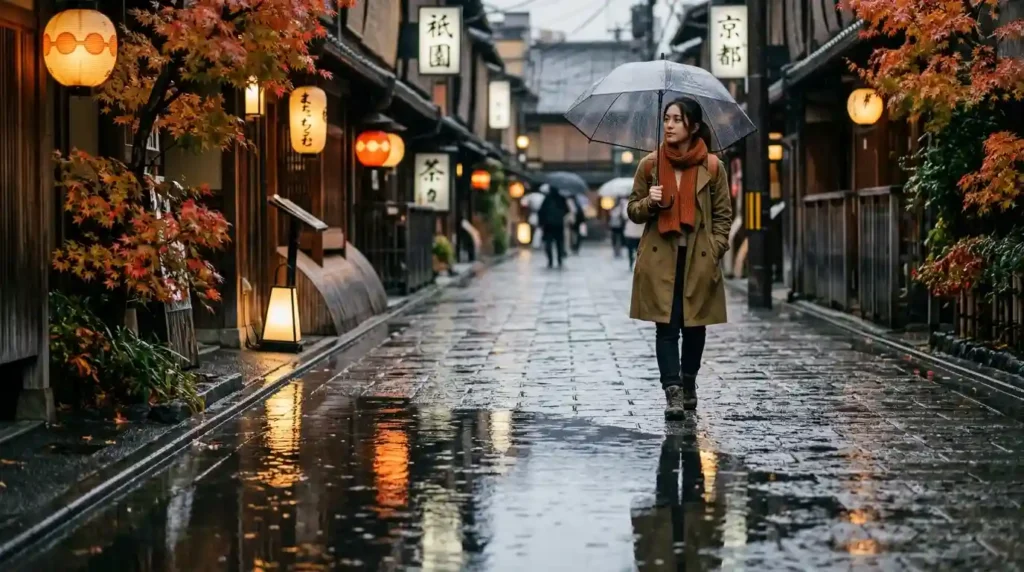
The flower and the streetlights are not merely background details. They place the changing season and a heart that has not yet moved on within the same scene.
Then the phrase “you, who will never return” connects the landscape before her with the person she has lost. Whether she looks at the rain, the flower, or the city, every sight eventually leads her back to the fact that he is no longer there.
Lyrics That Place Emotion Inside the Landscape
“Nokoribi” does not measure the depth of sorrow through direct explanation. Instead, the woman’s feelings are revealed through changes in what she sees: rain, an autumn flower, blue light, and faded leaves.
As a result, listeners are not simply told how she feels. They are placed beside her, looking at the same view. Emotion and landscape are not presented separately; they form a single world from the beginning.
What the Title “Nokoribi” Means
Heat After the Flame Has Disappeared
A lingering ember is the heat that remains in ash or half-burned wood after the visible flame has vanished. From the outside, the fire may seem finished, yet its nature still survives within.

The title also allows us to separate the end of the relationship from what remains in her heart. The relationship belongs to the past, but the fact that she loved him did not disappear at the same moment.
If the visible flame represents the time they shared, the remaining heat is the sensation that continues after she is alone. Mayumi Itsuwa places that nearly invisible state at the center of the song.
Burning Fallen Leaves in Search of Warmth
In the song, faded leaves are burned by the lingering embers of love. Those leaves once grew on branches and passed through the season before falling to the ground.
As she burns them, the woman searches for the warmth of days that have already passed. The scene suggests an attempt to confirm once more what those days meant to her.
Yet leaves placed in a fire can never return to their original form. By burning them, she verifies that they once existed while also causing their shape to disappear.
The desire to bring memories back within reach and the knowledge that she must eventually release them are both contained in this single image.
A Lost Child Dancing with the Seasons
Time That Does Not Move by Willpower Alone
In this song, people are portrayed as lost children dancing with the seasons. We may believe that we choose our own direction, yet a change of season can suddenly return something we thought we had forgotten.
Temperature, rain, wind, scent, and the color of light become tied to earlier events. When the same season comes again, a scene or a voice from long ago can return as a present sensation.

A year may pass, and daily life and relationships may change. The heart, however, does not follow the calendar with the same precision. When outer time and inner time fail to match, people can lose their sense of where they stand.
The phrase “lost child” does not describe helplessness alone. It captures a person who is still searching for a direction while being repeatedly drawn back into the past by the seasons.
What an Old Scar Leaves Behind
What remains in her chest is not a fresh wound but an old scar. That distinction tells us that a certain amount of time has already passed since the separation.
A wound may close, but its trace does not necessarily vanish. A scar is less the pain itself than evidence that something once happened.
Her feelings no longer cover every part of her present life. Even so, she cannot pretend that something carved into her life never existed.
Cold Tears and the Hope for Spring
The Feeling That Even Tears Cannot Be Relied Upon
The song speaks of cold tears waiting for spring. It is the first moment in a story that began in autumn rain when a season that has not yet arrived is brought into view.
Spring suggests a new beginning, but the woman has not reached it. Her present remains autumn, and the scar is still there.
Even her tears are not treated as a dependable companion. They are more like a passing friend encountered along the road. Crying will not end everything, and continuing to cry will not carry her to the next place.
Sorrow will not choose a life on her behalf. Where she goes after the tears is something she must decide for herself.
Setting a Small Boat on Rough Water
The Scene Moves from the City to the Sea
In the second half, the setting shifts from a rainy city to a rough sea. The woman, who had remained still and watched the world around her, now prepares to set a small boat afloat.
A small boat is not a vessel that guarantees safe passage across troubled water. It does not have the stability of a large ship, nor can it promise to protect her until she reaches her destination.
Even so, launching it means choosing to leave the shore. Rather than waiting for the lost person to return, she begins to move away from where she has been standing.
This woman does not depart after putting every feeling in order. She goes out onto uncertain water while still carrying both the scar and the lingering ember.

What the Rough Waves Suggest About the Life Ahead
The water before her is not calm. It is described as the rough waves of the returning seasons. Nothing in the song promises that the days ahead will necessarily bring happiness.
Still, she chooses to launch her own boat rather than remain on shore merely to avoid further pain. At this point, the song changes from recollection to action.
The Meaning of “Forgetting You”
Turning Toward Someone He Does Not Know
The woman imagines a future in which she seeks closeness with someone unknown to “you.” What matters is that this person has no connection to the man from her past.
Among people who know them both, or in places linked to their shared memories, she would never be entirely free from the former relationship. To enter another world, she may need someone who knows nothing of what came before.
The song does not say that a new romance will definitely begin. The image of leaning on someone remains only one possible scene within a future that has not yet taken shape.
Forgetting Is Not Erasure
At the end of the song, the woman repeats that she will forget him. Yet the old scar remains, and so does the lingering ember of love.
For that reason, “forgetting” is difficult to interpret as the complete removal of memory. It sounds closer to a decision not to let those memories determine every choice she makes from now on.

She does not deny that she loved him. Instead, she separates her future course from the relationship they once had. By repeating the same words, she tries to make that decision firm within herself.
The Inner Movement Created by Her Voice
A Low, Restrained Opening
Mayumi Itsuwa does not raise her voice dramatically at the beginning. She follows the rain-soaked flower and the blue-blurred city lights one by one in a calm, controlled tone.
Her singing sounds less like an appeal to another person than a quiet act of confirming what she herself can see. Because she does not force the words forward, the heat remaining deep inside becomes more distinct.
The surface is still, but there is tension and firmness beneath the voice. That condition mirrors a lingering ember that retains heat without producing a visible flame.
The Force of Decision in the Second Half
When the small boat appears, her voice gradually begins to face forward. She does not explode with emotion. Instead, she confirms each word while giving shape to the choice she is making.
The declaration that she will forget him contains not only resolve but also hesitation that has not disappeared. Because this is not the voice of someone who has completely detached herself, the repetition carries genuine urgency.

Mayumi Itsuwa does not portray a woman who has conquered every doubt. She lets us hear the voice of someone who still hesitates and nevertheless launches the boat.
Why I Chose It as No. 9
The Scenery Moves the Story Forward
In “Nokoribi,” rain, flowers, city lights, fallen leaves, tears, and a small boat appear in sequence, each taking on a different role. The images in the first half reflect a person who cannot yet leave a past love behind, while the small boat in the second half expresses the will to choose another direction.

What stands out most is the way the story advances through changes in scenery rather than lengthy explanations of emotion. The person who began in a rainy city eventually turns toward rough water. That movement gives the song a clear point of departure and a clear destination.
I chose “Nokoribi” as No. 9 because it does not close with the feeling of lost love alone. Through a sequence of images, it carries one person all the way to a decision.
In Closing
What remains most strongly after listening to “Nokoribi” is not simply the difficulty of forgetting. It is the sense that a person can choose another place even while carrying what remains in the heart.
One does not always move forward after everything has been neatly resolved. Sometimes a person moves while still carrying what cannot be put in order. “Nokoribi” portrays that deeply human decision with quiet but unmistakable strength.


音楽ファン同士の交流・リクエストはこちら / Connect & Request Songs Here