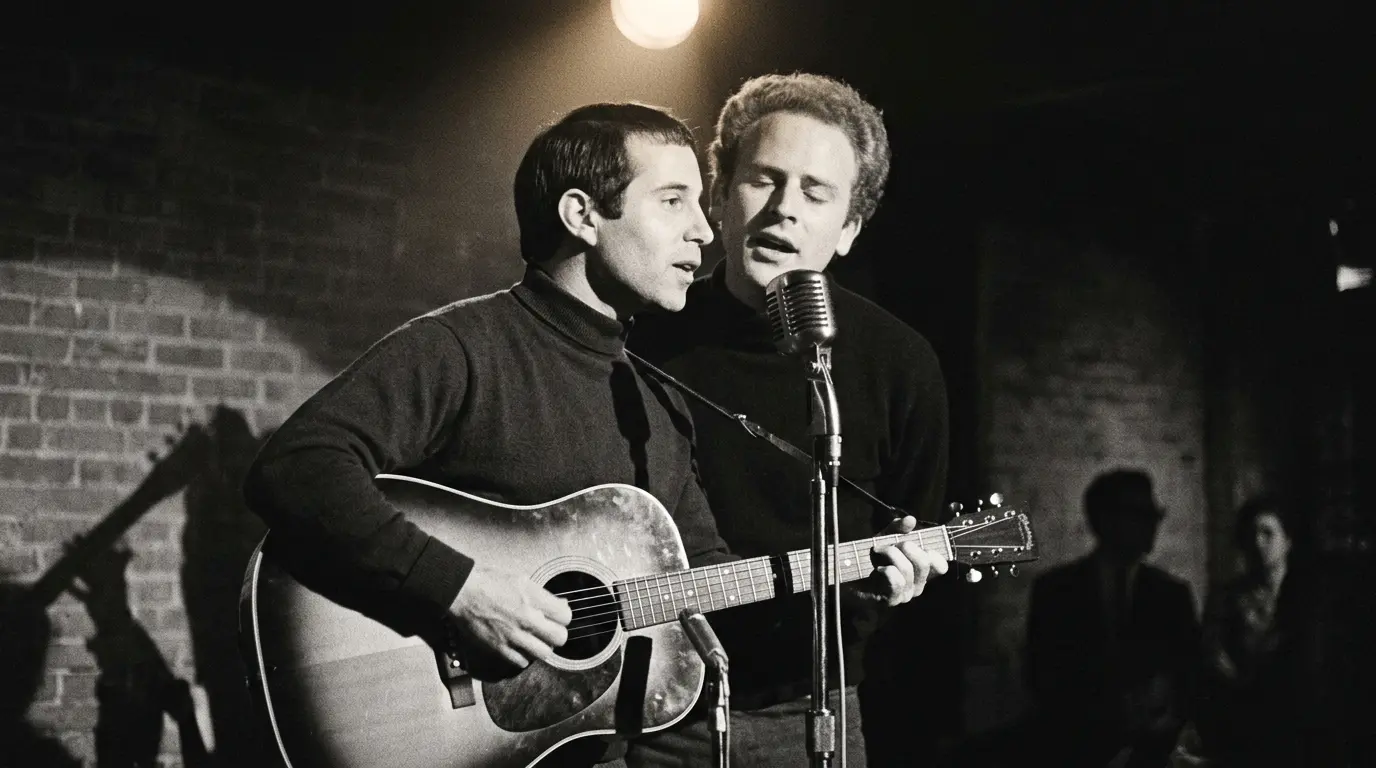
Simon & Garfunkel’s history is available here!
- 🎧 Enjoy This Article in Audio
- No. 4 is “Mrs. Robinson.”
- 🎥 As always, let us begin with the official YouTube videos.
- A Cheerful Guitar Sound with an Underlying Restlessness
- The Completed Song That Grew from Fragments in The Graduate
- The Other Face of Kindly Words
- The Studio Recording and the Central Park Performance
- Why I Ranked It No. 4
- In Closing
🎧 Enjoy This Article in Audio
Listen to a concise narration covering the main points of this article.
Recommended for anyone who would like to understand the appeal of “Mrs. Robinson” and the overall flow of the article before reading.
🎵 English Narration
An English audio introduction to the content of this article.
🎶 Japanese Narration
A Japanese audio introduction to the content of this article.
Listening first will make it easier to grasp the world of “Mrs. Robinson” and the article’s main points.
No. 4 is “Mrs. Robinson.”
“Mrs. Robinson” appeared on Simon & Garfunkel’s fourth studio album, Bookends, released on April 3, 1968. The song was also released as a single later that year.
It reached No. 1 on the U.S. charts and won Record of the Year and Best Contemporary Pop Performance at the 1969 Grammy Awards. Moving beyond its association with the film The Graduate, it became one of the defining songs of Simon & Garfunkel.
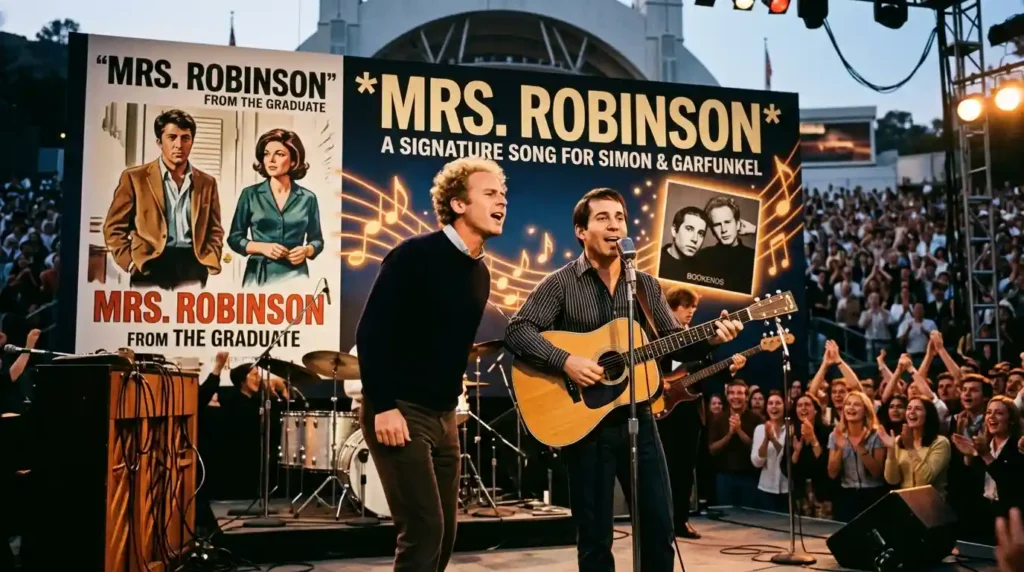
The acoustic guitar immediately leaps from the speakers, followed by a brisk rhythm and the bright, buoyant sound of their two voices. What first drew me to the song was not the social criticism hidden in the lyrics, but the music itself—music that makes the body move and invites the listener to sing along.
Yet when I later traced the meaning of the words, I began to see secrets concealed behind a well-ordered household and a society that tries to classify people under the guise of kindness. The cheerful sound and the unsettling implications of the lyrics maintain an extraordinary balance.
A Free Interpretation
Even a life greeted with smiles and blessings may conceal loneliness and secrets that cannot be revealed.
The sympathetic eyes surrounding us do not always represent genuine understanding.
Still, people carry on through each day as though nothing is wrong.
Mrs. Robinson—what lies hidden behind that smile?
🎥 As always, let us begin with the official YouTube videos.
Common Credits
Song: Mrs. Robinson
Artist: Simon & Garfunkel
Written and composed by: Paul Simon
Vocals: Paul Simon and Art Garfunkel
Official channel: Simon & Garfunkel
Original album: Bookends (1968)
Related film: The Graduate
① Original Studio Version
Video title: Simon & Garfunkel - Mrs. Robinson (Audio)
Recording: 1968 studio version
Produced by: Paul Simon, Art Garfunkel and Roy Halee
Two-Line Commentary
The quick guitar figures and springy rhythm give the song its instantly approachable pop appeal.
Beneath the bright harmonies, the unease hidden within family life and society gradually begins to emerge.
② The Concert in Central Park Version
Video title: Simon & Garfunkel - Mrs. Robinson (from The Concert in Central Park)
Recorded: September 19, 1981
Location: The Great Lawn, Central Park, New York City
Concert film: The Concert in Central Park
Two-Line Commentary
This historic performance captures the duo presenting one of their signature songs before an audience of more than half a million people.
The fuller band arrangement and the crowd’s response transform a song about private secrets into a shared anthem for an entire city.
A Cheerful Guitar Sound with an Underlying Restlessness
The first impression of “Mrs. Robinson” is shaped above all by the motion of its acoustic guitar. The notes move lightly between the lower and upper registers, repeating short phrases while continually carrying the song forward.
Although the arrangement is rooted in folk music, it is far removed from a tranquil solo performance. Guitar, bass and percussion interlock in small, precise units and never allow the song to stand still. As a result, even the bright melody contains the sensation of being hurried onward by something unseen.
For many years, I listened to the song as a lively and sophisticated piece of pop music. Even so, I always sensed that it was not entirely carefree. That impression may have come from the relentlessly moving rhythm and the slightly provocative tone of the singing.
The Harmony That Makes the Song So Approachable
The voices of Paul Simon and Art Garfunkel soften the song’s complicated subject matter. Rather than delivering the words with solemn intensity, they seem to exchange them with a hint of amusement, drawing the listener naturally into the music.
The chorus is especially memorable because language resembling a religious blessing is joined to vocal sounds whose musical pleasure arrives before their meaning. Even listeners who do not fully understand the English can remember the refrain and sing it naturally.
Once the meaning is followed more closely, however, the blessing no longer sounds like simple encouragement. Are the singers genuinely praying for her salvation, or are they offering ironic applause to a life burdened by secrets? The clear harmonies never force the listener to accept only one answer.

The Completed Song That Grew from Fragments in The Graduate
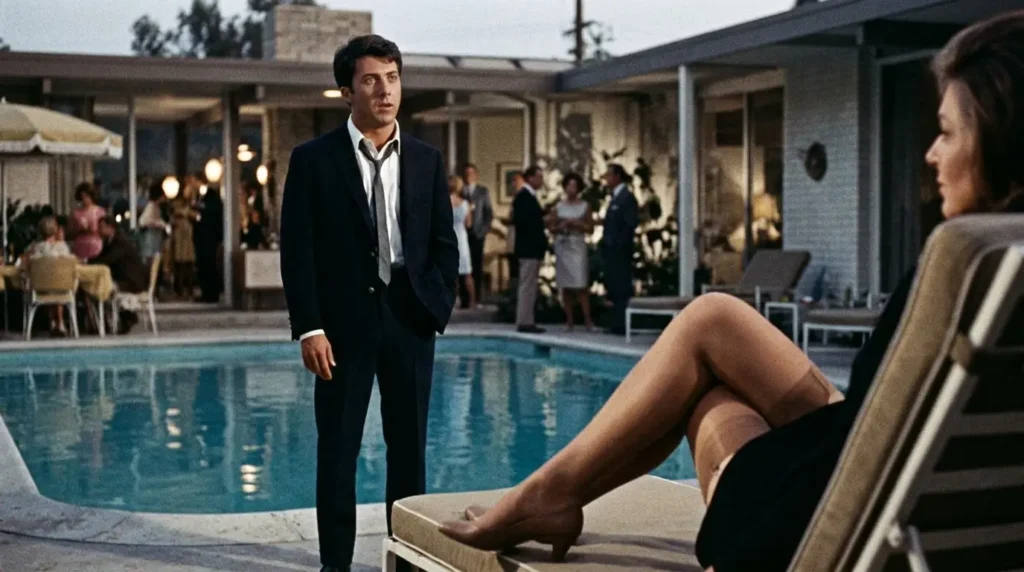
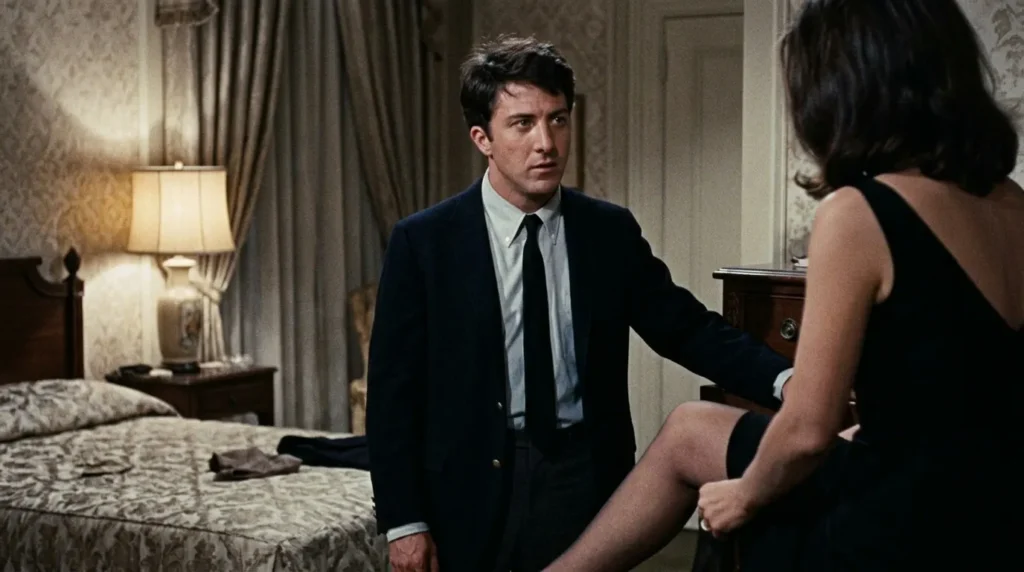
The connection with the film The Graduate is essential to any discussion of “Mrs. Robinson.” At the centre of the story are Benjamin, a young man who cannot find a direction after graduating from college, and Mrs. Robinson, the older married woman who seduces him.
The version heard in the film, however, was not identical to the completed recording later released as a single and included on Bookends. The movie used brief fragments of the song, which was subsequently re-recorded with additional lyrics and a fully developed structure.
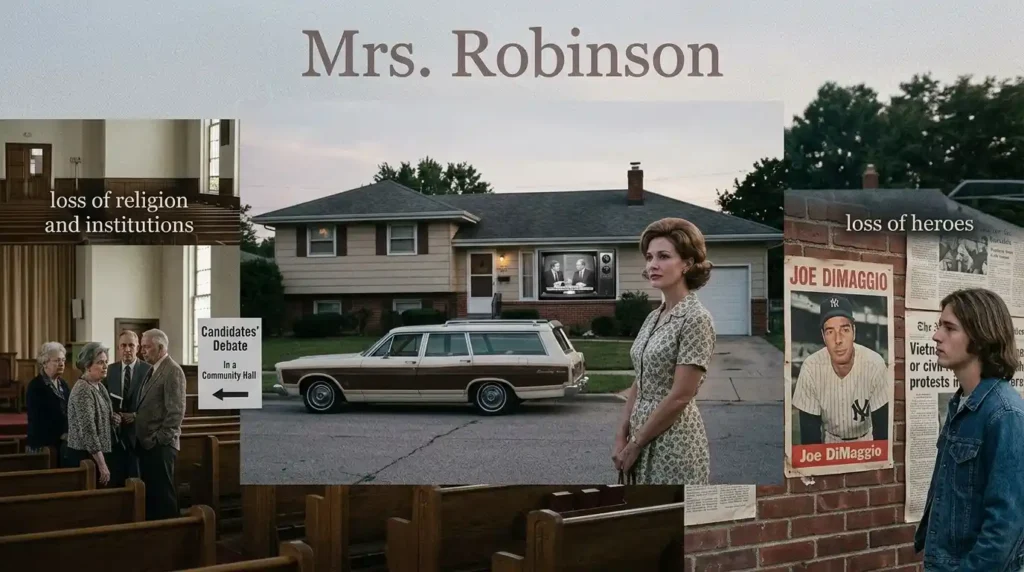
As a result, the completed version is no longer merely a song describing one character from the film. Using the name Mrs. Robinson as its point of departure, it widens its focus to the family, religion, social institutions and the disappearance of public heroes in late-1960s America.
Looking Beyond the Image of a Simple Villain
In the film, Mrs. Robinson betrays her husband and interferes with the relationship between Benjamin and her daughter. Judged solely by her actions, she can easily be seen as selfish and dangerous.
Yet although she appears to possess a comfortable home and family, she carries a profound disappointment with her own life. Her relationship with a younger man cannot recover the years she has lost; instead, it makes her isolation even more visible.
As I follow the implications of the song, Mrs. Robinson also begins to resemble a symbol of anyone who performs the happiness demanded by society while concealing different emotions within. Rather than blaming her alone, it may be more revealing to examine the kind of life that produced her.
The Other Face of Kindly Words
The lyrics include a proposal to learn about someone for official records and to help that person learn how to help herself. On the surface, these words sound like a gentle offer made to someone in distress.
Once the purpose of creating a record is introduced, however, the kindness takes on another meaning. Is the intention really to understand the individual, or to gather information, classify her and make her easier to manage? Even the sympathetic eyes surrounding her begin to resemble surveillance rather than compassion.
In late-1960s America, younger people were questioning established ideas involving the family, religion, education, business and politics. Rather than protesting through an openly confrontational performance, the song reveals the distance between institutions and individuals through the unease hidden inside polite language.
Secrets Hidden Deep Inside the Home
The song describes placing a secret somewhere no one ever goes and, above all, keeping it hidden from the children. The idea of storing a family problem alongside ordinary household items combines humour with unmistakable bitterness.
Instead of resolving the problem, the adults move it somewhere beyond public view and preserve the appearance of an orderly family. Their true feelings are suppressed in order to protect respectability. The lighter the music sounds, the more clearly the weight of what has been concealed can be felt.
The Studio Recording and the Central Park Performance
The Studio Version—Meticulously Constructed Lightness
In the 1968 studio recording, the guitar, rhythm and two voices each possess a clear outline, with every sound positioned for maximum effect. The arrangement has substance without becoming heavy, and it maintains its nimble momentum until the end.
The song does not begin by explaining its criticism of society. It first entertains the listener as music. Because of that order, the lyrics reveal an entirely different expression after repeated listening. Music and satire reinforce one another without either element diminishing the other.
The Central Park Version—A Song That Became Part of the City’s Memory
In the 1981 Central Park performance, the expanded band gives the rhythm greater force. The guitars travel across the vast outdoor setting, while the voices of Simon and Garfunkel possess a composure different from that heard in their younger studio recording.

With more than half a million people welcoming the duo’s major reunion, the function of the song also changed. What began as a work associated with characters from a film expanded into a piece of shared cultural memory that New Yorkers could sing together.
Even so, the doubts and irony within the lyrics do not disappear. The sight of an enormous crowd celebrating and the words describing a life hidden from others exist simultaneously, creating a contrast on a scale very different from that of the studio version.
Why I Ranked It No. 4
Simon & Garfunkel created songs that move the listener through quiet observation, as well as songs whose expansive vocals create a sense of grandeur. Among them, “Mrs. Robinson” is one of the clearest examples of their intelligence and accessibility working together.
- A guitar figure that remains in the ear after a single listen
- Harmonies that almost anyone can sing along with
- Questions about society concealed within a cheerful arrangement
- A musical identity strong enough to exist independently of the film
- The flexibility to flourish in a large-scale live performance
The song is immediately accessible, yet it never ends as something that can simply be heard and forgotten. It addresses serious matters without taking on the weight of a sermon or an academic argument. That exceptional control of form is why I placed it at No. 4.
In Closing
Whenever I hear “Mrs. Robinson,” I am still drawn first to the bouncing guitar and the vivid combination of their two voices. Even without knowing the film or the full meaning of the words, its power as an outstanding pop song has not diminished.
Once the lyrics are understood, however, the song reveals more than the story of a woman named Mrs. Robinson. It also opens onto people who conceal secrets behind orderly lives and systems that attempt to manage the individual. A familiar song begins to show a different landscape many years after I first came to love it.
Joy and unease, accessibility and sharp observation coexist naturally within the same recording. “Mrs. Robinson” demonstrates that Simon & Garfunkel were not only exceptional singers, but also artists capable of examining the age in which they lived.


音楽ファン同士の交流・リクエストはこちら / Connect & Request Songs Here