
The history of Kobukuro is…Click here!
- 🎧 Listen to This Article
- No. 8 Is “Ryusei”
- Listen on YouTube First
- A Song Born from the Drama’s Story
- The Irreplaceable Relationship Portrayed in “Ryusei”
- The Night Sky Created by Two Voices and the Arrangement
- The Urgency Reflected in the Light of a Shooting Star
- Its Place Among KOBUKURO’s Ballads
- Why I Chose It for No. 8
- In Closing
🎧 Listen to This Article
You can quickly explore the main points of this article through Japanese and English narration.
This audio introduction is recommended for readers who want to understand the atmosphere of “Ryusei” and the overall flow of the article before reading.
🎵 Japanese Narration
This audio presents the article in Japanese.
🎶 English Narration
This audio presents the article in English.
Listening before reading will help you grasp the emotional world of “Ryusei” and the main ideas of the article more easily.
No. 8 Is “Ryusei”
For No. 8 in My Personal Top 10 KOBUKURO Songs, I chose “Ryusei,” which means “Shooting Star” in English. Released on November 17, 2010, as the duo’s 19th single, it was later included on the album One Song From Two Hearts.
The song is widely known as the theme song for the Fuji TV drama Nagareboshi, but it also has the power to reach listeners deeply as a love song even if they have never seen the drama. Although it begins as a gentle ballad, the emotions it portrays are anything but calm.
There is the anxiety that grows as one cares more deeply for another person, the distance that cannot quite be closed despite the desire to draw nearer, and the hesitation that remains inside the wish to believe. These emotions are reflected in images of the moon shining on a winter sea and a streak of light crossing a dark night sky.
Even when two people in love are looking in the same direction, neither can know everything hidden inside the other’s heart. “Ryusei” is a song about continuing to choose that person while accepting the part of them that remains beyond reach.
The song neither promises a bright future nor foretells a tragic ending. In a night where no answer can be found, the determination not to let go of the relationship prevents the song from becoming merely a sweet love ballad.
A Free Interpretation
Even when we are apart, our hearts remain connected beneath the same night sky.
Though we carry wounds and uncertainty, my feelings for you will not disappear.
Because no one can take your place, I want you to entrust me with your weakness and even your lies.
Like shooting stars, we live while being drawn toward one another.
💡 You might also like: View the original Japanese lyrics (External site)
If the lyrics are available only in Japanese, you can use your browser’s translation feature or an AI translation tool to understand their general meaning.
Listen on YouTube First
Common Credits
Song: Ryusei
Artist: KOBUKURO
Lyrics and Music: Kentaro Kobuchi
Arrangement: KOBUKURO and Masanori Sasaji
Label: Warner Music Japan
KOBUKURO "Ryusei" Official Music Video
Video Type: Official music video
Channel: KOBUKURO Official Channel
Song Release Date: November 17, 2010
Tie-in: Theme song for the Fuji TV drama Nagareboshi
Two-Line Commentary
This official music video allows viewers to experience the delicate emotional world of "Ryusei" through images as well as sound.
Kentaro Kobuchi's finely shaded voice and Shunsuke Kuroda's expansive singing convey the urgency of loving someone while still carrying uncertainty.
"Ryusei" Live Audio
Video Type: Officially provided YouTube audio
Source Release: KOBUKURO LIVE TOUR 2013 "One Song From Two Hearts" FINAL at Kyocera Dome Osaka
Provided by: Warner Music Japan
Performance Type: Live version
Two-Line Commentary
This live recording captures "Ryusei" as performed at Kyocera Dome Osaka, allowing listeners to hear the duo's voices reaching across the vast venue. Compared with the studio version, the vocal dynamics and emotion come further forward, and the growing harmony toward the end leaves a powerful impression.
A Song Born from the Drama’s Story
“Ryusei” was created in close connection with the story of the Fuji TV drama Nagareboshi.
From Jellyfish to Space, and Then to a Shooting Star
After reading the drama’s script, KOBUKURO focused on the aquarium that serves as an important setting in the story and the jellyfish drifting there.
Kentaro Kobuchi expanded the image of jellyfish slowly drifting through the water into images of space and the stars, and named the song “Ryusei.” The sensation of floating underwater and the sight of light crossing the night sky come together within a single musical world.

On the drama side, lead actor Yutaka Takenouchi had also spoken of imagining jellyfish as shooting stars since childhood. It has been reported that, after learning the title of the theme song, the production team chose Nagareboshi as the title of the drama.
The song and drama were not simply paired after both had been completed. Each work took shape while sharing the same central image.
A Relationship That Begins as a Contract
In the drama, a man trying to save his seriously ill younger sister enters into a contract marriage with a woman burdened by debt.
A relationship that begins from mutual necessity gradually gives rise to emotions that cannot be reduced to calculation. Yet the birth of affection does not mean that every problem before them can suddenly be solved.
A Reality That Love Alone Cannot Overcome
Some realities cannot be changed through goodwill alone, and a decision intended to save one person may wound someone else.
“Ryusei” likewise does not portray love as an all-powerful force. Perhaps nothing can be done. Even so, the singer does not want to leave the side of the person who is suffering.
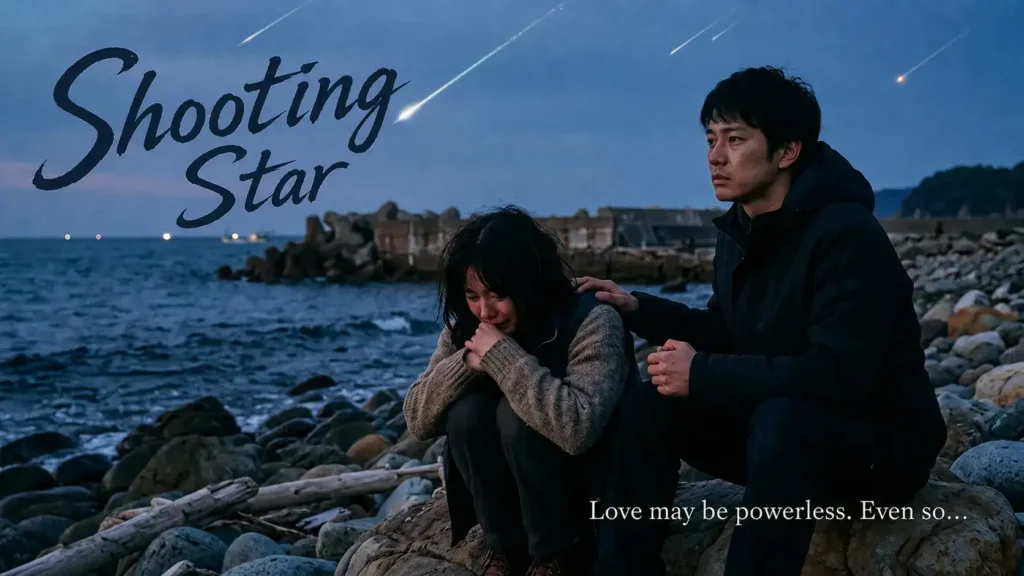
At that point, the circumstances of the drama’s characters and the awkward wish expressed in the song begin to overlap.
The Irreplaceable Relationship Portrayed in “Ryusei”
At the heart of the song is a form of love that does not choose someone according to conditions, but accepts that person as someone who cannot be replaced by anyone else.
Love Cannot Be Decided by Comparing Qualities
Someone more beautiful or even kinder than the person one loves may appear.
If romance were judged by comparing conditions, choosing the person who seems better suited to oneself might appear reasonable. Yet feelings for another person are not determined by such a ranking.
A person is formed not only by strengths, but also by hesitation, weakness, and the parts that are difficult to put into words. Even if someone else shares the same virtues, that person cannot replace the one with whom memories have already been shared.
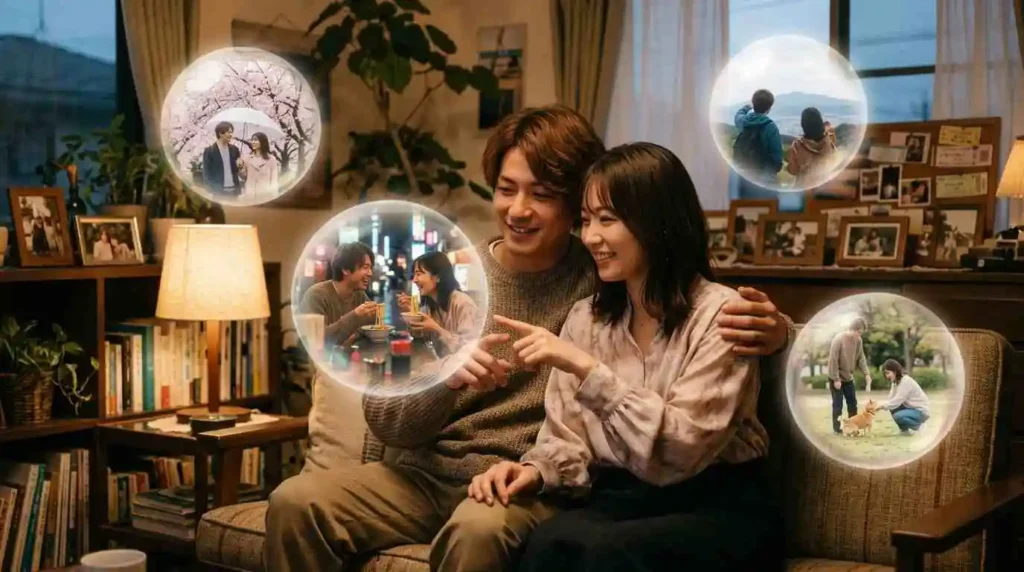
Perhaps love is not the search for the most exceptional person, but the continuing choice of the one person who has no substitute.
What “The Same Constellation” Suggests
The phrase “the same constellation” does not seem to mean that two people must come to share the same personality or the same way of thinking.
The stars in the night sky each occupy a different place. Yet when people connect one star to another with imagined lines, they begin to appear as a single constellation.
Creating One Relationship While Remaining Different
There is no need to become the same person as the one you love.
Even when two people think differently and cannot share every word, a relationship can still be created through one another’s presence. Different people retain their differences while forming a single shape together. That idea expresses the view of love at the center of “Ryusei.”
Believing Does Not Mean That Doubt Disappears
No matter how close a relationship becomes, there are parts of the human heart that remain beyond words.
Some emotions cannot be explained even by the person who feels them. Some things remain unspoken to avoid hurting someone, while other forms of uncertainty have not yet taken shape clearly enough to be expressed.

No One Can See Everything Inside Another Person
The speaker in “Ryusei” does not try to force those hidden parts into the open.
Instead, he asks the other person to entrust them to him and tries to say that they need not be carried alone.
The trust described here is not a state free from all uncertainty. There is no way to prove whether every word is true, what the future will bring, or whether the two people will remain together until the end.
Choosing Not to Let Go
Belief does not begin only after hesitation has disappeared.
Even after the heart has been shaken, one can still decide that the relationship in the present has meaning. One can choose not to release the bond. That choice gives the song its strength.
The Night Sky Created by Two Voices and the Arrangement
The world of “Ryusei” is supported by more than its lyrics.
The piano-led opening, the expansion of the strings, and two voices with different qualities create a sense of depth like looking upward into the night sky.

An Arrangement That Supports the Emotional Expansion
The arrangement was created by KOBUKURO and Masanori Sasaji.
The structure begins with restraint and gradually layers the voices and instruments toward the latter half, naturally conveying the growth of feelings that have been held within.
Two Voices Create a Feeling That Is Almost Within Reach
In “Ryusei,” Kentaro Kobuchi’s voice conveys the subtle movement of the words, while Shunsuke Kuroda’s singing receives that emotion and carries it into a broader melodic line.
What matters in this song, however, is not simply the contrast between the two voices. As the song moves from a first half that handles each word carefully into a latter half where emotion can no longer be contained, the way the voices overlap also changes.
Through that change, a relationship in which two people long to draw closer but cannot quite reach one another is communicated not through explanation, but through the movement of the song itself.
The Urgency Reflected in the Light of a Shooting Star
The sight of a shooting star recalls the familiar idea of making a wish before its light disappears.
In this song, however, the shooting star seems to be more than a symbol used to make wishes come true.
What a Momentary Light Suggests
A shooting star crosses the night sky for only a moment and then disappears from sight.
Its brief trail of light seems to overlap with the urgency of two people trying to move toward one another.
Words That Must Be Delivered Before the Light Disappears
The light of a shooting star does not remain in one place forever.
That is why there are words one wants to deliver before the relationship changes. There are feelings that must be expressed before the other person moves too far away.
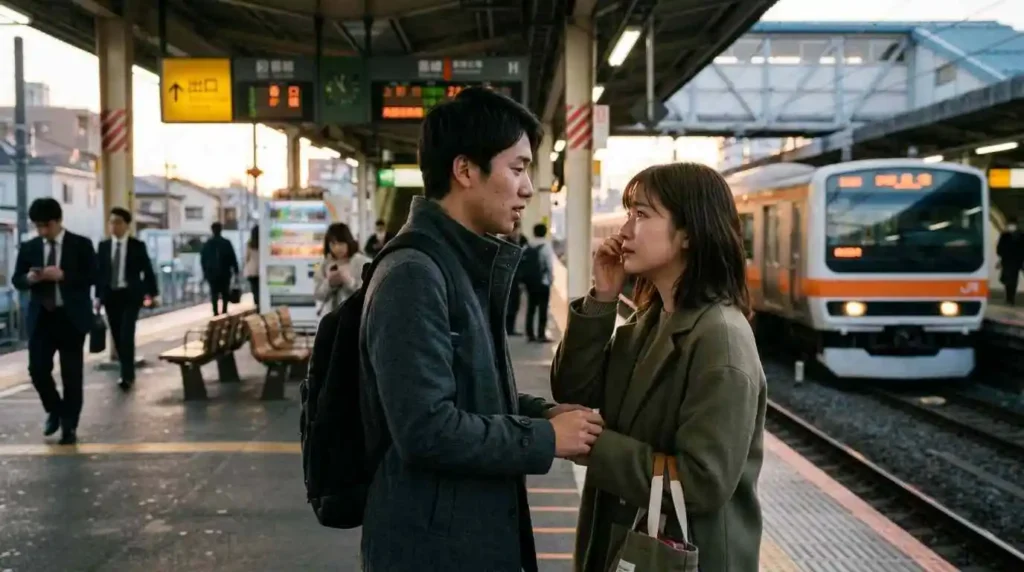
“Ryusei” does not portray a love that has already reached stable happiness. It portrays someone who understands the possibility of loss and still turns toward the person they love.
A Shooting Star Is More Than a Symbol of a Wish
The point is not that the light has value simply because it is brief.
Because it can be seen for only a limited time, the viewer cannot help following where the light came from and where it is going. In the same way, we listen while watching the uncertain future of the relationship as though tracing a light across the night sky.
Its Place Among KOBUKURO’s Ballads
KOBUKURO has many representative ballads dealing with separation, loss, and memory, including “Sakura,” “Tsubomi,” and “Akai Ito.”
“Ryusei” belongs to the same lineage of ballads, but the direction of time within the song is different.
How It Differs from “Tsubomi” and “Akai Ito”
In “Tsubomi,” feelings for someone who has been lost are portrayed through the present looking back toward the past.
In “Akai Ito,” a story unfolds in which time spent apart allows the characters to confirm what they feel for one another.
Not the Past, but a Relationship Still in Motion
Compared with those songs, the center of “Ryusei” is not a recollection of the past, but a relationship that is still wavering in the present.

The song never states whether the two people will eventually be united or move forward on separate paths. It sings most strongly only of the fact that, at this moment, each still needs the other.
A Love Song That Does Not Rush Toward a Conclusion
I am drawn to the song because it does not hurry toward a conclusion.
It does not divide romance neatly into fulfillment or separation, but portrays the time before an answer has been reached. That unfinished state is what makes me want to listen to “Ryusei” again and again.
Why I Chose It for No. 8
I chose “Ryusei” for No. 8 because its beautiful melody and the emotions of two people whose relationship remains unsettled are joined naturally within a single song.
The Title, Lyrics, Arrangement, and Drama Form a Single Line
The title, lyrics, arrangement, two voices, and the drama’s story do not scatter in different directions.
The idea moves along a single line: from jellyfish drifting underwater to space, from the stars to a shooting star, and from the shooting star to two people who remain apart.
Portraying a Present That Has Not Yet Reached an Answer
Even among KOBUKURO’s representative ballads, this song does not look back on what has already been lost. Instead, it portrays a present that has not yet reached an answer.
Unable either to believe completely or to give up, the song contains the feelings of someone standing between those two states without turning them into something more beautiful than they are.
A Song That Makes Full Use of KOBUKURO’s Two Voices
There are songs ranked above “Ryusei” that are more widely known or more strongly connected with my own memories.
Even so, I placed “Ryusei” at No. 8 because it allows listeners to experience both the appeal of KOBUKURO’s contrasting voices and the complexity of romantic love within the same work.
In Closing
“Ryusei” offers neither the conclusion of a love fulfilled nor the finality of a separation accepted.
What remains is the will to keep moving toward the other person.
That is why the song fits neither the category of a happy love song nor that of a sorrowful farewell. It resonates as a song for anyone who continues to care for someone while facing a night in which no answer can yet be seen.

Distant stars shine from separate places. Yet to the person looking upward, they may still appear connected as a single constellation.
Even when two people cannot understand everything about one another and cannot become the same person, they can still create one relationship. That idea lies at the foundation of “Ryusei.”
The light crossing the dark sky eventually disappears.
Yet even after the light is gone, the memory of its path does not vanish from the person who saw it. In the same way, “Ryusei” does not provide an answer. Instead, it leaves within the listener the memory of the time spent continuing to care for someone.

音楽ファン同士の交流・リクエストはこちら / Connect & Request Songs Here