
Click here for Yosui Inoue’s History!
- 🎧 Enjoy This Article in Audio
- No. 2 is “Shiroi Ichinichi” (A White Day).
- First, Please Listen to the YouTube Videos
- An Untouchable Distance Creating Silence in the Room
- A Unique Landscape Born from the Harmony of Words and Music
- Bridging 50 Years: Memories Awakened by Yosui’s Singing Voice
- Overwriting Youthful Memories: The Resonance of Yosui’s Version
- Closing Thoughts
🎧 Enjoy This Article in Audio
You can quickly grasp the main points of this article through narration.
Recommended for those who want to catch the vibe of the music and the flow of the article before reading.
🎶 English Narration
An English audio introduction to the contents of this article.
⌛ Duration: Approx. 4.5 mins
🎵 Japanese Narration
A Japanese audio introduction to the contents of this article.
⌛ Duration: Approx. 4 mins
Listening to the audio before reading helps you better understand the world of the music and the main points of the article.
No. 2 is “Shiroi Ichinichi” (A White Day).
Released in 1973, the album “Ice World” (Koori no Sekai) left a massive footprint on the history of Japanese music. Amidst its dense and intense tracks, this song exists quietly, almost hidden, yet radiating a certain, undeniable presence.
This piece was born from a unique collaboration in the folk scene of that era, featuring lyrics by Kei Ogura and music by Yosui Inoue.
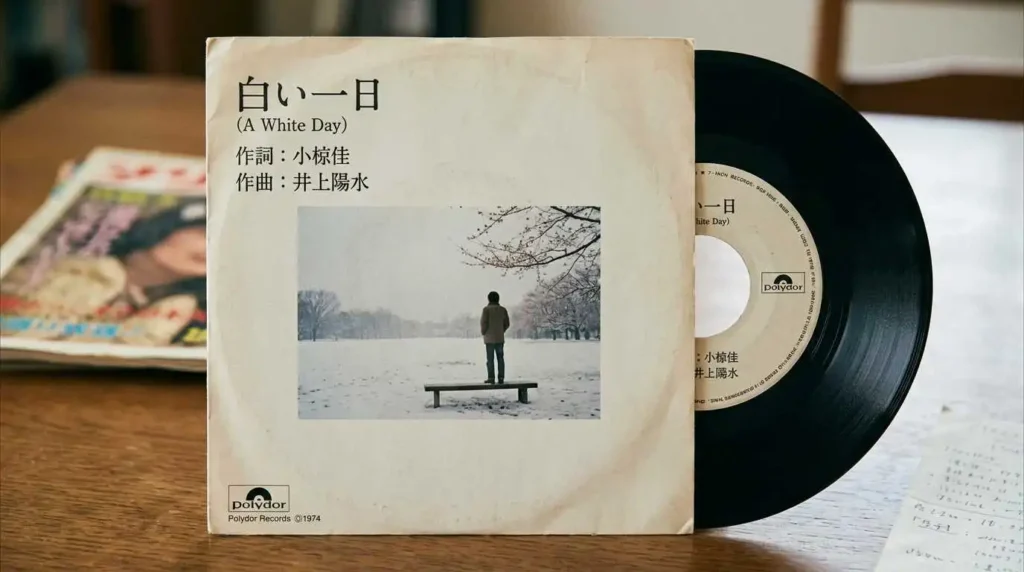
Unlike the sharp or abstract words Yosui usually spins himself, the world presented here is extremely neat and orderly, as if a fragment of daily life was captured raw. Yet, the moment it is sung by Yosui’s signature voice, a mysterious, vivid reality rises up, transcending simple imagery.
There are no grand expressions of love, nor do any dramatic events unfold. It simply contemplates the relationship between two people in a room and the blunt, indifferent passage of time flowing around them.
English Translation of the Lyrics
Like white ceramic, you sit there in silence.
I try to write a letter, but the words just won't come out right.
Even while waiting for the train to pass at the crossing, just having you by my side fills the time.
So for now, rather than saying anything, I just want to gently hold your shoulder.
💡 Also Read: Click here for the official original lyrics (Opens in an external site)
If the lyrics are displayed only in Japanese, you can use your browser’s translation feature or an AI translation tool to understand the general meaning.
First, Please Listen to the YouTube Videos
Common Credits
Song Title: Shiroi Ichinichi (A White Day)
Vocal: Yosui Inoue
Lyrics: Kei Ogura
Composition: Yosui Inoue
Album: "Ice World" (Koori no Sekai)
Release: December 1973
Label: Polydor Records

"Shiroi Ichinichi" is a song written by Kei Ogura and composed by Yosui Inoue.
It is included in Yosui Inoue's representative album "Ice World," standing out as a track that portrays intimacy and quiet moments rather than intense passion.

White ceramic, an old-fashioned letter, a railroad crossing, a barrier gate, a passing train.
Instead of acting as descriptive scenery, these words are placed like fragmented images remaining in the protagonist's mind.
The charm of this song lies in how a "day where nothing happens" transforms into an unforgettable time simply because of "your" presence.
First is the studio recorded version. Please click the image below.
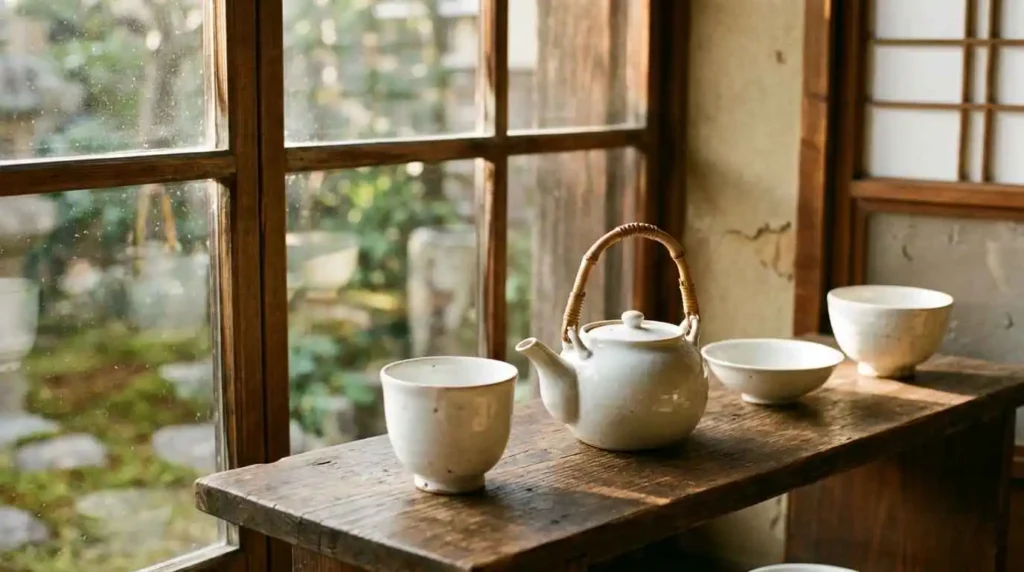
Studio Recorded Version ("The Origin of the Song")
This studio track is arranged with a minimalist set of instruments: an acoustic guitar, a bass, and a faintly echoing keyboard.
Yosui delivers the song calmly in a murmuring low register without ever raising his voice.
Because of this, the protagonist's helplessness in being "unable to find the right words" and the silence filling their room are conveyed directly from the record grooves in this brilliant early performance.
Next is a live version featuring an onstage talk. Please click the image below.
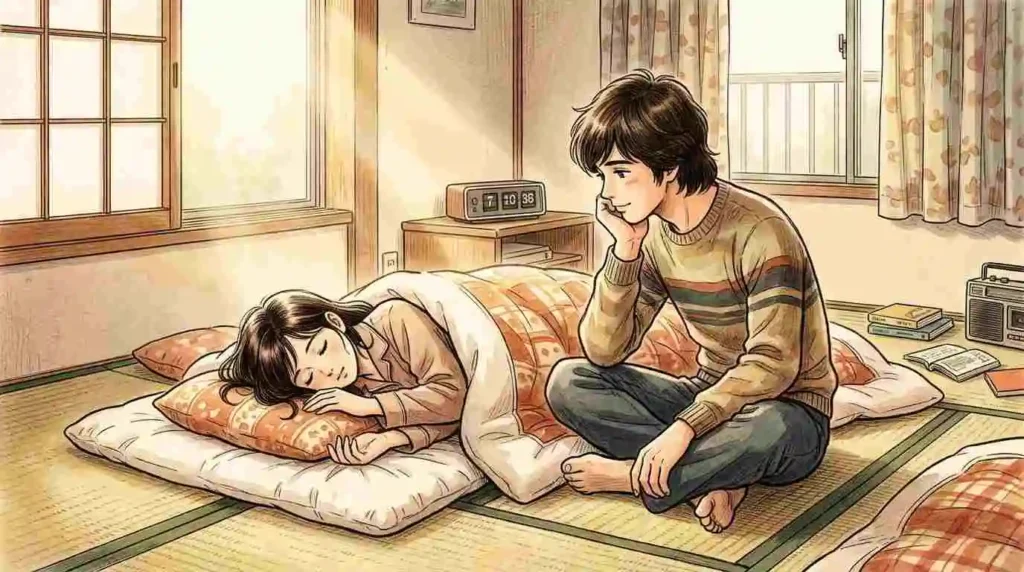
Live Version with Onstage Talk
Judging from the visual atmosphere, this video appears to feature a live performance by Yosui Inoue in his mid-30s.
Unlike the studio recording, this rendition allows you to savor the singer's breathing and the spaces between the notes.
"Shiroi Ichinichi" is not a song driven by dramatic sonic progressions.
When heard live, words like "white ceramic," "old-fashioned letter," "barrier gate," and "train" resonate much closer, enveloped in the singer's breath and pauses.
Please experience the difference between a polished studio track and a vocal performance conjured right on the spot.
Next is a live version from his later years. Please click the image below.
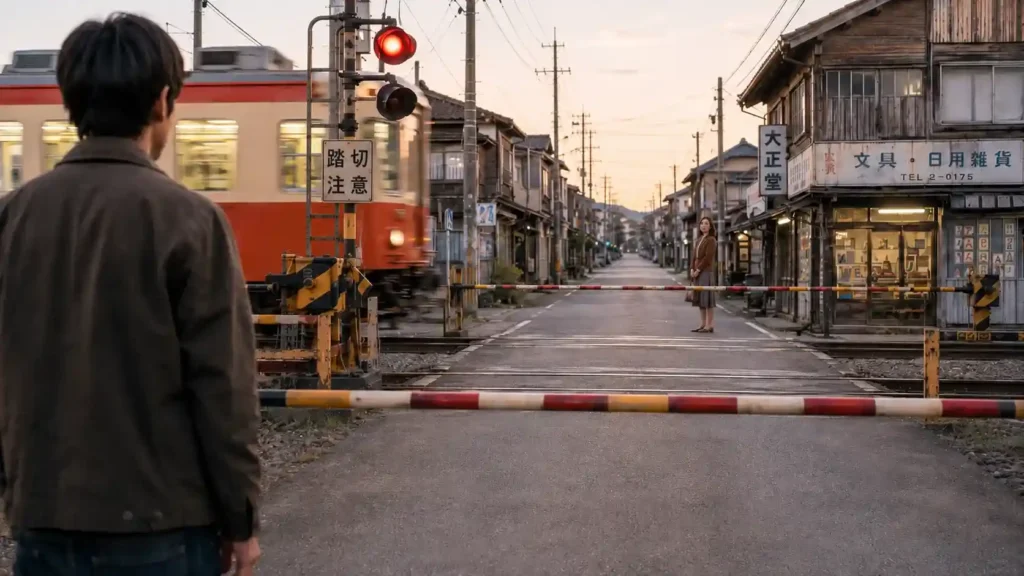
Later Years Live Version
This live video comes from a later period than the second one. The visual impression suggests a vocal performance by Yosui Inoue in his late 40s or early 50s.
In this live rendition, the sensation of a day slipping away around "you," the frustration of failing to write a letter, and the quiet gaze fixed on "you" across the railroad crossing press much closer to the heart.
The accumulation of these small vignettes shapes the protagonist's underlying earnestness.
It is a performance where the emotional ripples feel slightly more raw than the studio version.
(Note: For videos that are not officially distributed, this blog avoids direct embedding out of respect for copyright compliance. Instead, we use custom images that link to the external hosting platforms.)
An Untouchable Distance Creating Silence in the Room
Permeating this entire song is a sense of distance between the protagonist and “you” — a gap that cannot be easily closed.
The stage is a quiet room. A scene unfolds where nothing particular happens; the protagonist simply gazes at the partner.
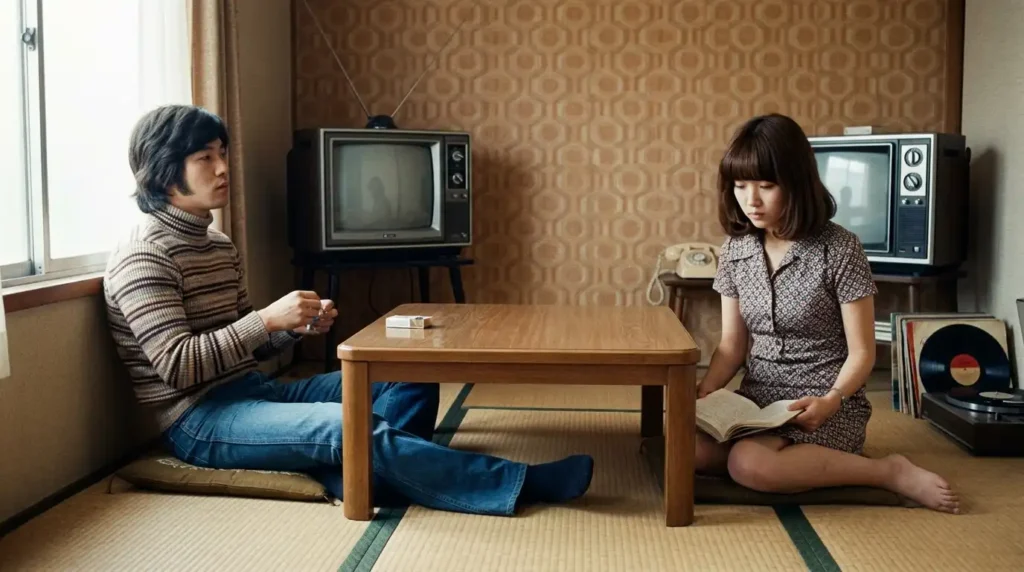
Despite being so close to each other, the protagonist harbors feelings that cannot be expressed face-to-face and tries to sit at the desk to write a letter. However, because the person is right there, the protagonist becomes overly self-conscious and cannot write smoothly. Within this awkward relationship, the immovable emotional distance between the two and the unutterable ripples of feeling are mirrored exactly as they are.
Just your own time slipping away around your partner.
This feels like the hesitation born of youth. At the same time, it captures the reality of a wordless moment where one’s inner self is fully satisfied just by sharing the same space with the other person.
There is a strange, dense concentration found here, where a day in which nothing happens just flows along on its own.
A Unique Landscape Born from the Harmony of Words and Music
What deserves attention here is how Yosui paired his melody and vocals with the highly literary, refined lyrics penned by Kei Ogura, who wrote the words for this song.
The world Ogura creates would normally feel more peaceful, carrying the detached perspective of a mature adult. However, Yosui’s singing voice seems to expose the underlying “unfulfilled longing” and “inner restlessness” hidden behind those serene lines.
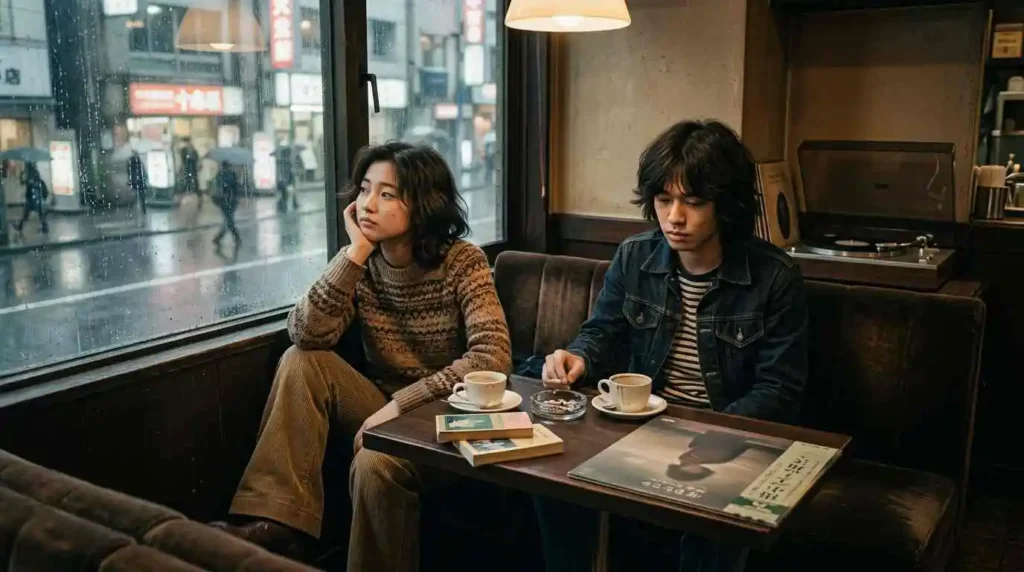
Carried by the simple plucking of a folk guitar, a vocal delivery that places each word down one by one transmits a quiet tension to the listener.
The phrase “pure white ceramic” appearing in the lyrics seems to symbolize something that stands beautifully before us, yet feels cold to the touch and fragile. The protagonist can do nothing but watch it.
This inability to take a step toward the partner forms the unique atmosphere and beauty that drifts through the entire track. It can be said that Yosui’s melody infuses the song with an earnest, tactile reality that prevents it from dissolving into just another beautiful, nostalgic love story.
The Railroad Crossing Landscape and Premonitions of Change
The narrative shifts from the room to the outside world during the railroad crossing scene in the middle of the song. The scenery depicted here brings a subtle shift to the two individuals’ frozen time.
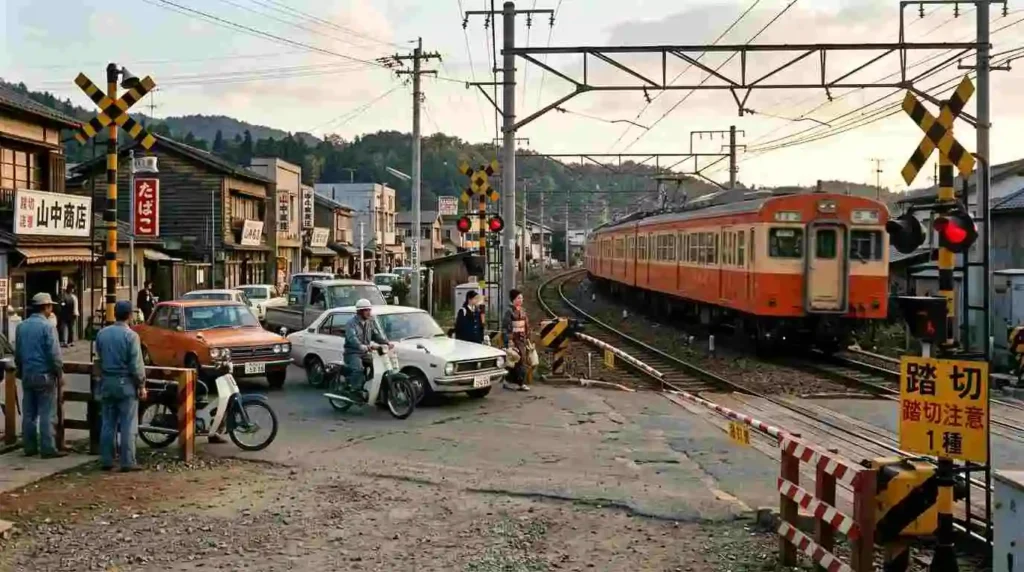
- The distance between the protagonist on this side and “you” standing on the far side of the crossing
- The motion of the train passing with a roar, cutting off their line of sight
- The figure of “you” turning around toward this side as the gate rises
As the train rattles past, “you” turn around just as the barrier gate goes up. Looking at that figure, the protagonist projects a premonition: “She must already have the face of an adult.”
From the presence of “you” appearing right in front of him once the separation of the gate vanishes, the protagonist intuitively senses a transformation — a feeling that she is slipping away into a distant world different from the person he once knew.
Precisely because no concrete words are spoken between them, the melancholy that strikes the protagonist in that fleeting moment reaches straight into the listener’s heart.
Bridging 50 Years: Memories Awakened by Yosui’s Singing Voice
From here, I would like to spend the latter half of this piece reflecting on my personal memories and how this track has intersected with my own life journey.
Truth be told, my first encounter with the melody of “Shiroi Ichinichi” occurred a little before I ever heard Yosui’s own singing voice, on an autumn day when I was a freshman in high school.
The School Festival Stage and My Personal Genesis
The first time I heard that melody was at my high school’s cultural festival. On a simple stage put together by volunteers, my classmate Kaneko (forgive me for dropping the honorifics here!) held an acoustic guitar and sang this song alongside a few friends.
He was a handsome young man, possessed a great personality, and naturally drew attention from everyone around him.
The “Shiroi Ichinichi” they performed on stage was by no means a polished, professional rendition. Yet, the beauty of that unfamiliar melody cut straight into my heart through the fresh, raw resonance of an amateur band.
With the benefit of hindsight, I believe I received a distinct, quiet shock right then and there from the sheer musical brilliance radiating from this powerful combination: “Lyrics by Kei Ogura, Composition by Yosui Inoue.”
That sensation — the kind that takes root deep in your chest after just a single listen — marked the beginning of my long, 50-year relationship with this piece.
Memories of Music Flowing in a Room at Higashi-Matsubara
Later on, I moved up to Tokyo to spend my university years, living in a tiny apartment in Higashi-Matsubara, Setagaya Ward, close to Meidaimae Station on the Keio Line. Kaneko, who had gone on to enroll at Meiji University, would frequently drop by my place, always swinging a guitar case over his shoulder.
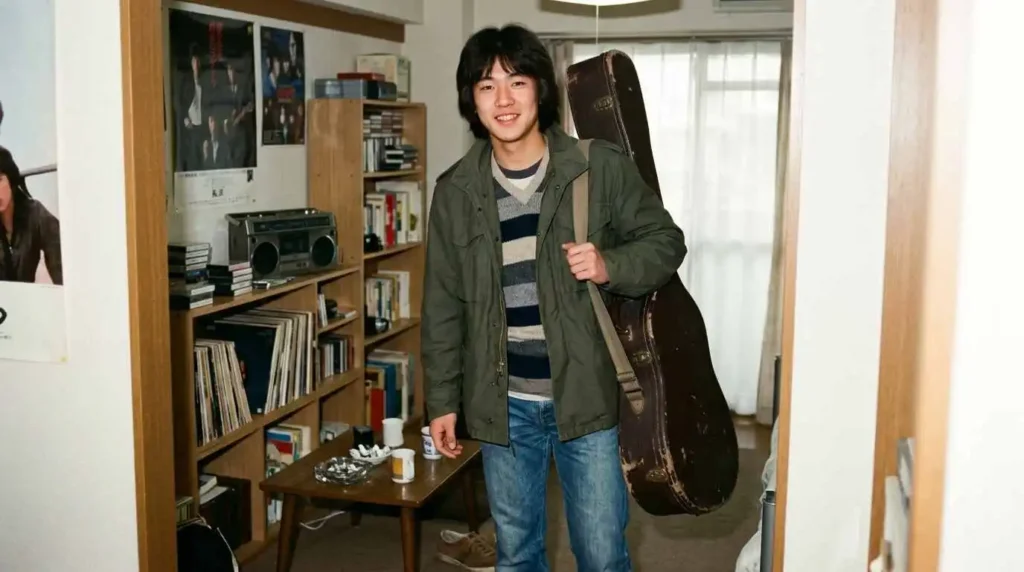
The Western rock records he brought to my room and the casual plucking of his acoustic guitar expanded my musical horizons boundlessly.
Until recently, I had always assumed that my very first taste of serious musical inspiration from him was learning about Eric Clapton during our college days. However, as I confront Yosui’s version of “Shiroi Ichinichi” today, I realize with newfound clarity that the true origin of my awakening to the depth of music lay back in that singular moment at the high school cultural festival.
Naturally, what is depicted in this song is a dense, unspoken intimacy between a man and a woman facing each other quietly in a room.
That world was completely detached from our daily reality back then, where two young guys did nothing but flip vinyl records in a cramped apartment. Yet, precisely because of that, perhaps the younger version of me looked beyond the melody Kaneko played and envisioned a melancholic distance between a man and a woman — like a scene from an adult movie — with a sense of yearning.
Overwriting Youthful Memories: The Resonance of Yosui’s Version
After being charmed by the unadorned beauty of Kaneko singing on that festival stage, I eventually obtained the album “Ice World” and heard Yosui’s own singing voice. At that moment, my memory of “Shiroi Ichinichi” was completely rewritten with an entirely new texture.
Unlike the somewhat detached and peaceful air carried by Kei Ogura’s own vocal version, the “Shiroi Ichinichi” expressed by Yosui’s particular voice harbored a deep, palpable earnestness beneath its quiet surface.
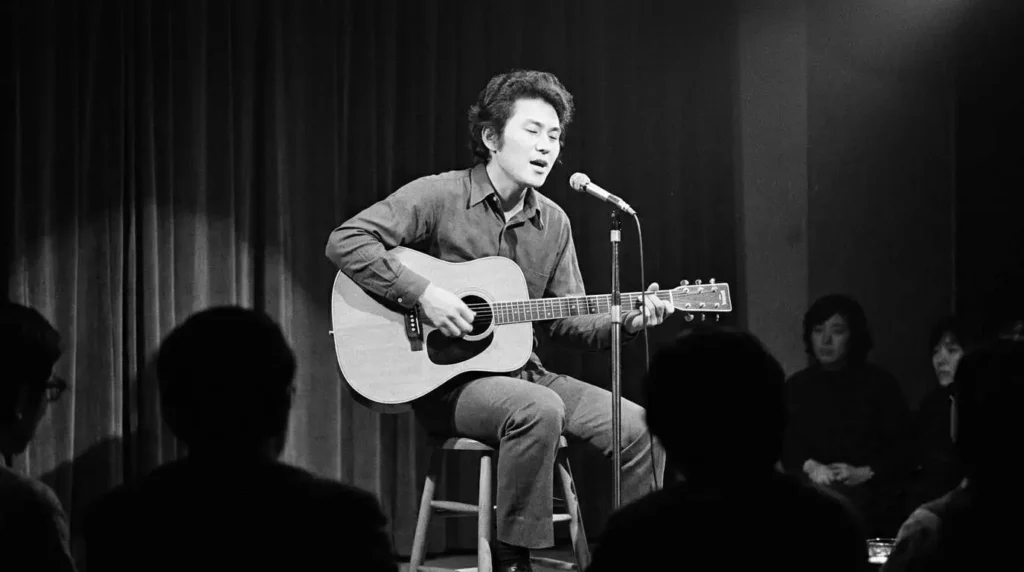
The vocal style, placing words down one by one over simple guitar plucking, seeped quietly and deeply into my heart, intertwining with the memory of the acoustic resonance Kaneko had played for me.
It was a shock to realize how completely a landscape could change depending entirely on the singer, even with the exact same piece of music. The rough, textured feel brought forth by Yosui’s melody seemed to grant a somewhat bittersweet reality to the landscapes I had walked through in my life.
A vast amount of time has slipped away since that stage at the cultural festival.
I hear that Kaneko is currently based in Kyoto. Once I finish writing this blog post, I think I will reach out to him for the first time in ages, just to ask, “How have you been?”
Closing Thoughts
Out of the countless masterpieces Yosui Inoue has given us, I deliberately chose “Shiroi Ichinichi” — a song he did not write the lyrics for — as my No. 2 selection.
Among the many tracks on the legendary album “Ice World,” I am drawn deeply to the exceptional presence of this song, where Kei Ogura’s literary words intersect beautifully with Yosui’s genius melody.
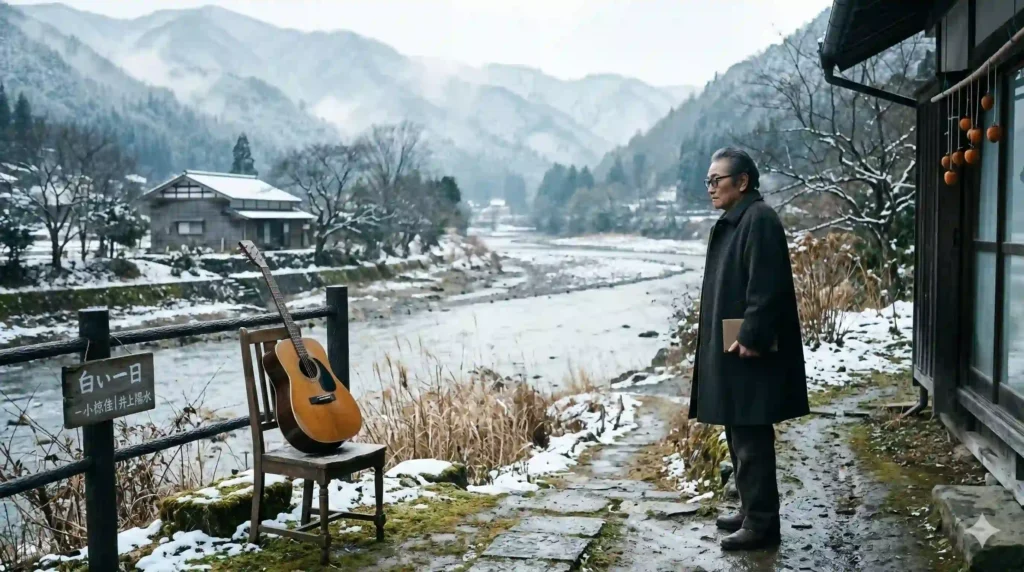
At the same time, it is an irreplaceable piece that vividly summons the scenes of my own youth. Beyond the acoustic resonance stripped of all flashy ornamentation, what kind of day does this song make you look back on?
This song always reminds us of the richness found in occasionally pausing, standing still, and simply accepting time as it flows away.

音楽ファン同士の交流・リクエストはこちら / Connect & Request Songs Here