
Click here for Yosui Inoue’s History!
- 🎧 Enjoy This Article in Audio
- No. 3 is “Kokoro Moyou” (Heart’s Texture)
- First, Please Listen to the YouTube Videos
- The Blue Stationery Reflects Two Parallels of Solitude
- The Atmosphere of a Masterpiece Carrying Unspeakable Thoughts
- The Universality Born from Eliminating Raw Realism
- The 1973 Miracle Formed by the A-Side and B-Side
- The Dramatic Coloration of Katz Hoshi’s Arrangement
🎧 Enjoy This Article in Audio
You can quickly grasp the main points of this article through narration.
Recommended for those who want to catch the vibe of the music and the flow of the article before reading.
🎶 English Narration
An English audio introduction to the contents of this article.
⌛ Duration: Approx. 4 mins
🎵 Japanese Narration
A Japanese audio introduction to the contents of this article.
⌛ Duration: Approx. 4 mins
* Listening to the audio before reading helps you better understand the world of the music and the main points of the article.
No. 3 is “Kokoro Moyou” (Heart’s Texture)
Only three songs remain in my personal Best 30 selection for Yosui Inoue. The track taking the No. 3 spot is “Kokoro Moyou,” a monumental milestone released in 1973 that left an indelible mark on Japanese music history.
Far more than just a hit single, this track stands as the absolute core of “Ice World” (Koori no Sekai), Japan’s first-ever million-selling album, and its brilliant luster remains completely undiminished to this day.
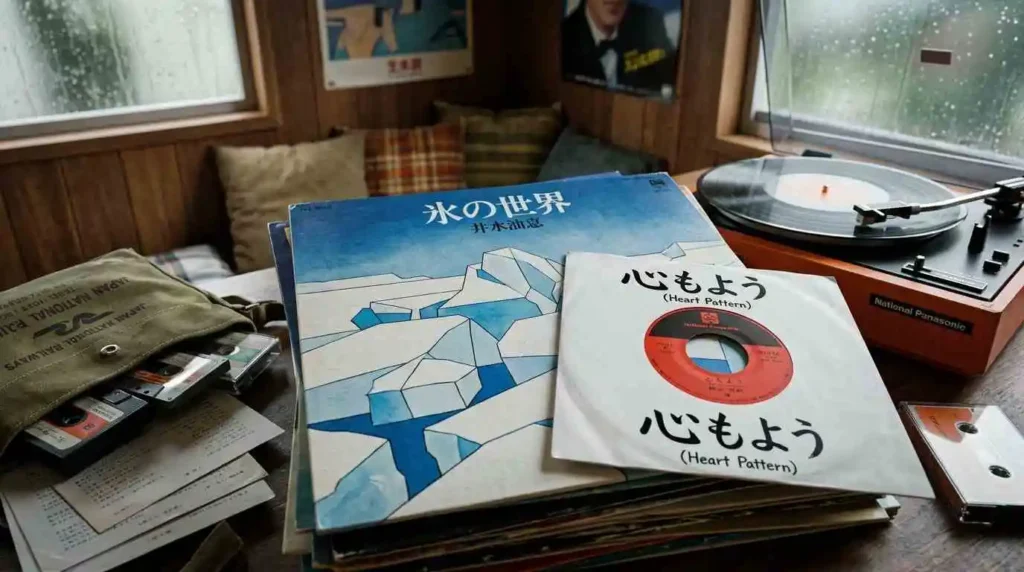
In this piece, I would like to focus on the deliberate arrangement of words within the lyrics and the quiet, internal conflict endured by the protagonist.
It is a melody so profoundly famous that almost anyone has heard it. Yet, when we truly attune our ears to the fierce tug-of-war between spoken words and heavy silence hidden behind that beautiful melody, we encounter the breathtaking expressive power engineered by Yosui as a true artist.
Poetic Translation: The World of “Kokoro Moyou”
There must be so many things I want to tell you.
Yet, the only thing left on the stationery is always loneliness.
Beyond the falling rain, your smiling face suddenly floats in my mind.
The letter that reaches you will surely, quietly bury itself within the changing seasons.
💡 You might also like: View the lyrics(External site)
If the lyrics are displayed only in Japanese, you can use your browser’s translation feature or an AI translation tool to understand the general meaning.
First, Please Listen to the YouTube Videos
Common Credits
Song Title: Kokoro Moyou
Lyrics, Composition & Vocal: Yosui Inoue
Arrangement: Katz Hoshi
Single Release Date: September 21, 1973
Single B-Side: Kaerenai Futari (The Two Who Can't Go Home)
Album Appearance: Ice World (Koori no Sekai)
Label: Polydor Records

"Kokoro Moyou" was released as a single on September 21, 1973, and was also included in the album "Ice World" released the same year, standing as one of Yosui Inoue's most definitive masterpieces. The B-side of the single featured "Kaerenai Futari."
This is the studio-recorded track. Please click on the image below.
Yosui Inoue - "Kokoro Moyou" Studio Recording
First, let us listen to the studio-recorded version of Yosui Inoue's "Kokoro Moyou."
While it lacks the spontaneous, improvised fluctuations found in live renditions, it allows the song's structural silhouette, the pure beauty of the melody, and the quiet desolation of the lyrics to be delivered straight to the heart.

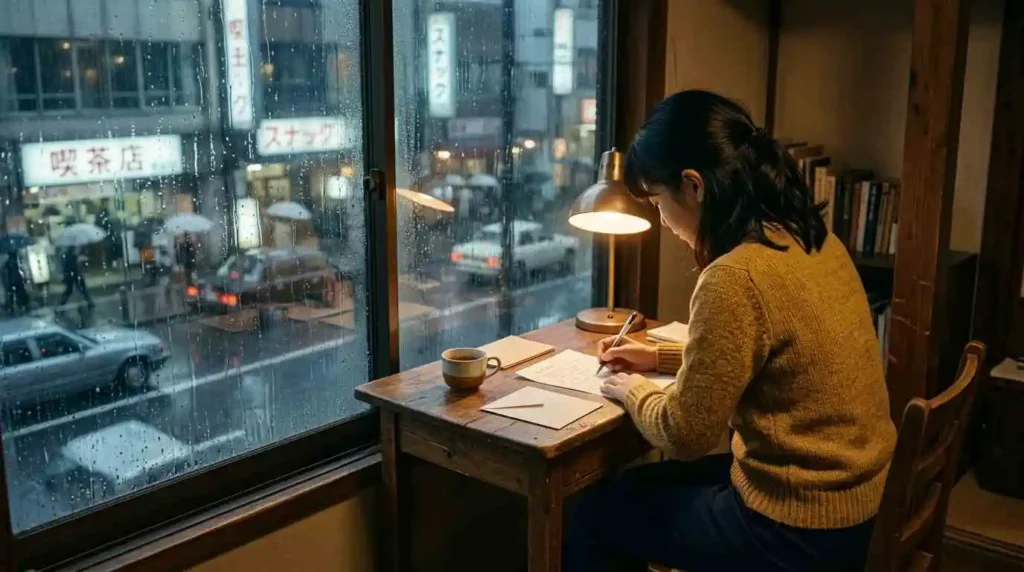
The protagonist of this song is attempting to mail a letter to a loved one living far away in their hometown. Blue stationery, black ink, a rainy window, and the genuine feelings that remain unwritten. Instead of shouting out heavy emotions, Yosui's restrained vocal delivery allows the unutterable loneliness to slowly seep through the track.
Yosui Inoue – “Kokoro Moyou” Live Performance (Date Unknown) – Please click on the image below.

In this live footage, unlike the studio version, the organic breathing and spatial timing of Yosui’s vocal delivery come through with vivid raw presence.
"Kokoro Moyou" is not a track designed to aggressively unload heavy baggage. Rather, it is a song that locks unutterable loneliness away inside the quiet envelope of a letter. Hearing it live, those contained emotions feel even deeper, amplified by the subtle tremors of his voice and the prolonged weight of the silences.
Next is a live performance from 2014 at NHK Hall. This is an “Official Video.”
Our third video offers a performance of "Kokoro Moyou" filtered through the passage of immense time.
When a young Yosui Inoue sang this piece, there was a raw desperation in the letter-writing protagonist, a sharp sting of youth still close at hand. Conversely, in this 2014 rendition, that old pain has weathered decades, resonating like a profound, distant memory.

The letter described in this song does eventually reach the recipient. Yet, even the handwritten ink slowly fades, buried under the steady transition of the seasons. Listening to his 2014 voice, this sensation transcends a mere breakup between young lovers; it sounds as though he is singing for all the words left unsaid and the fragments of intent left behind over a lifetime.
(*In accordance with copyright considerations, videos on this blog that are not from official distribution channels are not embedded directly. Instead, we utilize a format that links to external sites via specially prepared custom images.)
The Blue Stationery Reflects Two Parallels of Solitude
To talk about “Kokoro Moyou,” one must first examine the absolute sense of enclosure and distance established within the lyrics.
The protagonist of this song never faces the other person directly. The only connection present is a letter—a strictly one-way medium of communication that requires significant time to arrive.

A Letter That Amounts to a Soliloquy
Writing a letter is fundamentally an act meant to bring someone closer. However, in the world Yosui crafts, the more the protagonist writes, the more the staggering distance between them is brought into stark relief.
Every time characters are traced onto blue stationery with black ink, the writer is forced to remember just how entirely alone they are.
This profound sense of isolation is precisely what forms the core of the sorrow flowing through this song.
Colors Left Behind in a Rainy Room
As you trace the lyrics, a striking contrast of colors catches the eye: the blue stationery and black ink close at hand, set against the rain outside the window turning the world gray.
This chromatic contrast softly illuminates the restless, helpless urgency of the protagonist marooned alone in a small room. The frustration of words skittering across the surface the more one tries to convey true intent is drawn with an incredibly refined, elegant touch.

The Atmosphere of a Masterpiece Carrying Unspeakable Thoughts
The Beautiful and Tragic Scenery of a Letter
What this song paints is the figure of a protagonist quietly composing a letter in the midst of a heartbreaking situation.
Even while sensing the looming crisis hovering over their relationship, the mind fixates only on the quiet scenery immediately ahead and the visual colors of the writing tools at hand.
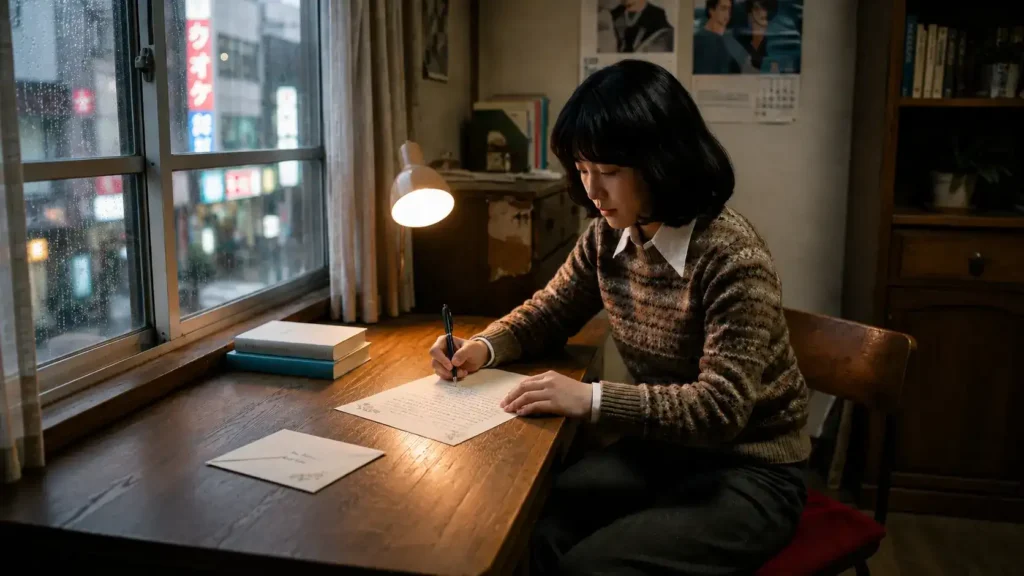
Unable to give form to the deepest parts of the heart, they pack nothing but raw “loneliness” into the envelope to send back home. This unplaceable silence is exactly what elevates the song’s melancholy into something truly profound.
A Monologue Seeping Quietly into the Listener’s Soul
This step-back, detached posture possesses a magnetic charm that captures our hearts across generations, entirely independent of fleeting musical trends.
When we are on the verge of losing track of our own true feelings, or when we are agonizing over the distance separating us from someone important, we all harbor a certain helpless displacement inside. Because this song reflects those nameless, deeply personal points of grief exactly as they are, “Kokoro Moyou” transcends eras and continues to seep quietly into the lives of so many listeners.
The Universality Born from Eliminating Raw Realism
Choosing Timeless “Symbols” Over Fleeting Trends
The mainstream folk songs of that era (such as “Kandagawa” by Kaguya-hime) typically relied on highly specific details—like “tenugui mufflers,” “bars of soap,” “boxes of crayons,” and “three-tatami-mat rental rooms”—to capture the raw, immediate lifestyle and tangible scent of youth at the time.
While those details fostered immense contemporary empathy, they inherently anchored the music to a very specific backdrop: “that particular era, that exact place.”
In stark contrast, Yosui chose abstract words completely detached from gritty domestic realism: “ink,” “stationery,” “rain,” and “loneliness”—universal concepts scattered across anyone’s daily life, regardless of the decade.
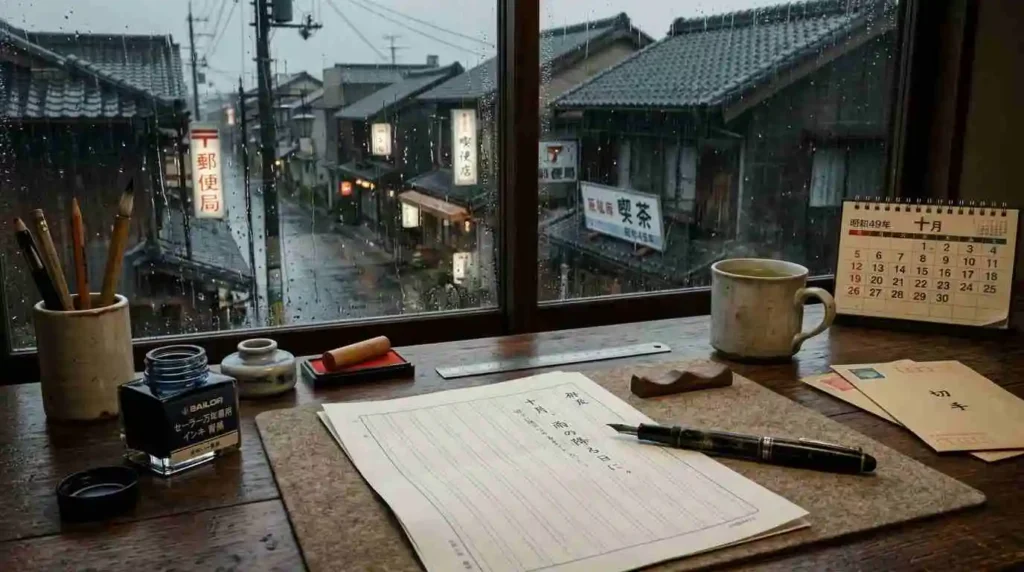
By deliberately stripping away localized domestic textures and arranging only timeless symbols, the track avoids being bound to a single historical moment. It preserves a magnificent, universal presence that never feels dated, no matter when it is uncovered.
The 1973 Miracle Formed by the A-Side and B-Side
A Luxurious Divergence Alongside “Kaerenai Futari”
The true luxury of this single lies in the fact that the iconic “Kaerenai Futari” was tucked away on the B-side.
Co-written with the legendary Kiyoshiro Imawano, this track stands as a masterpiece in its own right, painting a vivid, breathless nocturnal landscape. It possessed a level of quality that could have easily justified making it the main A-side.
History notes that ahead of the single’s release, Yosui Inoue personally championed “Kaerenai Futari” for the top billing, while producer/director Hidenori Taga fiercely backed “Kokoro Moyou.” Ultimately, “Kokoro Moyou” took the A-side slot, leaving “Kaerenai Futari” to anchor the reverse.
“Kokoro Moyou” closes itself inside a quiet room, packing unreached longing into an envelope.
“Kaerenai Futari” steps out into the nightscape of the city, two people sharing a pocket of endless time.
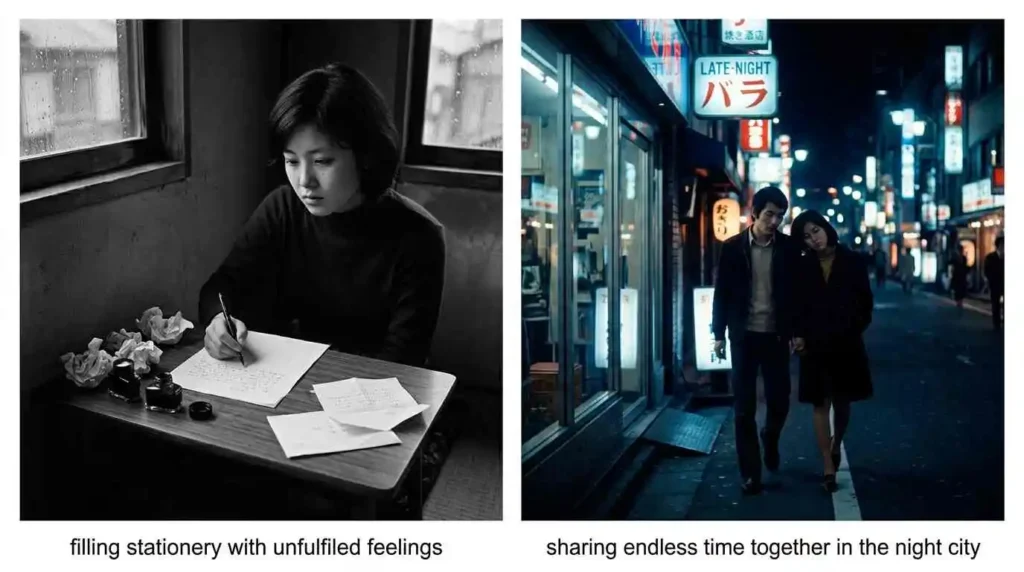
The exquisite structural gradient formed by these two contrasting facets of isolation would eventually bridge beautifully into “Ice World,” the record destined to become Japan’s very first million-selling album.
The Dramatic Coloration of Katz Hoshi’s Arrangement
Elevating Folk into Sophisticated Pop
When dissecting the sheer gravity of this piece, one cannot overstate the brilliance of the arrangement provided by Katz Hoshi. What easily could have devolved into a plain, bleak folk monologue was elevated by dramatic, sweeping string arrangements, transforming the track into a pop masterpiece with the cinematic scale of a feature film.
When this grand orchestration intersected with Yosui’s rigid, beautiful melodic line, the innate melancholy of the song expanded into something infinitely deeper.
“Kokoro Moyou,” my choice for the No. 3 spot in my personal Yosui Inoue Best 30 selection.
The architectural placement of the words, the universality born from avoiding localized realism, and the luxurious juxtaposition with its brilliant B-side. It was the flawless fusion of these elements that allowed it to stand tall as an eternal, shining monument in the history of Japanese music.

音楽ファン同士の交流・リクエストはこちら / Connect & Request Songs Here