
Click here for Yosui Inoue’s History!
- 🎧 Enjoy This Article in Audio
- 🎧 Enjoy This Article via Audio
- No. 12: “Koori no Sekai” (Ice World)
- My Deep Interpretation: The Worldview of the Lyrics
- First, Please Listen to the YouTube Audio
- The Dual Nature of Unique Funk-Rock: “Heat” Meets “Detachment”
- The Paradox of “Poetic Venom” and “Kindness” Vibrating Across Time
- Conclusion
🎧 Enjoy This Article in Audio
You can quickly grasp the main points of this article through narration.
Recommended for those who want to catch the vibe of the music and the flow of the article before reading.
🎶 English Narration
An English audio introduction to the contents of this article.
⌛ Duration: Approx. 3 mins
🎵 Japanese Narration
A Japanese audio introduction to the contents of this article.
⌛ Duration: Approx. 3 mins
* Listening to the audio before reading helps you better understand the world of the music and the main points of the article.
Click here for 【The History of Yosui Inoue】!
🎧 Enjoy This Article via Audio
Through this narration, you can quickly grasp the key points of the article.
Highly recommended for those who want to catch the vibe of the music and the overall flow before diving into the text.
🎵 Japanese Narration
Listen to the content of this article in Japanese.
⌛ Duration: Approx. 3 min 40 sec
🎶 English Narration
Listen to the content of this article in English.
⌛ Duration: Approx. 3 min
* Listening before reading helps you sink deeper into the song’s universe and the highlights of the review.
No. 12: “Koori no Sekai” (Ice World)
Released in 1973, this is the title track of the historic album that became the first million-seller in Japanese music history. It is a masterpiece that fundamentally shattered the conventional boundaries of what “folk music” could be at the time.
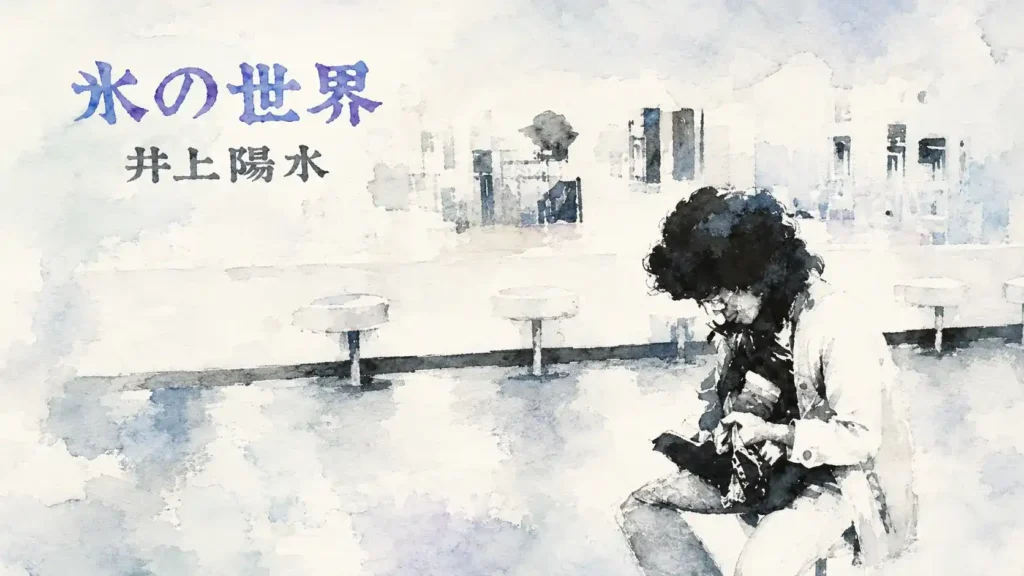
To be completely honest, when I first heard this song, I couldn’t quite connect with its unique universe compared to his other tracks. The tempo, the rhythm, the lyrics—everything felt piercingly cold, and I remember it being the hardest song for me to get used to on the album.
Yet, looking back, I realize that my absolute favorite album, Koori no Sekai, only truly functions as a cohesive masterpiece because this specific track serves as its core. It required a significant amount of time for me to finally digest and appreciate its true essence.
It was only after leaving the naive days of my youth and university years far behind, and being tossed about by the rough waves of the corporate world, that the song began to seep into my heart, hand in hand with time and life experience.
Beneath the surface of a sound I had somewhat avoided in my youth, I gradually woke up to the breathtaking depths of human psychology and a chillingly detached gaze fixed upon society.
In this review, I want to step away from the cliché, token interpretations like “a warning to the modern era.” Instead, I want to thoroughly unpack the absurd worldview presented in this song and explore the human “chill” woven beneath his words.
My Deep Interpretation: The Worldview of the Lyrics
Within a bleak winter landscape, everyone lives carrying their own small pockets of loneliness and anxiety.
Even when we wish not to hurt others, there are complex emotions that simple kindness cannot bridge.
Still, unable to turn completely cold-hearted, we carry our flawed selves, just wishing to get through today in peace.
A song about searching for a tiny flicker of warmth inside a freezing world.
First, Please Listen to the YouTube Audio
Please click the image below.
Credits
Yosui Inoue - "Koori no Sekai" (Ice World)
Lyrics & Composition: Yosui Inoue
Arrangement: Katashi Mashi
Album: Koori no Sekai
Release Date: December 1, 1973
Label: Polydor Records
Two-Line Commentary
An audio video allowing you to hear Yosui Inoue's signature track "Koori no Sekai" in full.
Through imagery of snowstorms and freezing temperatures, it sharply captures the stagnation of the era and human isolation.
"YouTube Published Audio"
(※ Out of respect for copyright policies, our blog refrains from embedding unofficial videos directly. Instead, we use our own custom images that link to external platforms.)
Next is the Official Live Video
Credits
Yosui Inoue - "Koori no Sekai" (Ice World)
Live at NHK Hall (May 22, 2014)
Video Title: 井上陽水 - 氷の世界(ライブ) NHKホール 2014/5/22
Related Release: Koori no Sekai Tour 2014 Live the Best
Publisher: UNIVERSAL MUSIC JAPAN (Official Release)
Two-Line Commentary
A live performance of "Koori no Sekai" captured at NHK Hall in 2014. It is absolutely electrifying!
While retaining the sharp chill and heavy suffocation of the original studio track, his mature vocals bring the weight of each word beautifully to the forefront.
The Dual Nature of Unique Funk-Rock: “Heat” Meets “Detachment”
In the audio track introduced above, the very first thing that grabs your ears is the rhythmic foundation brought to life through the London recording sessions, yielding a rhythm section that was exceptionally sharp and heavy for its time.
The funky, rhythmic guitar scratching and the deeply grooving bassline completely blow away any image of a dusty, unpolished folk song. Structurally, it carries the “hot” essence of black music, designed to forcefully move the listener’s body.
Yet, layered on top of this burning, high-energy arrangement are lyrics devoid of even a shred of warmth—a series of terrifyingly cold observations. This stark paradox between the “hot” instrumentation and the “cold” lyricism is the ultimate mechanism that induces a strange, brilliant vertigo in the listener’s mind.
This surreal chill, akin to vertigo, resonates even more vividly when we place ourselves within modern daily life, where rationality and functional efficiency are pushed to their absolute limits.
It cuts straight into the underlying “dryness” that hides in the gaps of human relationships—the reality where everyone perfectly acts out their societal roles, yet privately harbors a cold, unsharable space inside their hearts.
People Treading the Thin Ice of Everyday Life
The scenery captured within the lyrics plays out like a sequence of absurd, slightly distorted sketches. An apple vendor shouting until his voice cracks on a street corner, or a television screen that flickers with bizarre colors due to the freezing cold, only to vanish into nothingness.

The genius magic that Yosui pulls off lies in how he takes these seemingly disjointed, bizarre fragments of daily life and arranges them side by side, maintaining a completely cold and objective touch.
The Cold Gaze Lingering Behind a Distorted Normalcy
There is a cynical perspective that looks askance at the actions of others, muttering, “Surely someone is just fooling around and mimicking them.“
Or the deeply fragile emotional instability of wishing to connect with someone through empty promises, whispering, “Even a white lie would do.“
Furthermore, there is a raw, exposed introspection that harbors an ominous impulse to hurt others, only to mock itself upon realizing it is simply terrified. These are by no means twisted insanities confined to some far-off, alien world.
Human Nature Dispassionately Displayed Like a Specimen
These vignettes are snapshots of the raw human nature that lives right next door to us—or perhaps, the very secrets we lock deep inside our own chests.
Yosui doesn’t condemn these flaws from a high-and-mighty, preachy soapbox. Instead, he presents them dispassionately, like biological specimens pinned inside a glass case. It is precisely this low temperature that allows the song to slice so cleanly and deeply into the listener’s core.
The Paradox of “Poetic Venom” and “Kindness” Vibrating Across Time
The true terror of this song does not stop at merely exposing human ego. The words unleashed toward the latter half of the track act like a surgical scalpel, slicing through the invisible defensive walls we unconsciously build around ourselves.
Exposing the Hypocrisy Hidden Behind Pleasantries
Particularly iconic is the biting, sarcastic jab directed at those who “secretly cherish kindness in their hearts,” mocking them by asking if they are trying so hard just to win a Nobel Prize.
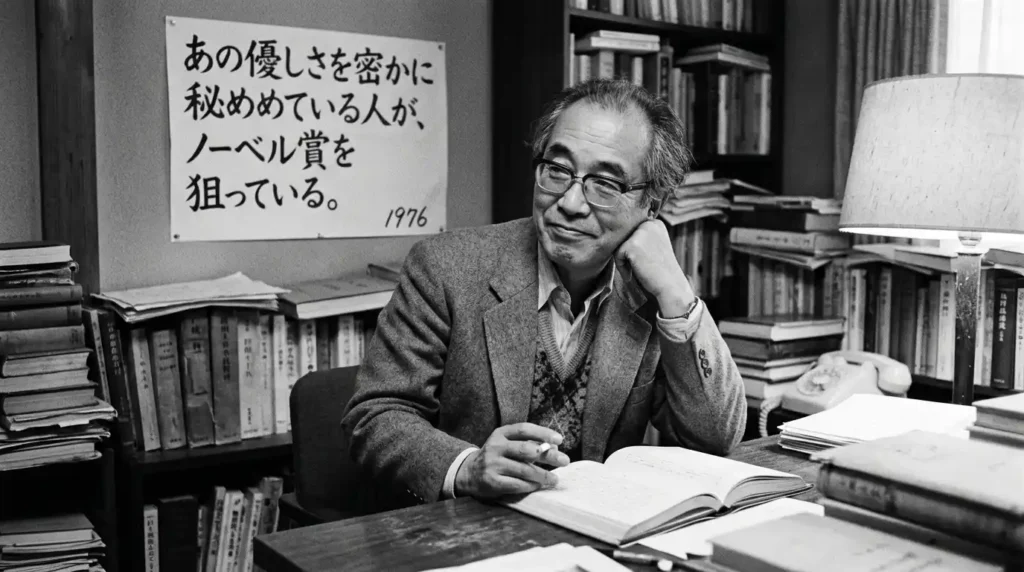
In our daily interactions, we frequently speak of “consideration for others” and “goodwill.” Yet, in a single heartbeat, Yosui sees straight through the elegant veneer of kindness, catching the distinct scent of a craving for validation and self-satisfaction lurking at the bottom.
The self-absorption and vanity of admiring oneself for being devoted to someone else, or for possessing a fragile, sensitive soul—this song turns a cold glare on those exact sentiments, asking: “Isn’t even that vulnerability just a calculated performance?”
Is the Shivering Caused by the Winter Cold, or by Pure Fear?
As the track marches toward its conclusion, the recurring line, “You’re shivering because of the cold, right? Not because you’re scared, right?” beautifully encapsulates the ultimate peak of human psychological vulnerability.
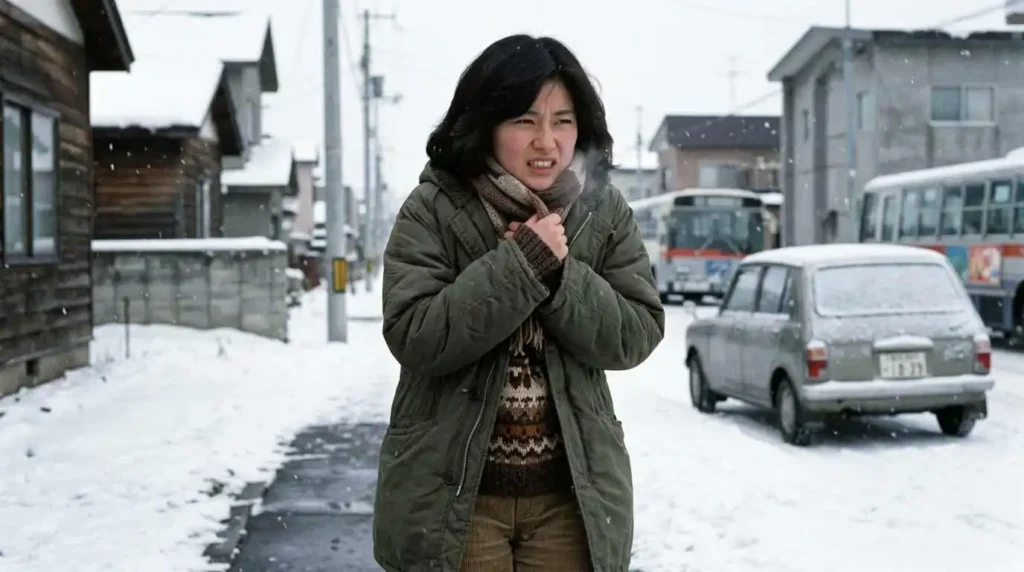
When forced to confront the malice or emptiness sleeping inside us, we experience a profound psychological tremor. Yet, we instantly try to look away from our internal terror, making excuses and claiming that our shaking is merely a physical reaction to the winter weather.
Every time I listen to this passage, I am struck by the profound fragility of the human mind and the almost comical defense mechanisms we deploy to hide it. Yosui quietly, yet mercilessly, lays bare the fact that we live our lives lying even to ourselves.
Conclusion
The most astonishing historical fact is that the entire nation of Japan actively competed to buy, play, and sing along to a funk-rock track laced with such uncompromised, venomous exposures of human hypocrisy, ultimately pushing it to become the country’s very first million-selling album.
Behind the ecstatic, blinding glare of the Post-War Economic Miracle, perhaps everyone deeply craved and resonated with the “internal freeze” captured by this song. Because it was not a mere transient pop hit, but a monument that completely overturned the cultural zeitgeist of an era, its historical value remains unparalleled.
Yosui Inoue’s Koori no Sekai continues to press its razor-sharp edge directly against our throats, completely unaffected by how much our social frameworks or technologies change.
This is because the human coldness and surreal isolation exposed within this track are not tied to temporary, fleeting cultural trends. Instead, they reflect the universal, unescapable karma tied to the very core of human existence.
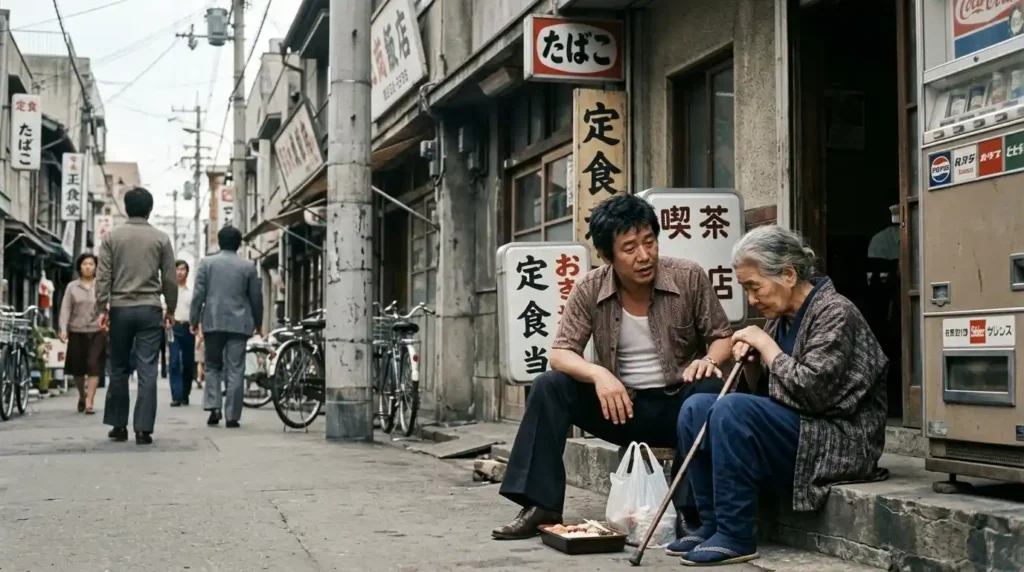
If anything, in our contemporary world where efficiency and superficial connections have become hyper-refined, the mosaic-like unease painted by this song returns to us with an even more visceral, realistic texture.
When we stare unflinchingly into this frozen world, we find that it yields not mere despair, but a kind of fierce, brilliant energy. That is precisely why the cold, sharp gaze of this timeless masterpiece will never cease to pierce right through our deepest pretenses, no matter how the eras turn.

音楽ファン同士の交流・リクエストはこちら / Connect & Request Songs Here