
Click here for Yosui Inoue’s History!
- 🎧 Enjoy This Article in Audio
- Ranked at No. 15 is “Itsunomanika Shojo wa” (Before You Know It, She’s a Young Woman)
- First, Please Listen to the Track via These YouTube Videos
- A Gaze Fixing Its Eyes on a World Changing Without a Sound
- The Quiet Shift Brought by “Love” and “Romance” in an Adult World
- The Air Spun by Minimal Acoustic Elements
- The Scenery Along the Boundary Line That We Overlooked Back Then
- In Closing
🎧 Enjoy This Article in Audio
You can quickly grasp the main points of this article through narration.
Recommended for those who want to catch the vibe of the music and the flow of the article before reading.
🎶 English Narration
An English audio introduction to the contents of this article.
⌛ Duration: Approx. 3 mins 30 secs
🎵 Japanese Narration
A Japanese audio introduction to the contents of this article.
⌛ Duration: Approx. 3 mins
* Listening to the audio before reading helps you better understand the world of the music and the main points of the article.
Ranked at No. 15 is “Itsunomanika Shojo wa” (Before You Know It, She’s a Young Woman)
In “My Personal Best 30,” a list chosen through my own bias and affection, the song I have placed at the No. 15 midway mark is “Itsunomanika Shojo wa,” which was quietly released in March 1973 as the B-side track to the single “Yume no Naka e” (Into the Dream).

In sharp contrast to the cheerful, cynical frenzy of the chart-topping A-side, this track has continuously and quietly stirred the hearts of its listeners, as if standing still in the depths of a thick mist.
This time, I would like to write about that nameless sense of loss drifting along the boundary line between childhood and adulthood—a boundary that every single one of us has crossed.
The World of “Itsunomanika Shojo wa” (Essence Translation)
Before she even realized it, looking up at the sky and clouds, the girl had become an adult.
Having grown up quietly, she eventually learns about love and romance, changing bit by bit.
Yet, wrapped in the radiance of youth, she is not yet aware of the sadness of her own transformation.
This song captures the brilliance of the time a girl changes into an adult, and the faint loneliness that lingers right behind it.
First, Please Listen to the Track via These YouTube Videos
Three versions are featured below.
【Title】 Itsunomanika Shojo wa
【Lyrics & Composition】 Yosui Inoue
【Arrangement】 Katz Hoshi
Released on March 1, 1973, as the B-side of the single “Yume no Naka e”
Two-Line Commentary
This song layers the image of a girl approaching adulthood like the turning of the seasons with scenes of blue skies and summer light. It is a signature Yosui Inoue folk number where brilliance and sorrow coexist within a quiet growth.
Please click the image below. (Studio Recording Version)
【Before you know it, a patch of blue sky peeks through…】

【Video Commentary】
Studio Version (B-side of the single "Yume no Naka e")

The original version seamlessly blends the taut arpeggio of the acoustic guitar with the somewhat urgent vocals of a young Yosui. Because all unnecessary sounds have been completely stripped away, the unique, translucent beauty of early Yosui vividly breathes through the track.
Please click the image below. (Live Audio Version)
【The burning summer sun is just around the corner】

【Commentary】
Live Audio Version (From the album "Yosui Live Modorimichi")

A precious take from Yosui's very first live album released in July 1973 (recorded at Shinjuku Kosei Nenkin Hall in April of the same year). Captured just one month after the single's release, this remarkably early stage performance allows you to feel the dynamic band sound unique to live shows alongside the fresh yet tightly strung vocals of a youthful Yosui.
Please click the image below. (Live Audio: Acoustic Guitar Solo Version)
【Your smile has grown up, enough to make me sad…】
_202605-1-1024x572.webp)
【Commentary】
Live Acoustic Guitar Audio Recording (Yosui Inoue Solo)

This extremely rare live concert audio recording comes from the performance at Amami Culture Center on June 23, 2007. Carrying only a single acoustic guitar, Yosui sings completely alone from start to finish. Because this recording exists within a space of pure subtraction—completely eliminating decorations like percussion or backing vocals—the resonance of his voice, layered with the experience of age and distinct from the sharpness of his youth, along with the lingering echoes of the guitar, strikes the heart with direct and powerful emotion.
(* Note: The majority of Yosui Inoue’s audio files available on the internet are not official distributions. Therefore, out of consideration for copyright, this blog chooses to link to external sites via custom-made images rather than embedding the videos directly.)
A Gaze Fixing Its Eyes on a World Changing Without a Sound
The Moment of “Transformation” That Takes One’s Breath Away Because It Is Not Dramatic
The true charm of this song lies in the way Yosui captures the scene of a girl quietly changing.
Yosui sang here that the girl approaches adulthood “without making a sound.”
Whenever I encounter that expression, a slight, rough melancholy stirs deep inside my chest.
When looking back, the most fundamental turnings in our own lives do not arrive amidst loud, dramatic events; rather, they tend to unfold slowly within a silence that nobody notices.
Even when tracing back through memories of university days or the period right after entering the workforce, no one can pinpoint the exact calendar date they truly became an “adult.”

By the time you realize it, that innocent spark you once possessed has worn away, and you have already begun walking as a different person. Yosui sublimates this unavoidable, stark reality into a piece of beautiful poetry.
The Synonym for Knowing the Shortness of Spring
The phrase appearing in the latter half of the lyrics, “Nobody knows the shortness of spring,” is a testament to Yosui’s extraordinary sensibilities as an artist.
The “spring” sung about here surely refers to those pure, somewhat fragile days born of youth that exist within everyone’s heart at some point.
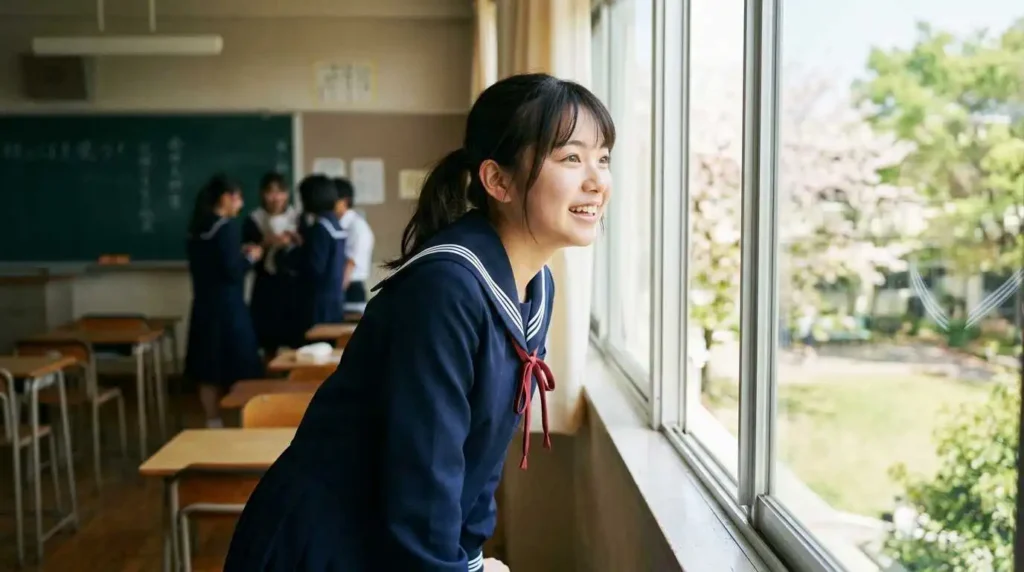
- A time when you could view the world with pure affirmation, completely untouched by hurt.
- A transparent season when there was absolutely no need to feign yourself for the sake of anyone else.
We only ever notice how short that season was after it has completely slipped away. Those who are in the middle of it remain blissfully unaware of its preciousness. Yosui gazes at the changing girl from a painfully close proximity, while simultaneously and gently singing of the underlying “irreversibility of time.”
The Quiet Shift Brought by “Love” and “Romance” in an Adult World
Learning Words Means Losing Wilderness
Yosui described the process of a girl growing into a woman through the phrases “learning how to use love” and “becoming someone who plays with romance.” The weight carried by these expressions lies in how he portrays “love” and “romance”—concepts that should naturally be passionate—by coolly detaching himself, treating them almost as tools or the rules of a game to be “used” and “played with.”
In a child’s world, emotions are far more raw, clumsy, and unbound by words.
However, to adapt to the “adult world” we call society, one must assign appropriate names to those emotions and manage them as a form of understanding. While it represents a type of wisdom and growth, it is also a protective measure—a coating applied to the softest parts of the heart to prevent them from wearing down.
The girl Yosui sings of has “unwittingly” enveloped herself in these adult manners. The quiet sorrow drifting from that transition tightly grips the listener’s chest.

A Smile Sad Enough to Cry, as the Destination
The song then moves toward its poignant conclusion: “Your smile has grown up, enough to make me sad.”
Why should a smile, which ought to be proof of growing up, be described as “sad”? It is because that smile has begun to function as a mask to conceal her true feelings.
The being who was once just a young girl now puts on a perfect “adult smile” to survive in society, or perhaps to avoid disappointing someone. The narrator, “I,” knows better than anyone the sheer magnitude of what was surrendered in exchange for that maturity. Therefore, while this growth is something that should be celebrated, it simultaneously becomes the subject of a tender, aching sentimentalism.
_202605-1024x572.webp)
The Air Spun by Minimal Acoustic Elements
Katz Hoshi’s Restrained Arrangement
As touched upon in previous articles, Katz Hoshi’s arrangements form the core of early Yosui’s sound, and in this specific track, an approach that condenses the sound as much as possible is maintained throughout.
The acoustic guitar arpeggio ringing from the intro through the entire piece feels like the hands of a clock ticking away with absolute precision. Choosing deliberately not to build dramatic heights with excessive strings or heavy drums, the track dominates the space solely with the guitar’s resonance and Yosui’s voice. It is precisely because of this clean, simple architecture that the subtle changes in the girl stand out so clearly.
The Timeless Power of a Voice That Transcends Eras
As can be seen in the featured YouTube videos, distinct gradations exist across the original track, the fresh energy of the early live performance, and the solo acoustic version of his later years.

The high-register vocals of a young Yosui, filled with a certain vulnerability and urgency, bring a tension that makes you feel as though you are witnessing “an innocent time slipping away right before your eyes” in real-time.
On the other hand, his singing on stage as he matured oozes a profound depth, as if he has accepted everything and is quietly observing the inevitable passage of time. It is not a matter of which version is superior. Rather, it is the sheer caliber of Yosui as a vocalist that has allowed this simple folk song of just a few lines to endure through the decades as a truly universal piece of music.
The Scenery Along the Boundary Line That We Overlooked Back Then
A Nameless Bewilderment Toward a Changing Familiar Presence
Let us shift our perspective slightly to that of the narrator, “I.” The protagonist of this song does not straightforwardly rejoice or offer congratulations for the girl’s growth.
Nor is he frantically trying to bind her to him. He merely stares intently at her form, as if quietly observing the shifting of the seasons.
A similar “quiet transformation” must have taken place around us as well.
A friend with whom we laughed effortlessly until yesterday suddenly, one day, begins to carry an adult aura that feels almost untouchable.
In that moment, we surely felt a certain “sense of being left behind” or an “awkwardness.”
Yosui gave an exquisite melody and words to those very emotions that we could never quite name.
The “Smile Sad Enough to Cry” That Everyone Carries
Why does this song continue to hold our hearts so firmly even today? It is because the figure of the “girl” being sung about perfectly overlaps with our own pasts—with the way we once relinquished the privileges of youth to adapt to society.
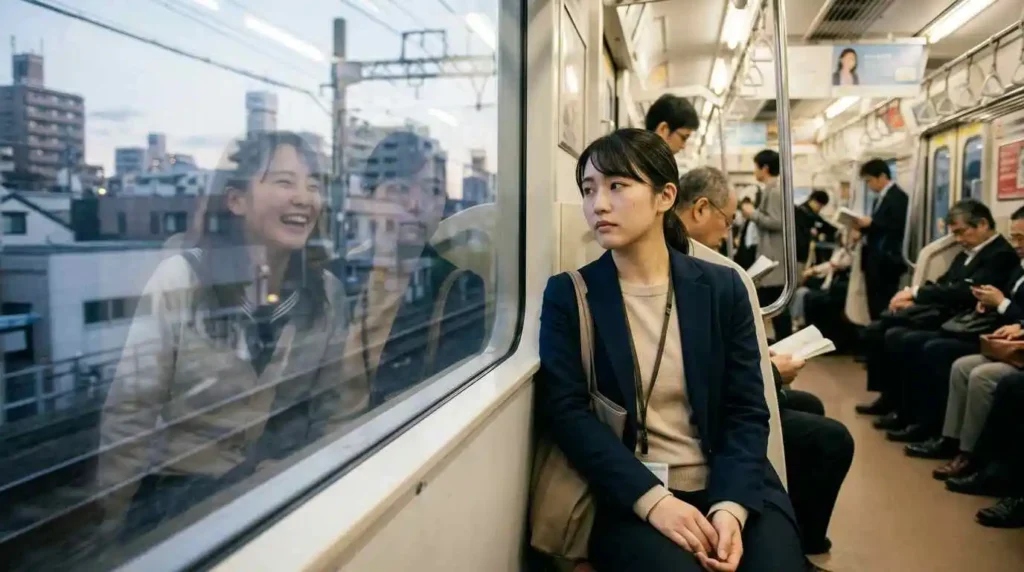
- The social navigation skills we picked up along the way while being tossed about by the waves of the world.
- The practiced adult smile we might have rehearsed in front of a mirror just to hide genuine tears.
We have all become adults by letting go of things bit by bit and allowing ourselves to wear down. When listening to this track, we are not merely pitying a girl; we are remembering that poignant boundary line we crossed ourselves, feeling our own chests tighten at the memory.
In Closing
Yosui Inoue’s “Itsunomanika Shojo wa” is far more than a mere record of a single girl’s growth. It is a masterpiece that simultaneously captures the inherent beauty and heartbreak bound within the human journey of growing up.
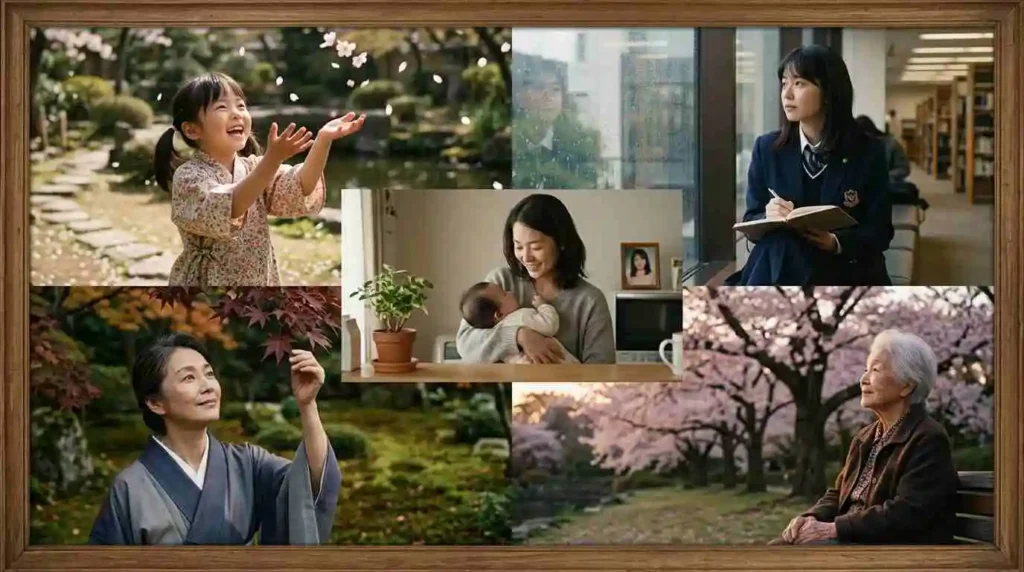
Within the figure of the girl who has thus crossed over that boundary line, we catch a glimpse of the lingering afterimage of our own irretrievably lost, innocent days.
Tucked away quietly as the B-side behind the massive hit “Yume no Naka e,” this song bears Yosui’s characteristically sharp yet tender gaze, making it, in a sense, a track of the absolute highest caliber.


音楽ファン同士の交流・リクエストはこちら / Connect & Request Songs Here