
Click here for Yosui Inoue’s History!
🎧 Enjoy This Article via Audio
Through the narration, you can quickly grasp the key points of this article.
Recommended for those who want to catch the musical atmosphere and the overall flow before reading.
🎶 English Narration
Listen to the content of this article in English.
⌛ Duration: Approx. 3 min 45 sec
🎵 Japanese Narration
Listen to the content of this article in Japanese.
⌛ Duration: Approx. 3 min 45 sec
* Listening to the audio beforehand deepens your understanding of the song’s worldview and the key points of the article.
No. 20: “Shiroi Carnation” or “White Carnation”
It is a beautiful, an utterly beautiful, truly magnificent piece of music.
When reflecting on the vast career of Yosui Inoue, many listeners tend to gravity toward the sharp, biting edge found in “Kori no Sekai” (Ice World) or the perfected nostalgia of “Shonen Jidai” (Boyhood). However, the true essence of his expression—the serene yet subtly unsettling atmosphere that stirs the listener’s heart—can perhaps be tasted in its purest form through the modest, understated gems tucked away in his earliest albums.
The song I have chosen for the number 20 spot is “Shiroi Carnation” (White Carnation), the fourth track on Side A of his 1972 debut album, “Danzetsu” (Severance). At first listen, this track might seem like a simple, autobiographical love song from the dawn of Japanese folk music, or perhaps a gentle, everyday sketch themed around a familiar flower.
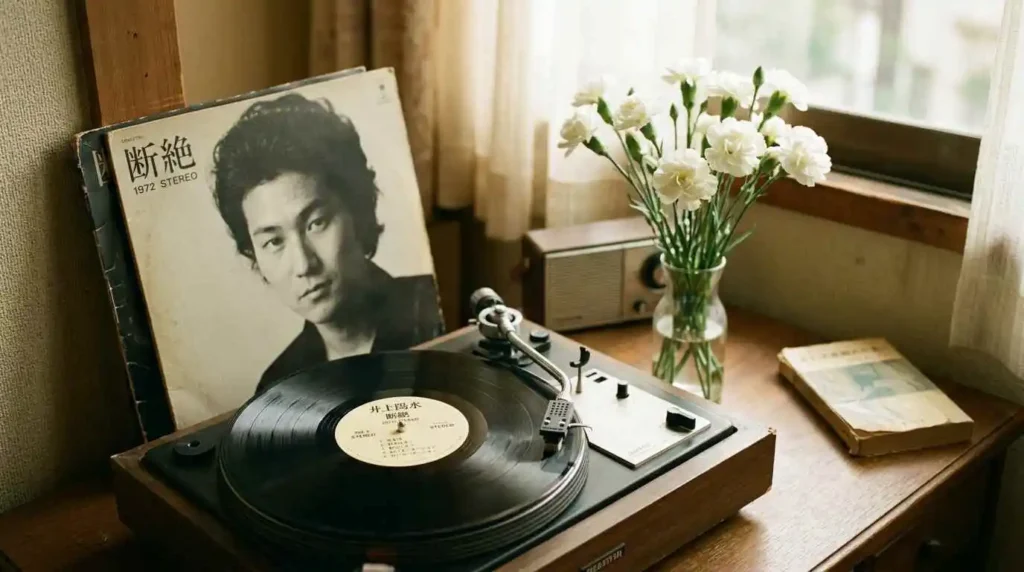
Yet, the genuine flavor of this composition lies just beneath its quiet, unpretentious demeanor.
In listening to and comparing the original studio recording with his live performances from later years, what caught my attention was the subtle psychological impact brought about by the change in vocal tone and key. From the youthful, innocent air of the studio version to the gentle shadow and mature composure that emerge when he performs it in a lower key in later years, I would like to examine the charm of this quiet transformation from an objective, step-back perspective, without overly mystifying it.
Poetic Interpretation
I never noticed it when I was a child,
but now I understand the true beauty of that flower.
Precisely because all flowers must wither someday,
my feelings for the white carnation will linger in my heart forever.
First, Please Listen to the YouTube Video!
Credits
Yosui Inoue - "Shiroi Carnation ('72)"
Artist: Yosui Inoue
Lyrics & Composition: Yosui Inoue
Arrangement: Katashi Hoshi
Album: "Danzetsu"
Release Date: May 10, 1972
Two-Line Review
"Shiroi Carnation" is a delicate folk ballad from Yosui Inoue's early days, overlapping the fleeting beauty of a flower with the cruel reality of time.
Katashi Hoshi's arrangement maintains the song's simple outline while deepening its quiet sorrow and lingering resonance.
Next is the Acoustic Live version. Please click the image below.
Credits
Yosui Inoue - "Shiroi Carnation"
Live Audio: From "Hikigatari Passion"
Artist: Yosui Inoue
Lyrics & Composition: Yosui Inoue
Original Album: "Danzetsu"
Original Release Year: 1972
Live Recording Date: April 11, 2007
Venue: Toyama Aubade Hall
Live Album Release Date: July 16, 2008
Two-Line Review
This later rendition features his 1972 early folk track sung quietly during a 2007 acoustic live performance. Rather than the youthfulness of his early years, the spacing between vocals, the surrounding emptiness, and a seasoned, weathered resonance take center stage, allowing the memory and sense of loss entrusted to the white flower to settle deeply.
(Note: Currently, the vast majority of Yosui Inoue’s audio files available on the internet are not official releases. Out of consideration for copyright compliance, this blog chooses to link via custom-made images to external sites rather than embedding the videos directly.)
A “Gradation of Scenery” Brought by Sonic Evolution
From a Fresh, Vivid “White” to a Calm, Rooted “White”
The studio version of “Shiroi Carnation” contained in the album “Danzetsu” leaves an impression with Yosui’s fresh, straight-ahead high tone voice.
Katashi Hoshi’s arrangement relies on a delicate acoustic guitar fingerpicking style as its foundation, yet the strings playing in the background add an elegant lyrical touch, boasting a level of sophistication that stood out among the folk music of that era. Here, the “white” of the carnation retains a youthful innocence, as if directly reflecting pure sunlight.
On the other hand, when he revisited this song on stage in later years, he adopted an approach of lowering the key.
Behind this choice lies a practical reality that many singers eventually face: as the years pass, maintaining a soaring high register becomes challenging, and one must consider the physical strain on the throat. Dropping the register from those once-piercing high notes to a more settled tone is a necessary adjustment to keep delivering professional stage performances. It is a completely natural adaptation to physical changes over time.
Yet, even with this pragmatic compromise in his vocal delivery, it doesn’t work as a negative attribute for this particular piece of music.
The Subtle Shifts Extracted by a Lower Register
When Yosui’s characteristically moist voice traces the melody in a slightly lower tone, a grounded weight shifts into his delivery, creating a genuine gradation in how the words resonate.

- Original Key (High Register): The vocal texture is light and soaring, straightforwardly conveying the innocent surprise of discovery in the line “It looks so beautiful.”
- Lowered Key (Later Live Renditions): The vocal depth gained over the years lends a calm nuance to the chorus melody, providing a natural, unforced persuasiveness to the line “It must wither away someday.”
The sense of impermanence sung by a youthful Yosui was an objective concept—a “conceptual awareness of transience” toward an unseen future.
However, in his later years, as he accepts these physical changes and murmurs the lines in a lower tone, the reality that all tangible things must change overlaps directly with his voice. I feel that this detached, understated “gloom” seeping from the lowered key is precisely what lends a new layer of depth to this simple early masterpiece.
Yosui’s Unique Irony Embedded within “White” as a Symbol
Why Was It Not a “Red” Carnation?
In folk music, motifs of plants and flowers frequently serve as metaphors for human emotion. When we hear the word “carnation,” most of us immediately picture the bright red or pink hues typically gifted on Mother’s Day.
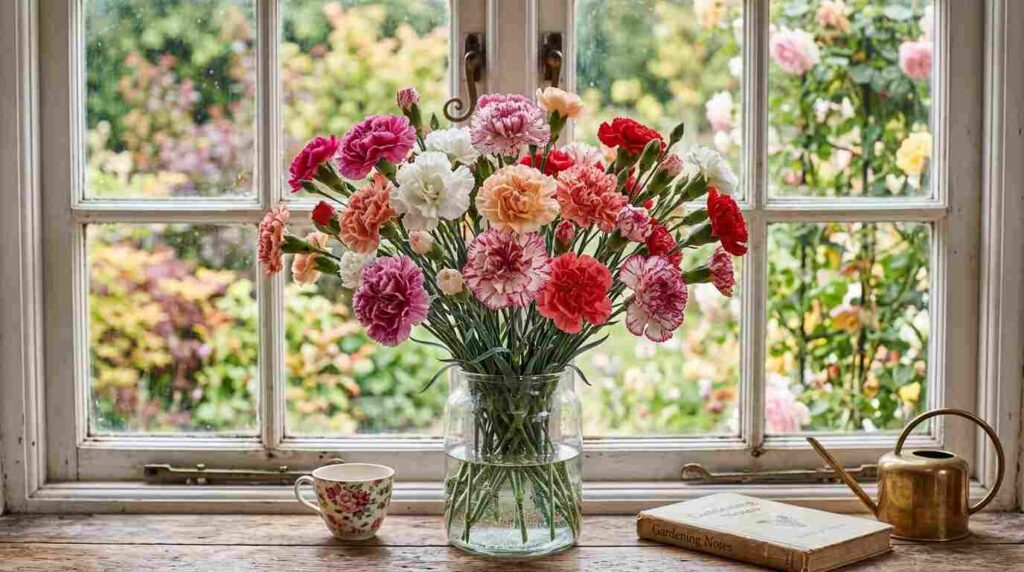
Yet, the fact that Yosui specifically chose a “white carnation” and made it the centerpiece of his title hints at the twisted perspective and unique irony characteristic of his early works.
Considering the imagery surrounding a white carnation, it carries connotations of “pure love,” but it is also accompanied by a quiet solemnity and a certain sense of loneliness.
As expressed in the lyric, “I didn’t feel anything when I was a child,” one suddenly discovers an incredible beauty in that pure whiteness that was easily overlooked in youth.
This is not merely an innocent, casual diary entry about a pretty flower; it reflects the cold, discerning, yet profoundly sensitive gaze of someone beginning to realize the boundaries of the world and the inevitability of endings. This linguistic sensibility—injecting a drop of unfamiliarity into ordinary, familiar scenery—was the definitive dividing line separating Yosui Inoue from the other “tatami-mat folk” singers of his generation.
The Weight of the Phrase “Withering Away”
The line in the latter half of the song, “No matter how beautiful a flower is, it must wither away someday,” might at a glance seem like a trite, worn-out expression of transience. Yet, set within this track built around a simple acoustic guitar arrangement, the phrase carries a weight that catches the ear with strange persistence.
Here, the reality of his vocal transformation over time ties back into the lyrics.
When a young Yosui delivered this section with his piercing high tones, it felt like an objective observation of the future. However, as decades pass and the phrase is uttered in a low, composed voice, the meaning passes through the singer’s own accumulated time, carrying a raw, palpable gravity. The unavoidable reality that all things must change and fade away dissolves quietly into this brief phrase: “withering away.”
The Perfect Placement of the Track in the Album “Danzetsu”
An “Oasis” Bridging Madness and Serenity
Taking a broader view, it is worth looking at the role this track plays within the entire structure of his debut album, “Danzetsu.” Driven by songs like the title track “Danzetsu” and “Kasa ga Nai” (No Umbrella), the album is a highly energetic work, laying bare the social anxieties of the era, complex internal human egos, and frantic desperation.
Within that heavy environment, “Shiroi Carnation” acts like an air pocket, momentarily dissolving the tightly wound tension.
- The Album Flow: Interspersing this deeply private, tranquil piece amid tracks depicting intense emotional outpourings and heavy human relationships creates an essential breathing space—a vacuum—within the entire album.
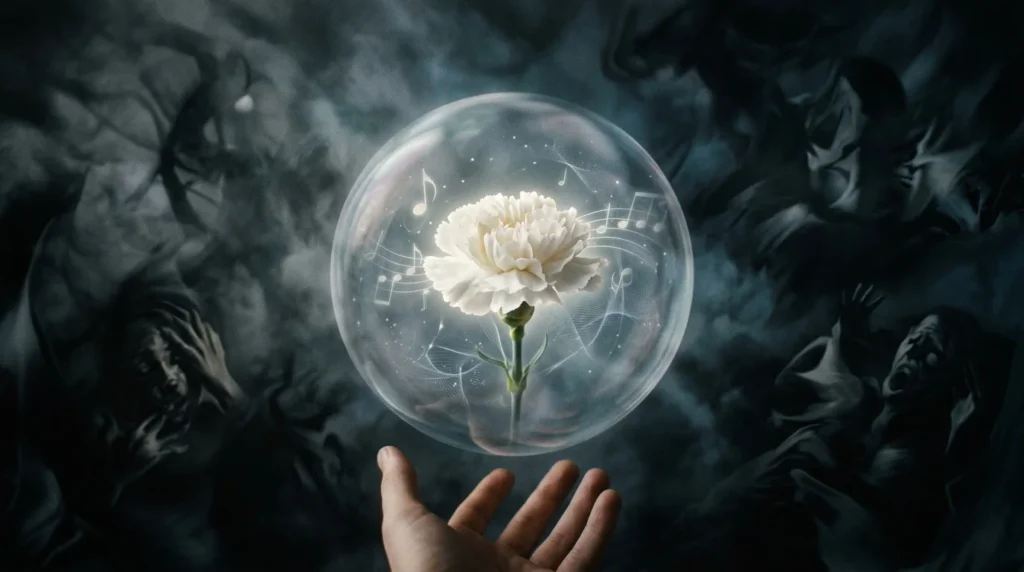
Yet, Yosui’s true brilliance ensures it never functions as a mere break.
Because of the intense heat radiating from the surrounding tracks, the coldness of this track’s white world stands out all the more, leaving listeners with a faint, underlying anxiety: “Is this tranquility truly real?”
The stillness hiding behind intense tracks, and the madness lurking beneath the calm. It is astonishing to realize that the balance required to navigate these two extremes was already fully mastered in his very first debut album.
Conclusion
“Shiroi Carnation” remains a modest, quiet piece often overshadowed by the massive hits in Yosui Inoue’s catalog.
However, from the vivid tones of the original studio recording to the settled, deeper timbre brought about by the unyielding passage of time in his later years, this song shows us a different kind of “shadow” with each era.
There is an unfathomable charm to Yosui Inoue as an artist who allows the physical inevitability of a maturing voice to naturally harmonize with the song’s intrinsic theme of fading away. There are no flashy arrangements or intense emotional outbursts here; just the simple beauty of watching a white flower quietly bloom and fade. This minimalist approach continues to bloom softly and flawlessly in the depths of our hearts, more than half a century since its release.

音楽ファン同士の交流・リクエストはこちら / Connect & Request Songs Here