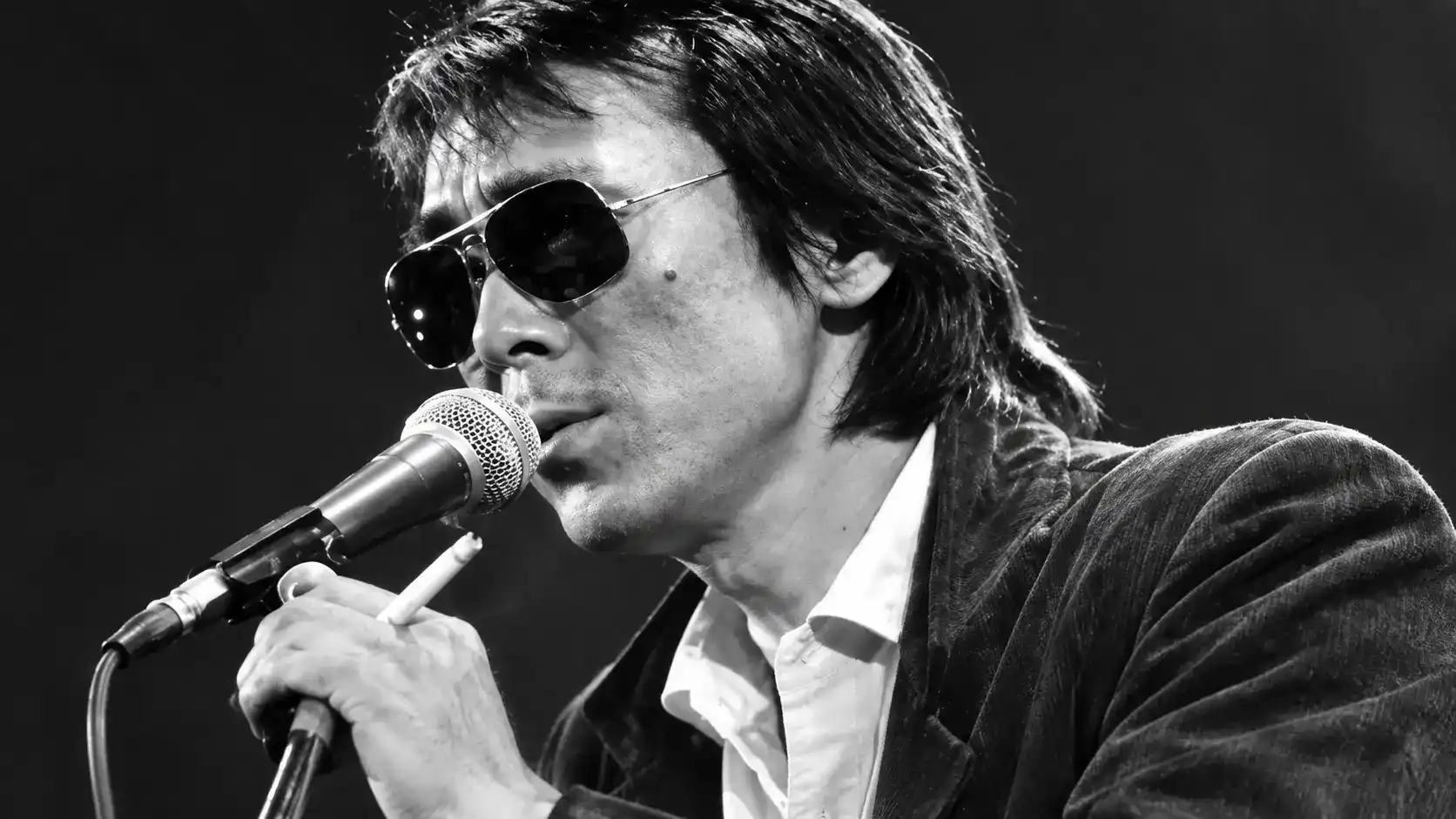
- 🎧 Enjoy This Article in Audio
- ―The Pinnacle of Hard-boiled AOR, Transmuting Urban Solitude into Aesthetics―
🎧 Enjoy This Article in Audio
You can quickly grasp the main points of this article through narration.
Recommended for those who want to catch the vibe of the music and the flow of the article before reading.
🎶 English Narration
An English audio introduction to the contents of this article.
⌛ Duration: Approx. 5 mins
🎵 Japanese Narration
A Japanese audio introduction to the contents of this article.
⌛ Duration: Approx. 5 mins
* Listening to the audio before reading helps you better understand the world of the music and the main points of the article.
―The Pinnacle of Hard-boiled AOR, Transmuting Urban Solitude into Aesthetics―
Born in Yokohama, Kanagawa, on May 18, 1947, Akira Terao was born into the destiny of an artist as the son of the renowned actor Jukichi Uno. Yet, he carved out a unique and incomparable niche in the Japanese entertainment world, using his signature “refined coolness” as his greatest weapon.
While his success as an actor needs no introduction, any discussion of Akira Terao as a musician must center on the “Terao Whirlwind” that swept across Japan in 1981. At the heart of this phenomenon was the legendary, record-breaking hit single, “Ruby no Ring” (Ruby Ring).
The Era-Defining “Ruby no Ring” and the Album Reflections
Released in February 1981, the single “Ruby no Ring” achieved a staggering record of 10 consecutive weeks at No. 1 on the Oricon charts. On the popular music program The Best Ten, it held the top spot for 12 consecutive weeks—an immortal milestone that remains unbroken to this day. The fever ignited by this single flowed directly into the album Reflections.
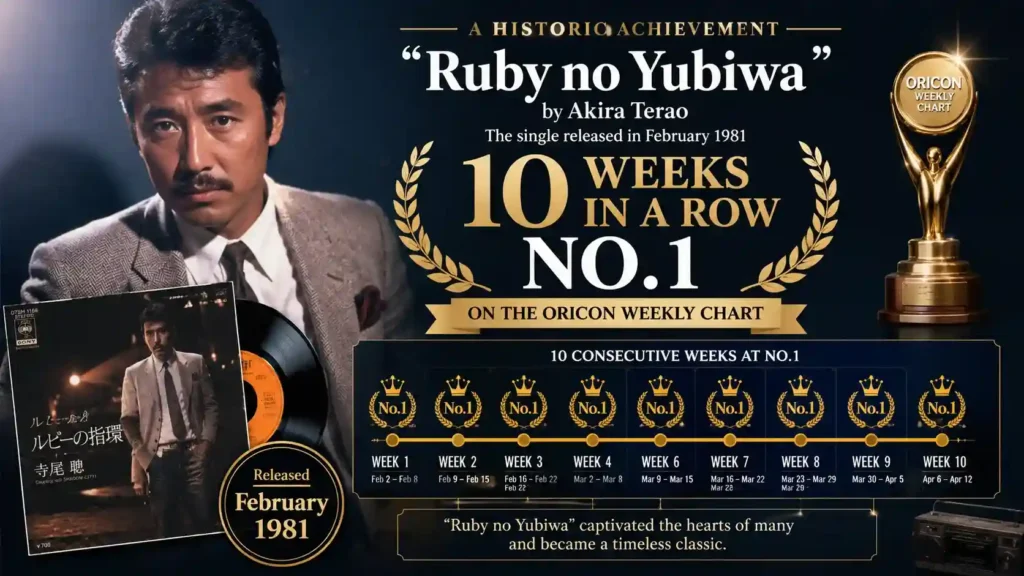
Reflections shattered the all-time sales records previously held by Yosui Inoue’s Korii no Sekai (World of Ice), marking the highest sales in the history of the Japanese record industry at that time. It became a mega-hit with over 1.6 million copies sold, ultimately defining the music scene of the 1980s. The song I’m featuring today, “Sasurai” (Departure), is the closing track of this historic album and is deeply cherished by fans, also serving as the B-side to the single “Havana Express.”
The year 1981 was a time when traditional “Kayokyoku” was evolving into “New Music,” and a sophisticated, urban sound was in high demand. Capturing that atmosphere perfectly, this song transcended the boundaries of a simple pop hit to define the “stoic style” that a mature man should embody.
First, check out the song via the official YouTube video!
English Credits
Akira Terao "Sasurai" (Departure)
Album: Reflections
Lyrics: Masako Ariyama
Composition: Akira Terao
Arrangement: Akira Inoue
Audio provided by: Universal Music Group
Master Rights: ℗ 1980 EMI Music Japan Inc.
Release Date: April 5, 1981
Quick Take
A signature track from the album Reflections, embodying the essence of urban AOR/City Pop.
The restrained vocals and heavy arrangement quietly depict the aesthetics of departure, solitude, and the stoic beauty of a departing figure.
The first time I heard this song… ♫
| My Age | Elementary | Jr. High | High School | University | 20s | 30s | 40s | 50s | 60+ |
| Release Year | 1981 | ||||||||
| When I Listened | ● |
The first time I heard this song was right around its release. In April 1981, I had just graduated from university and was on the threshold of my career as a new member of society. It coincided exactly with the time I finished my student life and left my familiar life in Tokyo to return to my hometown in Oita.
Akira Terao’s album Reflections is a work that recorded explosive sales, including the previously mentioned “Ruby no Ring.” For me personally, it was the first album where I truly felt the essence of Japanese AOR (Adult Oriented Rock). Of course, I loved “Ruby no Ring,” but I was equally—if not more—captivated by this song, “Sasurai.”
Tokyo at that time was an incredibly attractive city, brimming with an energy that was hard for young people to resist. I had considered finding a job in Tokyo until the very end, but one particular sight shook that decision. It was the night-time crowded trains I saw during my job hunt. Seeing the exhausted faces pressed against the window glass, I suddenly realized with a cold clarity, “I can’t live like this for decades.” As a result, I chose to return home to Oita.
“Sasurai” was released exactly at that turning point in my life. Even now, listening to this song brings back the vivid intersection of Tokyo’s glittering landscape and the dry wind that blew through my own heart at that moment.
1981: The Moment Japan Became Intoxicated with the Urban Mirage
Historical Context: The Shift from Emotionalism to Hard Textures
The year 1981, when “Sasurai” was released, marked a definitive turning point for the Japanese music scene. The previous year had seen the retirement of Momoe Yamaguchi and the rise of Seiko Matsuda as the new idol of the era. Meanwhile, with the release of Eiichi Ohtaki’s A LONG VACATION, the era of earthy folk songs and emotional ballads gave way to the rise of “City Pop” and “AOR”—genres characterized by a dry, calculated sophistication.
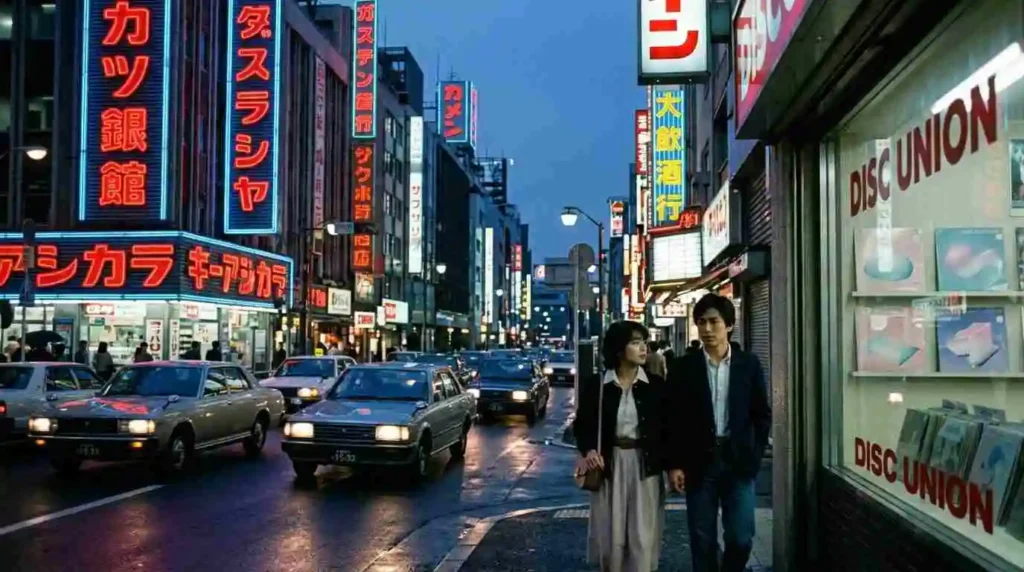
During this era, Japanese people, having tasted the fruits of high economic growth, were seeking a “spiritual presence” beyond mere material wealth. Akira Terao embodied that very ideal.
His cool persona as Detective Takeshi Matsuda (Riki) in the TV drama Seibu Keisatsu, always accompanied by a cigarette and sunglasses, provided a visual identity that fused perfectly with the meticulous arrangements of Akira Inoue. This fusion crystallized into the song “Sasurai.”
The Deconstruction and Redefinition of Japanese Pop
Akira Terao occupied a truly unique position in the music movement of the time. Coming from a background in the Group Sounds band “The Savage,” he completely stripped away traditional enka-like emotionalism, instead applying a Western musical approach to Japanese lyrics. For listeners at the time, this method functioned perfectly as “the background music for the urban lifestyle they aspired to lead.”
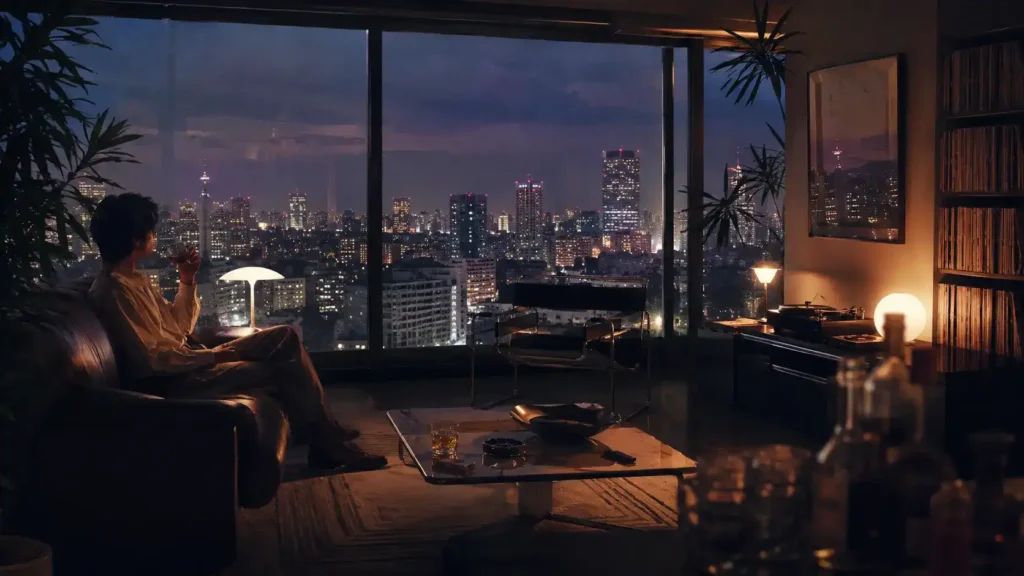
The success of “Sasurai” was not just due to the quality of the song itself, but rather the result of a high-level synchronization between the powerful influence of television dramas and the professional craftsmanship of sophisticated studio work.
The Cold Intelligence Hidden Within the Melody
A Voice Profile Utilizing the Deep Baritone Range
Akira Terao’s greatest weapon is his deep, resonant baritone voice. Though he composed the song himself, the melodic line is highly intellectual and does not rely on shouting or emotional outbursts. Positioned at the opposite end of the spectrum from the high-pitched emotional hits common at the time, his method involves placing notes like precision parts within a landscape of silence.
This “aesthetics of restraint” creates a powerful magnetic pull, inviting the listener to step into the song’s world rather than forcing a perspective upon them.
The Cutting-Edge Sound Design of Akira Inoue
Arranger Akira Inoue assembled top-tier musicians, including members of the band Parachute, and utilized the most advanced recording technology available at the time.
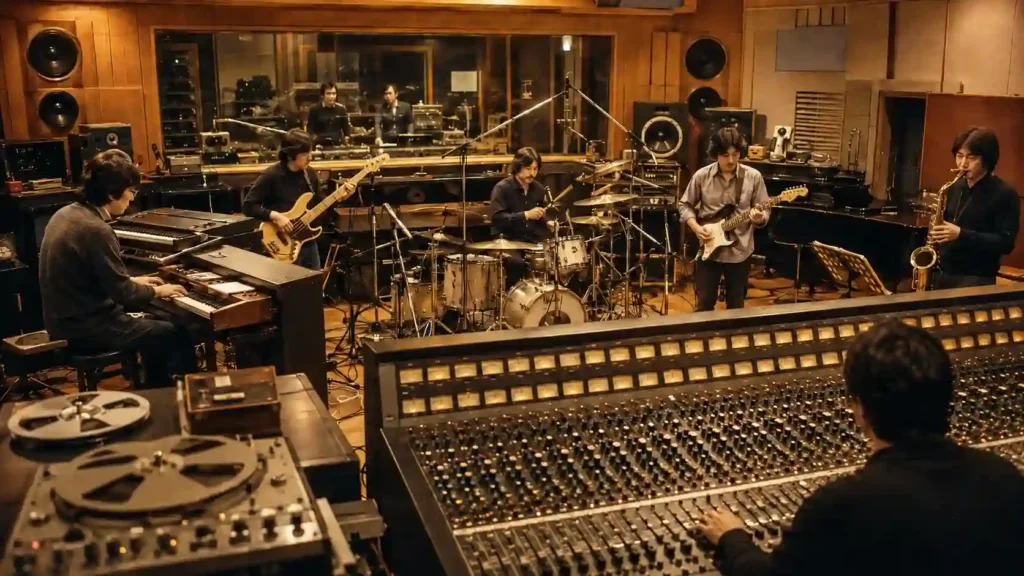
- Tight Drums: A snare sound that completely eliminates moisture, ringing out with the hardness of winter air.
- Sinuous Bassline: A technical performance that supports the song’s structure while expressing the pulse of an urban night.
- Synthesizer Accents: Electronic tones that shine coldly and sharply like a blade at key moments.
Together, these elements give the track a solid texture, reminiscent of the click of a high-end oil lighter or the sound of a heavy door closing. By intentionally emphasizing moments where no sound is played, this “subtractive composition” highlights the coldness of the city and the faint warmth hidden beneath its surface.
The Philosophy of the Endless Journey Within the Lyrics
Analyzing the lyrics by Masako Ariyama, one finds not a simple “escape,” but a “farewell and departure” chosen by one’s own will. While the City Pop of the time often depicted glamorous urban nights, this song captures the atmosphere of a cold, early morning.
The Equal Exchange of Freedom and Solitude
From the opening lines, a highly cinematic narrative unfolds. Against the backdrop of ships leaving the harbor, the protagonist leaves only their “shadow”—a symbol of their past self—on the pier. This metaphor eloquently demonstrates the resolve of a man trying to shed the weight of lingering attachments. What is expressed here is not sweet sentimentality, but an extremely dry sense of self-discipline.
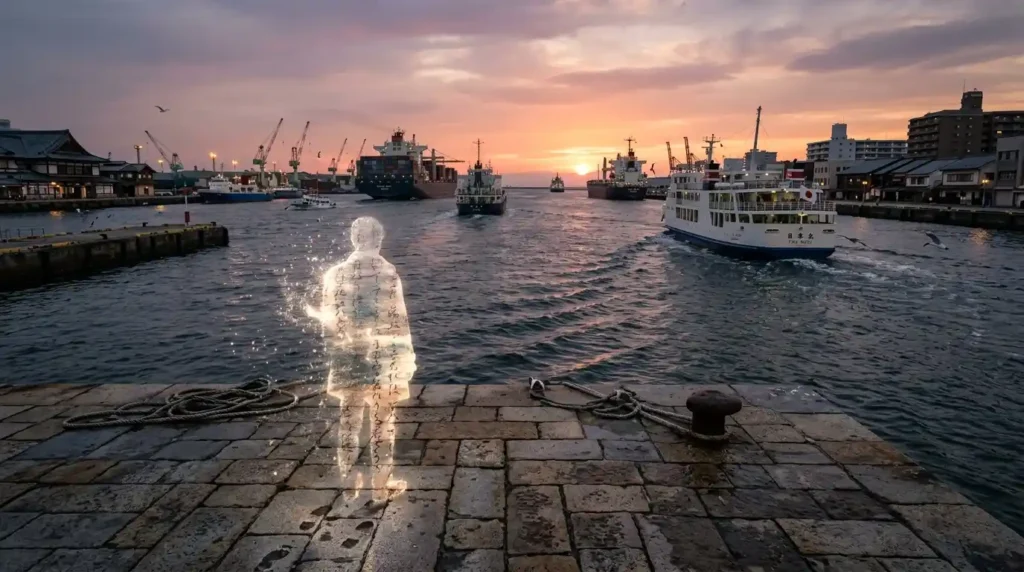
A Farewell that Leaves the “Shadow” Behind
The phrase suggesting that one exchanges “solitude” for “freedom” is the very embodiment of the stoic values held by a hard-boiled novel protagonist. Unlike earlier folk songs that emphasized emotional laments, Akira Terao sings of a dignified presence as an “individual” facing the world. This sense of scale captured the hearts of mature listeners and young people aspiring to be adults at the time.
This resonates perfectly with the decision made that winter—recognizing the energy of Tokyo while calmly deciding my “place to live” after seeing the exhausted faces in the crowded train. Leaving the glittering city behind as a “shadow.” Only those who know the weight of such a decision can truly feel the essence of this song.
The “Dawn Wind” as an Inorganic Accomplice
The phrase “Dawn Wind,” repeated throughout the lyrics, is not merely a description of a natural phenomenon. Ultimately, everyone must walk alone, but the wind blowing at one’s feet exists without emotion, yet never betrays.
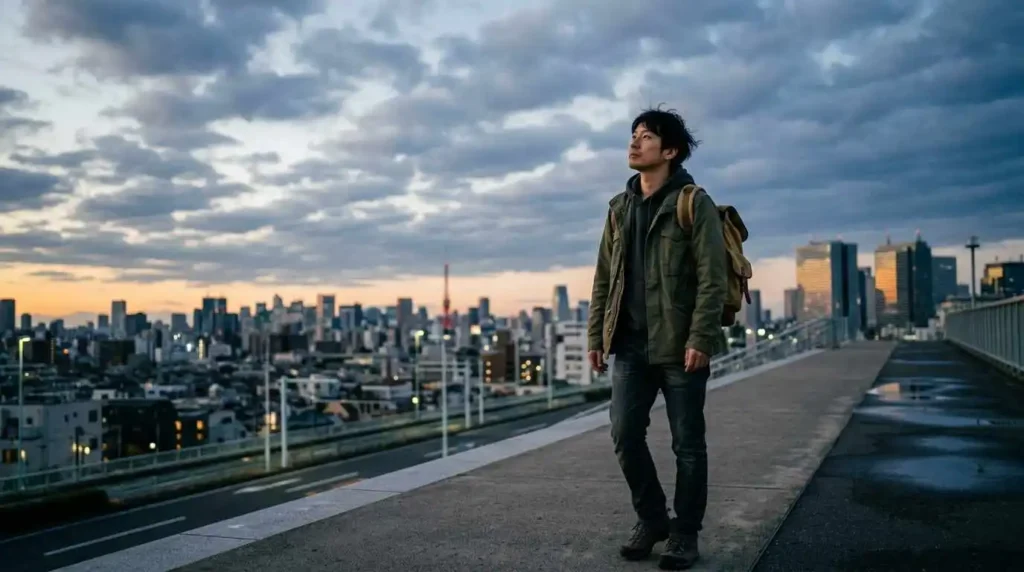
This “wind” is the only inorganic companion available to those who have cast off their attachments. There is a grace in acknowledging past memories as “colors” but refusing to take them as companions on the journey. Akira Terao’s intelligence as an artist shines through in his choice of words that run quietly alongside the listener without overstimulating the emotions. The cold tension generated in moments of silence makes the chill of this “wind” feel all the more real.
The Spiritual Depth Symbolized by the Color “Blue”
The final phrase, “The blue dawn wind,” uses the color “blue” (aoi) not to indicate immaturity, but to symbolize a deep, transparent state of mind—like the deep sea or outer space—reached after stripping away all impurities. As the sound fades, that “blueness” remains etched in the listener’s mind as a vivid afterimage.
The Trajectory of Akira Terao and the Establishment of the “Self”
From “The Savage” to Kurosawa Films and Reflections
Akira Terao’s musical career began in the 1960s with the Group Sounds band “The Savage.” He initially showed a refreshing youthful image with hits like “Itsumademo Itsumademo.” However, after nearly 15 years, he attained a completely different musicality.
His career as an actor deeply influenced this evolution. Having appeared in several masterpieces by director Akira Kurosawa, such as Ran and Dreams, and having stared into the depths of human nature, he was able to seal the “weight of life” into his songs without any impurities. Rather than a singer playing a role, the core of his artistry as an expressive creator bleeds into both his singing and acting. This consistent style is concentrated within the few minutes of drama that is “Sasurai.” His singing is the ultimate form of the “aesthetics of subtraction,” stripped of all excessive ornamentation.
Uniqueness Within the Modern City Pop Revival
In recent years, Japanese music from the 1980s has been re-evaluated worldwide, mostly centering on images of resorts, summer liberation, or glamorous urban nights. However, Akira Terao’s music—and “Sasurai” in particular—stands apart from such fleeting trends.
Not a Cocktail Party, but the Intensity of Straight Whiskey
If most City Pop is a colorful cocktail party, “Sasurai” is like a glass of straight whiskey enjoyed alone in a bar just before closing. Because it presents a universal “way of being” as an individual that is not swayed by trends, it doesn’t feel dated at all even 40 years after its release; instead, it provides a sharp, cold comfort to modern people exhausted by the flood of information.
_202-1024x572.webp)
In Conclusion: The Meaning of Listening to This Song Today
Celebrating Akira Terao’s birthday by listening to “Sasurai” again, I realize that it records the difficulty of remaining true to oneself and the dignity found beyond that challenge.
In the journey of life, we sometimes let go of precious things and leave familiar places. My own choice back then—graduating from university and leaving the bright lights of Tokyo for my hometown—was perhaps a kind of “Sasurai” in its own right. Yet, there is a strength in quietly staring at one’s own shadow remaining in that moment and starting to walk again with the dawn wind. This song teaches us that noble sense of self-discipline.
The “essence of being cool” that Akira Terao has shown us throughout his career is not about surrendering to the waves of emotion, but about loving the freedom that comes with solitude and continuing to walk forward.
Happy Birthday, Akira Terao. Your performance of “Sasurai” continues to act as that clear “dawn wind,” steadily pushing the backs of those striving to walk their own paths.


音楽ファン同士の交流・リクエストはこちら / Connect & Request Songs Here