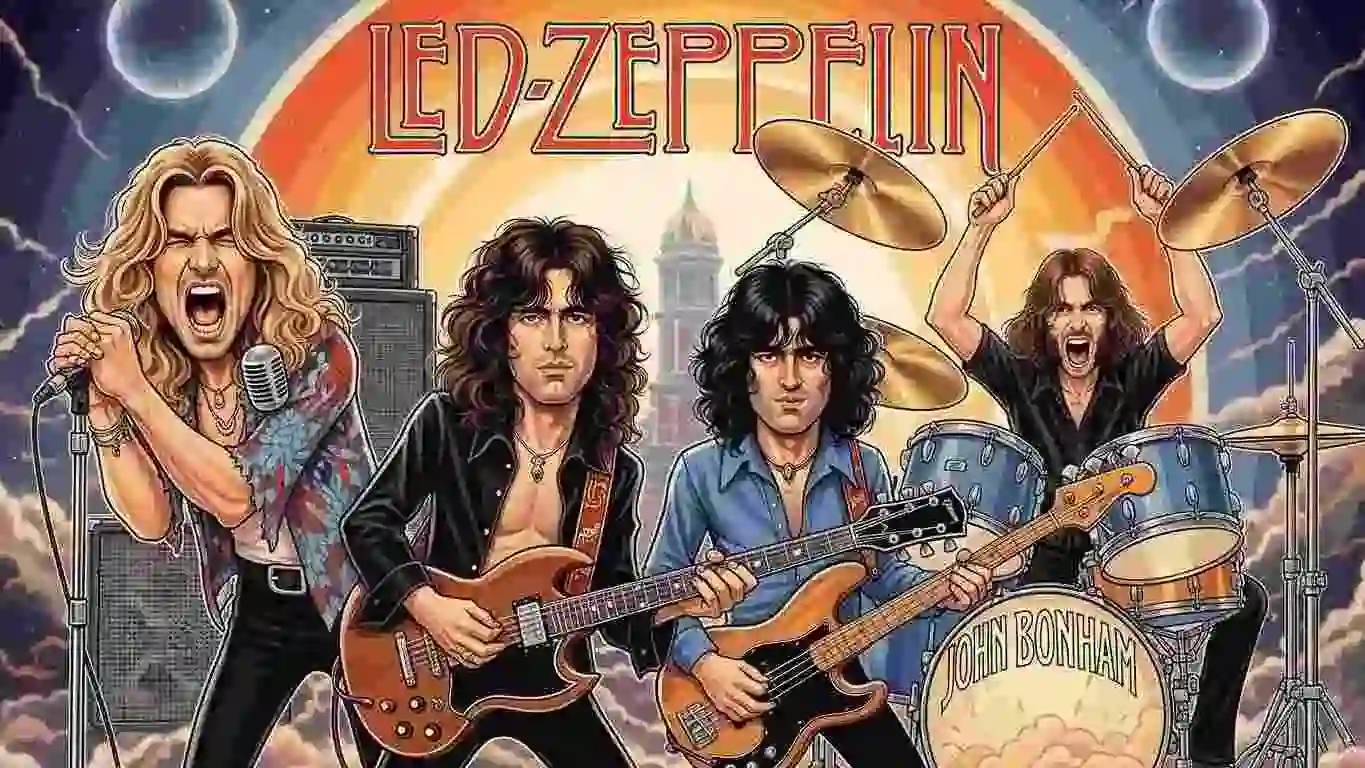
■For more information about 【Led Zeppelin】, click here・・・・➡ 🎈 (Zeppelin)
- 🎧 Listen to This Article
- 🎸【Led Zeppelin Series】Ranked No. 24 is…
- Basic Information About the Track
- A Structure Shaped by a Fragmented Recording Environment
- What the Unaccompanied Guitar Break Reveals
- What the Lyrics Portray Is Not Emotion, but Judgment
- A Structure That Captures Only the Moment of Ending
- When Sound Overtakes Words
- A Distance That Has Not Changed Over Time
🎧 Listen to This Article
This article is also available as a short audio narration (about three minutes).
Based on the flow of the text,
the narration traces the sharp intensity and sense of distance found in “Heartbreaker.”
English is on the left, Japanese on the right.
🇺🇸 English narration
🇯🇵 日本語ナレーション
🎸【Led Zeppelin Series】Ranked No. 24 is…
🎸 No.24 in the 【Led Zeppelin Series】: “Heartbreaker”.

Placing this song at No.24 may feel slightly unsettling, especially when you think of Led Zeppelin’s most iconic tracks.
With its instantly recognizable guitar riff, unmistakable structure, and repeated references throughout rock history, this placement may seem surprising.
Even so, I settled on this position.
The reason is simple: I reconsidered the role this song plays within my Best 25 list, not emotionally, but structurally.
Ultra-Short Summary
In this song, a narrator looks back on a past relationship.
The other person has returned, but the relationship cannot return to what it once was.
Time has clearly passed, and the experiences and wounds accumulated along the way have created distance between them.
Ignoring rumors and outside opinions, the narrator tries to move forward, while repeatedly recalling betrayal and exhaustion within the relationship.
What is ultimately expressed is not reconciliation or understanding, but a determination to cut the relationship off entirely.
🎥 As always, please start by watching the official YouTube video.
🎬 Official Video Credit (Official Audio)
Song Title: Heartbreaker
Artist: Led Zeppelin
Album: Led Zeppelin II
Release Year: 1969
Format: Official Audio
Source: Led Zeppelin Official YouTube Channel
🎼 Two-Line Commentary
With its sharply cutting guitar riff and highly improvisational structure, this track symbolizes the aggressive edge of early Led Zeppelin.
Rather than leaving behind a story or lingering aftertaste, it imprints pure performance intensity through moments of focused impact.
Basic Information About the Track
About This Song
- Artist: Led Zeppelin
- Song Title: Heartbreaker
- Album: Led Zeppelin II
- Release Year: 1969
This track has a particularly strong presence within the album, instantly changing the atmosphere when it begins to play. However, its presence doesn’t expand outward—it concentrates sharply into a single point.

A Structure Shaped by a Fragmented Recording Environment
A Song Born Between Touring and Recording
When “Heartbreaker” was created in 1969, Led Zeppelin were in an exceptionally intense period, balancing touring and recording at the same time.

A Production Style Without Settling In
Fragmented Time and Place
The album Led Zeppelin II was not created in a single studio through concentrated sessions.
Instead, it was completed by assembling tracks recorded in fragments—between travels, within limited timeframes, and across different environments.
How That Environment Shaped the Music
That fragmented production process seems to be etched directly into the structure of “Heartbreaker.”
Rather than carefully weaving a narrative, the song prioritizes extracting and connecting only moments of high intensity.
What the Unaccompanied Guitar Break Reveals
The Moment the Ground Suddenly Disappears
The guitar break that appears in the middle of “Heartbreaker,” where the rhythm section completely drops out, is an element that cannot be ignored when discussing this song.

Sound in a Space Without Tempo
A Structure That Rejects Support
With both drums and bass disappearing, the guitar is left alone in a space where the foundation that supports tempo is gone. This structure was highly unusual at the time.
Choosing the Moment Over Stability
What is demanded here is not continuity or accumulation, but intense focus within a single moment. This is not merely a performance highlight—it symbolizes the very stance that “Heartbreaker” takes as a song.
What the Lyrics Portray Is Not Emotion, but Judgment
There Is Reflection, but No Nostalgia
Looking back at the lyrics of “Heartbreaker,” the narrator is clearly reflecting on a past relationship.
However, there is almost no warmth of nostalgia or lingering attachment in that gaze.

They Returned, but the Relationship Could Not
Distance Determined by Time
The other person has returned. Yet the relationship cannot return to what it once was.
The reason is not emotion, but time—time that has already passed.
What Repeats Is the Memory of Exhaustion
What the lyrics emphasize are betrayal and fatigue experienced within the relationship, and a deep sense of exhaustion tied to continuing it.
A Structure That Captures Only the Moment of Ending
Why This Is Not a Breakup Story
“Heartbreaker” is not a story meant to heal heartbreak.
The process of wavering emotions, hesitation, and gradual decision-making is largely absent.
The Coldness of Presenting Only the Result
No Reconciliation, No Understanding
What is ultimately expressed is not understanding or compromise, but a clear intention to cut the relationship off entirely.

Lyrics That Offer No Emotional Exit
This structure offers no emotional escape for the listener.
Sadness is not soothed, anger is not resolved—only the fact that “it has ended” remains.
When Sound Overtakes Words
Momentum Leaves the Story Behind
Playing That Moves Forward by the Shortest Route
The guitar riff refuses explanation, and the rhythm section pushes forward without hesitation.
As a result, the listener experiences not a narrative, but a succession of intensity.

The Choice Not to Explain
The more one tries to closely analyze the lyrics, the more distance can be felt from the music.
However, this gap is not a flaw.
I see it as the result of an intentional choice by the song—to remain unspoken.
A Distance That Has Not Changed Over Time
A Song That Always Rises in the Same Place
After listening to this song over many years, the sense of distance I feel toward “Heartbreaker” has hardly changed.
The sharpness and aggression I felt when I was younger still rise up in the same way today.

A Distance Unchanged by Time
I’ve listened to this song for a long time, but my distance from “Heartbreaker” has not changed much.
The sharpness I felt the first time still rises exactly as it did then.
When I want to reset my mood or tighten the atmosphere, this is a song that quickly comes to mind.
Still, it’s not a place where I linger.
The music keeps moving forward, leaving little space for emotion to settle.
An Unchanging Strength
No matter how many times I listen, this song faces me from the same angle.
There is a sense of reliability, but the relationship does not deepen.
“Heartbreaker” is a strong, sharp, and decisive song.
By maintaining a certain distance from it, its intensity becomes most visible.
That is how I feel now.

コメント