
■ For a detailed overview of 【Led Zeppelin】, click here・・・・➡ 🎈 (Zeppelin)
- 🎧 Listen to the Audio Version of This Article
- 🎸【Led Zeppelin Edition】No.23 is…
- Looking at the Background—Only What’s Necessary
- Depth Seen Through Narrative
- The Uneasy Ground Created by the Sound
- What an Unresolved Story Leaves Behind
- How the Song Changed Along My Own Timeline
- Why I Placed This Song Here
- In Closing
🎧 Listen to the Audio Version of This Article
🎵 Japanese narration
🎶 English narration
Press play to listen to an approximately three-minute narration (Japanese or English) exploring why “Going to California” holds a quiet but essential place within the album, and how its presence continues to linger without drawing attention to itself.
Listening to the narration before reading may help clarify why this song feels neither flashy nor definitive, yet remains an essential part of Led Zeppelin’s story.
🎸【Led Zeppelin Edition】No.23 is…
No.23 is “Going to California”.
The sound image most people associate with the name Led Zeppelin feels noticeably distant from what this song actually delivers. Words like heaviness, power, or symbolism don’t quite explain where this track belongs. And yet, the more times I return to the album, the more quietly this song continues to stay with me. That lingering presence has always felt a little mysterious.
It isn’t flashy. It isn’t decisive. And still, it would be missed if it were gone.
“Going to California” stands in exactly that kind of place.
Ultra-Short Interpretation
Leaving behind days that didn’t work out, and heading far away to change something.
 With no clear destination, only the feeling that another way of living might exist somewhere.
 Overwhelmed by the scale of nature and uncertainty, yet still choosing to move forward.
 Dreaming of an ideal presence while facing a self that has not yet become anything.
🎥 As always, please start by watching the official YouTube video.
🎬 Official Video Credit (Official Audio)
 Song Title: Going to California
 Artist: Led Zeppelin
 Album: Led Zeppelin IV
 Release Year: 1971
 Format: Official Audio
 Source: Led Zeppelin Official YouTube Channel
 🎼 Two-Line Commentary
 A quiet, introspective journey woven from acoustic guitar and mandolin.
 By stripping away aggression, the performance gently traces the emotional uncertainty of searching for an ideal place.
Looking at the Background—Only What’s Necessary
A Creative Atmosphere That Never Fully Became Myth
This song appears on Led Zeppelin IV, released in 1971.
Although the band was ascending toward both commercial and critical peaks, the recording process itself reflected a period of careful searching—of what should come next. Simply amplifying what had already been established was no longer enough. That sense of restraint quietly shaped the atmosphere around this track.
Stories remain that the song carried a different working title during its early stages, and that experiences during the band’s stay in Los Angeles helped solidify its imagery. Yet these details feel distant from the kind of mythologized anecdotes often attached to rock history.
The finished sound avoids projecting grandeur as a symbol of its era. Instead, it feels personal. Accidents and environmental influences remain lightly unpolished. What comes through is less a “calculated masterpiece” than a state of mind that could only exist at that moment. That sense of warmth, rather than intention, is what lingers.

What an Alternate Mix Reveals About the Design
Listening to later-released alternate mixes clarifies how carefully this song was constructed. With the vocals pulled back, it becomes clear that the melody and accompaniment exist primarily to establish a space rather than to dominate it.
Here, words are not the sole focus; the environment surrounding them becomes equally important. The slight unease present in the final version was not accidental—it had already been built into the music itself.
Depth Seen Through Narrative
What’s Being Sought Isn’t an Answer
The protagonist never declares a clear goal. It may sound like a search for someone, but that outline never fully solidifies.
To me, it feels less about a person or ideal, and more about finding a place where the current state can finally be escaped.
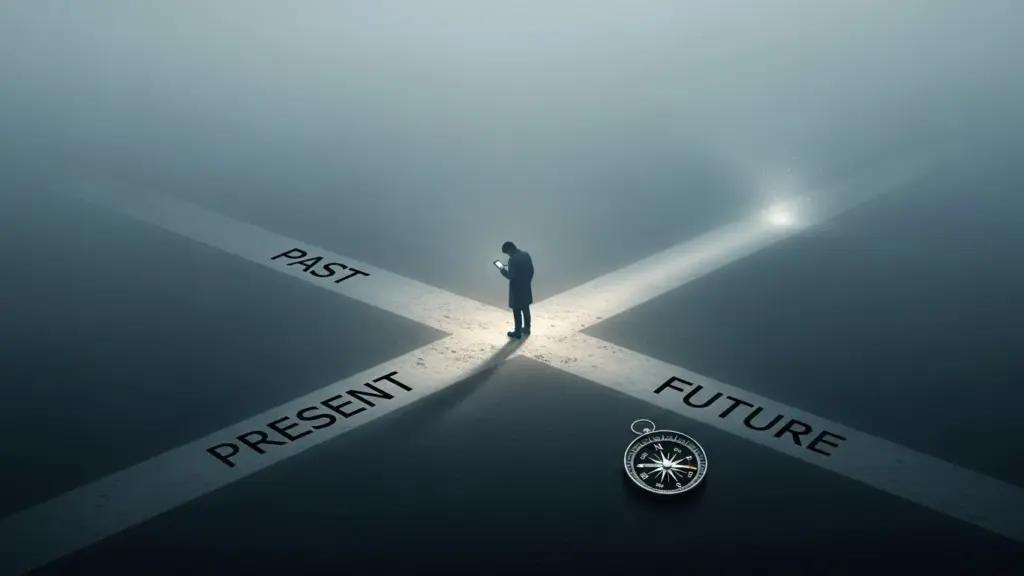
There is no certainty that movement will solve anything.
And yet, staying still is no longer an option.
That contradiction is never resolved within the song.
Mythic Language as a Support for Reality
Everyday images coexist with words that feel almost mythological. But this isn’t about enlarging the world—it feels more like a way to endure moments when reality itself becomes too heavy to hold.
Reality alone is unbearable.
Yet total escape into fantasy isn’t possible either.
That in-between time becomes the song’s quiet breathing space.
The Uneasy Ground Created by the Sound
When Unassertive Sound Preserves the Situation
The performance remains restrained throughout, centered on acoustic instruments. The mandolin never steps forward as decoration; instead, it traces the outline of the scenery, quietly supporting the space the song inhabits.
A tuning slightly removed from conventional resonance creates a texture that never fully settles into brightness or darkness. Even without understanding the technical details, one can sense that the ground beneath the song is subtly tilted. That instability lingers unmistakably in the ear.

What an Unresolved Story Leaves Behind
By Avoiding Conclusions, the Song Never Ends
Even after “Going to California” reaches its final note, the story never fully closes.
Whether the protagonist found what they were searching for—or even intended to find it at all—remains unclear.
I take this lack of resolution as a deliberate absence.
By withholding the outcome of the journey, the song remains not as an event, but as a condition. Movement has occurred, yet its meaning stays suspended.
Many real-life choices cannot be neatly organized afterward as “the right one.” This song feels as if it turns that very impossibility into sound.

Neither Hope Nor Despair Takes Over
There is no explicit declaration of hope here, nor is there a sense of collapse or final resignation.
What remains is simply the feeling that staying is no longer possible—and the fact that movement continues anyway.
Because of this, the song doesn’t offer instruction, nor does it push the listener forward. It leaves the state of suspension intact, without judgment. That stance feels deeply realistic to me.

How the Song Changed Along My Own Timeline
At First, It Failed to Leave an Impression
To be honest, this song wasn’t special to me at first.
The album is filled with tracks that immediately seize attention, and beside them, “Going to California” felt almost too quiet, its contours difficult to grasp.
At the time, I likely couldn’t tell what the song was trying to say. Its assertions were subtle, its peaks muted, and it lacked an obvious hook to anchor it in memory. I listened, and then I moved on.
It Became Real During a Time of Indecision
There came a period when I believed I had made a choice, yet remained uncertain. I couldn’t tell whether I was truly moving forward or simply changing locations. It was during that prolonged state that I happened to listen again—and suddenly, the song’s sense of “being in transit” felt close.
Movement without resolution. Time passing without conclusions. None of it dramatized or explained—just left as it was. That honesty is what made the song resonate differently.

Sometimes, What Isn’t Said Is What Remains
This song never dictates how the listener should feel.
There is no pressure to interpret it in a particular way.
As one’s own circumstances change, the song’s shape shifts naturally in response. Things once invisible can suddenly take form. Noticing that change, I realized that this song’s place within me had quietly been rewritten.
Why I Placed This Song Here
Stepping Away from the Center Clarifies the Shape
Placing this song at the very center of Led Zeppelin would oversimplify something.
They are not a band that can be summarized as quietly introspective.
“Going to California” works precisely because it operates slightly off-center. Amid songs of greater intensity, it introduces uncertainty and motion without resolution. Considering that role, this position felt the most natural.
This Is Not About Evaluation, but Placement
The ranking here does not represent superiority or inferiority.
It reflects where the function of this song is best understood.
By appearing earlier, the song subtly reframes what follows. It introduces a scale that cannot be measured solely by power or completeness. For that purpose, this placement felt exactly right.
In Closing
“Going to California” is a song that exists to prevent over-explanation.
By refusing to offer conclusions, it leaves room for the listener’s own time to enter.
It is not flashy. It is not definitive. And still, it would be missed.
Because this song is here, Led Zeppelin becomes just a little more dimensional.
For me, that is exactly what this song is.


コメント