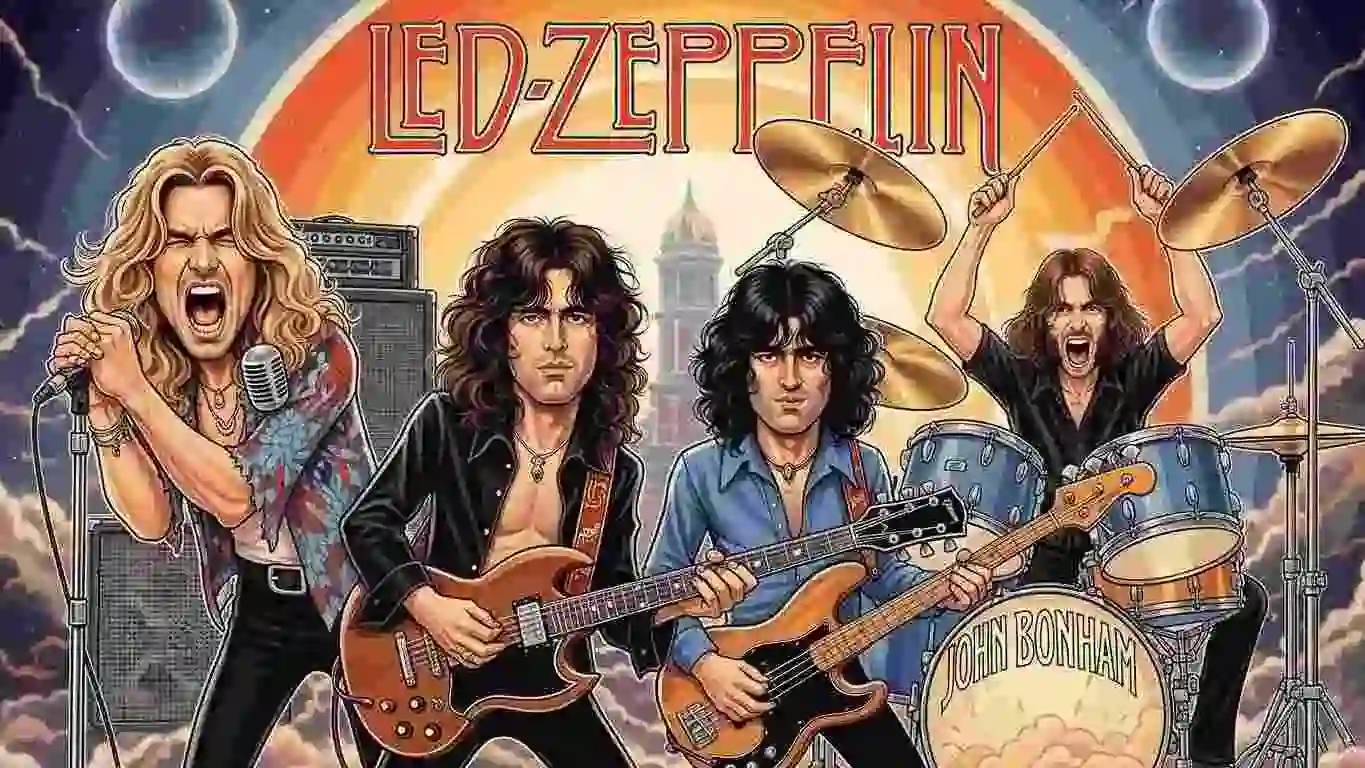
■【About Led Zeppelin】For more detailed information, click here・・・・➡ 🎈(Zeppelin)
🎧 Listen to the Article
This article is also available as a short audio narration of about three minutes.
Following the structure of the written piece,
the narration traces the restless momentum and physical drive of “Trampled Under Foot,” ranked No.21.
Feel free to listen before reading, or after finishing the article.
🇺🇸 English narration
🇯🇵 Japanese narration
🎸【Led Zeppelin Edition】No.21 is・・・・
🎸 No.21 in the Led Zeppelin edition is “Trampled Under Foot.”
When listening through Physical Graffiti, this track offers almost no place to catch your breath.
Nothing feels like it resets or turns over—before you realize it, the next song has already begun.
That lingering sense of restlessness is reflected directly in its placement in the ranking.
Ultra-Summary
This song portrays a direct, physical desire to hold onto another person’s body and presence. The narrator repeatedly reaches out, tries to touch, dominate, and keep hold of the other, but what ultimately happens to the relationship is never stated. With no clear beginning or end, only the impulse of the one who desires continues to revolve at a constant intensity.
🎥 As usual, please start by watching the official YouTube video.
🎬 Official Video Credit (Official Audio)
Artist: Led Zeppelin
Song Title: Trampled Under Foot
Album: Physical Graffiti
Release Year: 1975
Format: Official Audio (Remastered)
Two-line Commentary
Driven by a funky rhythm and repetitive performance, this track depicts a situation where desire continues at a constant pace.
Within Physical Graffiti, it functions as a high-momentum track that pushes the album forward without interrupting its flow.
Official Live Video Credit
Artist: Led Zeppelin
Song Title: Trampled Under Foot
Original Album: Physical Graffiti
Performance Year / Venue: 1975 / Earl’s Court, London
Format: Official Live Video (HD)
🎼Two-line Commentary
Compared to the studio version, this live take emphasizes tempo and forward momentum, with the performance itself driving relentlessly ahead.
The song’s portrayal of desire becomes a visible physical motion as it merges with the audience’s response.
The Shape That Emerges Within the Album
ThThe First-Half Flow of Physical Graffiti
“Trampled Under Foot” is featured on Physical Graffiti, Led Zeppelin’s 1975 double album. The record brings together material recorded between 1969 and 1974, resulting in a wide range of sounds and moods shaped by different periods.
The song appears relatively early in the first half of the album. Recorded during the 1974 sessions, it was also released as a single in the United States, highlighting the band’s growing focus on groove-driven, rhythm-centered tracks at the time.

As Physical Graffiti unfolds, its pacing shifts constantly from track to track. Rather than slowing the album down, “Trampled Under Foot” keeps things moving, carrying the listener directly into what follows.
When I first heard this song in college, I wasn’t analyzing it closely. I simply noticed that once it came on, the album never seemed to lose its forward pull, and the music flowed straight into the next track.
At the time, I didn’t have words for that feeling. Looking back now, it seems less like a dividing point and more like something that quietly pushes both the preceding and following songs ahead together.
Choosing Not to Be the Centerpiece
The playing and vocals are assertive, yet the song never settles into the role of carrying the entire album. With longer and more narrative-driven tracks waiting nearby, it presents a situation and then moves on without lingering.
I never felt this distance made the song modest or lightweight. Its role is clearly defined, and there’s no hesitation in how it’s placed. Setting it around this point in the ranking sharpens its outline rather than diminishing it.
The Concrete Situation Described in the Lyrics
Why the Metaphors Become Entangled
The object of desire described in this song is clearly a person.
However, the words directed toward that person are repeatedly layered with imagery drawn from cars and machinery.
As a result, the boundary begins to blur between seeing the other as a human being and treating them as something to be possessed. The narrator’s stance remains firmly on the side of “the one who desires,” while the relationship itself gradually becomes harder to discern.
What matters here is not the cleverness of the metaphors, but the fact that the narrator is unable to organize the object of desire. Wanting comes first, while meaning fails to catch up. That imbalance is sustained throughout the lyrics.

What Remains Is Action, Not Relationship
How the other person feels, or where the relationship might be headed, is barely depicted. What remains are repeated actions—chasing, reaching out, trying to touch. Here, progression of a story matters less than the persistence of the same situation.
This structure reads less like a love song and more like a record of impulse. It is not about gaining something, but about movement that refuses to stop. That clarity is what keeps the song pressing forward.
The Sense of Motion Created by the Sound
Why the Body Reacts First
This song leaves little room for reflection. With a clear rhythm and well-defined roles for each sound, the listener naturally starts marking the beat with their body. Before there is time to step back and examine the structure, the music pulls you into the next movement. That speed is one of its defining traits.
Why the Flow Never Breaks
Even as phrases repeat, the sound never becomes congested, so the momentum does not stall. No single element dominates the space; everything moves forward at the same pace. As a result, the song carries force without leaving behind a sense of heaviness or pressure.
Organizing the Lyrics as a Situation
Not Unable to Stop, but Unwilling to Stop
What the song presents is the impulse to want another person’s body and presence. It feels less like a loss of control than a deliberate abandonment of control. The narrator continues to want, without explaining why stopping is impossible—only that the behavior persists.
There is little sign of conflict or hesitation. The initial desire is never adjusted or questioned. Because of this, the lyrics move in a straight line, leaving no space to pause. It is not so much that the desire is strong, but that continuing to desire is treated as a given. That assumption gives the song its rigid quality.

A Structure Where the Other Fades from View
The narrator continues to throw words toward the other person, but no response is shown. Neither rejection nor acceptance appears, and the other gradually loses definition. In its place, only the narrator’s actions and sensations remain in the foreground.
This creates an unstable texture. Though it seems to describe a relationship between two people, only one perspective truly exists. That imbalance produces a sense of closure even as the language stays concrete.
What Happens in the Moment of Listening
Excitement That Does Not Accumulate
There is excitement here, but it does not keep building upward.
The song advances at the same speed and height throughout.
When it ends, the feeling is less about release than about that state simply remaining.
That lingering sensation feels central to the song’s character.
The Body Moves Ahead of Meaning

The strong forward drive of the performance makes the body react before the content can be processed. When you try to follow the metaphors and words, the next beat has already arrived. That mismatch leaves behind a faint sense of restlessness.
That restlessness keeps the song from being reduced to simple groove. As it moves forward without allowing full comprehension, the intensity of desire becomes the most visible element. That sensation runs through both the sound and the lyrics.
Why No.22?
Why It Doesn’t Belong Higher
The song has momentum and immediacy, but it does not carry the listener to a different place. It neither expands a worldview nor pulls emotions into deeper layers. Placing it too high would make the overall flow of the Best 25 feel flat.
Why It Doesn’t Sink Lower
At the same time, this is not merely a functional track. It keeps the body moving while holding the listener within a closed perspective. That distinct sensation is too strong to be dismissed by placing it lower.
For that reason, this song sits at No.22. It does not lead the entire list, but it prevents the flow from stopping. Just as it functions within the album, it serves a similar role within the Best 25.
This is not music meant to conclude or resolve anything. It simply gives sound to a state of continued wanting. Keeping that character intact is why this position feels appropriate.
コメント