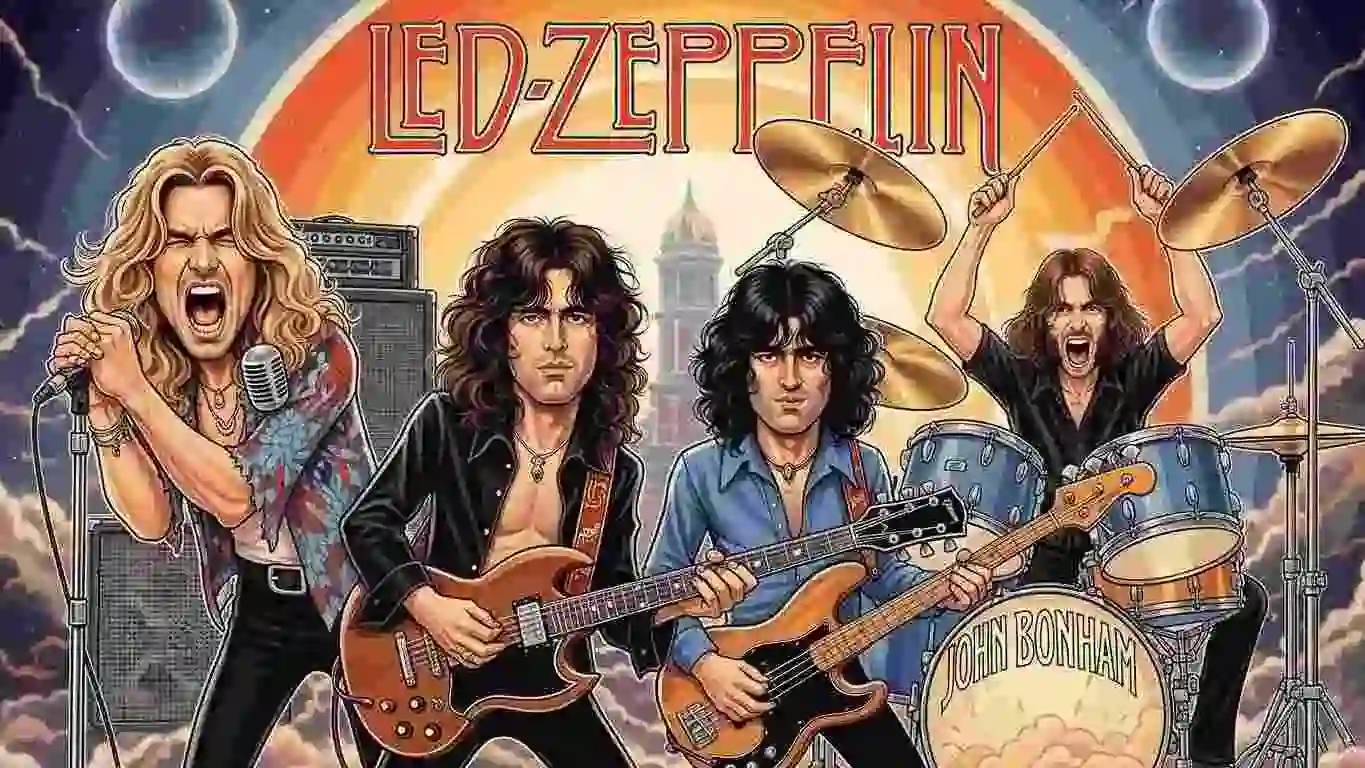
■For more on Led Zeppelin, click here… ➡ 🎈(Zeppelin)
🎧 Listen in Audio
This article is also available as an audio narration of about three minutes.
Following the flow of the text, we explore the unique atmosphere of No.2 “D’yer Mak’er,” where loneliness and freedom blend together.
Please enjoy the story in sound as well — before reading, or after you finish.
🇺🇸 English Narration
🇯🇵 Japanese Narration
🎸【Led Zeppelin】No.2 is…
It is “D’yer Mak’er”, from the 1973 masterpiece Houses of the Holy. (I had always read it as “Didja Make Her.” In Japanese, it is often written as “D’yer Mak’er (Jamaica).”)
After passing through the huge cathedral that is No.3, “Kashmir”, the song I chose for No.2 wears a light rhythm—standing at the opposite pole from the heavy atmosphere up to that point.
This song feels like a crystallization of a certain “playfulness” that Led Zeppelin carried within them. But for me, it isn’t merely a trick pitch. No matter how many great songs I’ve passed through, the rhythm of this “beloved heretic” has always continued to ring in the deepest place of my heart.

A wistful melody, and a reggae rhythm so bright it almost feels out of place. In that strange coexistence, I feel a loneliness beyond words—and a freedom that feels like salvation.
Why is this song placed right beside the summit, at No.2? I want to unravel that reason not with logic, but only with the heat of my simple feeling: “I love it.”
[Ultra-Short Summary: A Lament for the One Left Behind]
A painfully naïve plea: “Don’t go.”
A boundary of sanity barely maintained by borrowing an upbeat rhythm.
Facing the back that walks away, an inarticulate scream entrusted to a reggae pulse.
It is the most delicate, and the most selfish, shape of love shown by an unbreakable band.
🎥 First, as always, please watch the official YouTube video.
🎬 Official Video Credits (Official Audio)
Song: D’yer Mak’er (D’yer Mak’er)
Artist: Led Zeppelin
Album: Houses of the Holy (1973)
Written by: Jimmy Page / Robert Plant / John Paul Jones / John Bonham
Audio: Remastered (Official Audio)
Two-line Note
An unusual track in which Zeppelin absorbed the reggae movement of the time through their own interpretation. John Bonham’s massive drums and Robert Plant’s sweet, wistful vocal create a strange chemical reaction.
■ Foreign Light and Shadow Streaming into Houses of the Holy

1973. Led Zeppelin stepped out of the mythic aura of the “four symbols” they had worn up to the previous album, and moved into a more open—more experimental—mode. The emblem of that shift is Houses of the Holy.
The beauty of this album does not live in perfectly controlled formal elegance. Rather, it resides in what “spills out” beyond the frame. And the song located at that farthest edge is this “D’yer Mak’er”.
The instant the intro hits, what grabs our ears is the bold rhythm John Bonham hammers out—so powerful it feels almost clumsy. Reggae, as a genre, is usually built on the “aesthetics of subtraction.” The bass draws a winding line, and the drums lightly strike the offbeat. That is the standard recipe for Jamaica’s dry, airy feel.
But Zeppelin—and Bonzo’s drums—refuse that recipe head-on.
What comes blasting from that large-diameter drum kit is resonance big enough to fill the room, and a heavy strike like drilling into bedrock. He wasn’t trying to “play reggae.” He was trying, while still wearing the huge body of the monster called “Led Zeppelin,” to step into a foreign dance. The result is this “reggae that’s too heavy,” and it’s what makes the song one of a kind.

This awkwardness—this “not going the way it should.” That is exactly the human texture I feel in this song.
■ The Air of That Room Where Loneliness and Freedom Melt Together
When I listen to this song, a scene from a certain “small room” rises vividly into my view.
It was in a corner of Higashi-Matsubara, Setagaya Ward—simple enough to call it modest, yet for me at the time it was also a sanctuary where nothing mattered except a thirst for music.
As I’ve written many times on this blog, my path has always been accompanied by a hunger that began in my middle- and high-school years. Even the force that kept me spinning words every day for a year and three months has been nothing other than that same thirst.
In the western sunlight slipping through the window of that room, I surrendered myself to this rhythm again and again.
Robert Plant’s vocal holds both the sweetness of ’50s doo-wop and a fragility that feels like it could vanish at any moment.
“Oh, oh, oh, oh, oh, oh…”
That phrase is like a clumsy, desperate plea to a lover who is about to leave.

The lyrics are pure anguish: “Don’t go,” “Give me back my love.” And that cry is dancing on top of that distinctive, bouncing rhythm.
This “emotional split” was, for me back then, reality itself.
When a person is truly deep in loneliness, they do not necessarily seek out a heavy minor-key song. Sometimes it is precisely the gap between the pitiless brightness of everyday life outside the window and the helplessness settling inside that projects the truest self.
Thinking of one woman, in air where loneliness and freedom mixed together, I was saved by the rhythm of this “beloved heretic.” Into the small, personal gap that the grandeur of “Kashmir” could not fill, this song slipped in with ease.
■ The Too-British Irony Called “D’yer Mak’er”
When speaking of this song, we can’t avoid its strange title: “D’yer Mak’er.” Few people can pronounce it correctly at first sight, let alone grasp its meaning instantly.
It comes from an old joke popular in Britain at the time: “My wife’s gone to the West Indies.” “Jamaica?”—a wordplay that also sounds like “Did you make her?,” in a Cockney accent.

I believe this cheeky, impish title symbolizes the essence of the band called Led Zeppelin.
When they speak the truth, they sometimes choose to wrap it in the soft paper of “a joke.” In the lyrics they pour out a heart about to split open, while the title wears a light gag. That sense of hiding in embarrassment—or a cool objectivity bordering on cynicism—only sharpens the song’s sadness of longing that will not reach its destination.
In a small apartment room, I savored the “not going as it should” that lies behind this wordplay. Thinking of one woman, wavering between loneliness and freedom in those days, I found that music with this kind of “twisted kindness” fit my skin far more than straightforward love songs.
■ John Paul Jones’s Silence: Refusing Perfect Harmony
Looking at the song from a musical angle leads to an interesting fact: an episode that John Paul Jones (JPJ), the band’s musical brain and a master of many instruments, absolutely hated this track. He felt the song’s low “reggae completeness,” and Bonzo’s “too heavy” drums, were destroying a refined ensemble.
And yet, that “discord” is exactly my reason for placing it at No.2.
If JPJ had been satisfied—if it had been polished into a perfectly refined piece that followed reggae grammar—this song would never have shaken my heart so deeply. John Bonham’s gigantic hit, like pounding the ground until it cracks. Jimmy Page’s offbeat guitar, somehow careless yet delicate. And Robert Plant’s vocal, as if praying.

They point in different vectors, and yet miraculously they sound as a single living creature called “Zeppelin.” This precarious balance cannot be manufactured by calculation. They weren’t intentionally trying to “break” it; rather, the fact that it “spilled out” as the result of their full-force effort—in that uncontrolled leakage of energy, I end up seeing life itself.
In my middle- and high-school years, when I was still nobody, what I sought was not textbook beauty. The nameless “dregs” inside me, the “unease” that made me spill out of society and everyday life—what affirmed those things was always music like this, “beloved heretics” such as “D’yer Mak’er.”
■ Beyond the Sanctuary Lies My Own “Truth”
At No.3 I placed “Kashmir.” That song is certainly a summit of rock, a gigantic sanctuary before which anyone should kneel. But no matter how magnificent a building is, you cannot live there forever. One day, you must pass through that heavy cathedral and return to a “personal place” warmed by your own body temperature.
For me, that place is exactly where No.2 stands.
For a year and three months, I have been updating this blog. It has been like a kind of training—like carving myself out piece by piece. Along the way, I kept asking myself what it means to “talk about music.” Should I make an objective guide to classic albums, or should I record the tremor of my own soul?
The answer appears in this ranking.
If I cared only about objective evaluation, I would never have placed “D’yer Mak’er” here. But this is my story. To remain myself—to honor the rhythm that saved me in that room, in that loneliness—I needed to raise it higher than anything else.
■ What Echoes at the End of Thirst
The desperate wish—“Don’t go”—repeated in a fade-out that rides on a rhythm bright to the point of seeming carefree. In that disappearing sound, I still find the person I used to be.

Those feelings continue to change shape inside me, becoming the force that lets me spin words like this. This blog is not ending here. Rather, by accepting this “heretic” as a rightful rank, I feel my musical journey is about to dive even deeper.
Instead of completed beauty, crooked loveliness.
Instead of grand epics, a trembling instant of monologue.
What “D’yer Mak’er” taught me was the strength to trust only my own feeling of “I love it,” in a world with no single correct answer. With that certainty in my chest, from this high ground called No.2, I finally turn my eyes toward the view from the summit. At last, the preparations to speak of it are complete.

コメント