
- 🎧 Listen to this article
- Ranked #9: “Hikoki Gumo” (Vapor Trail)
- First, please listen to the official audio
- The Shock of 1973: The Day a “Vapor Trail” Was Etched into the Japanese Sky
- The Encounter with Caramel Mama: A Soundscape of “Dry Sadness”
- The Depth of a Sound that Symbolized an Era
- Editor’s Note: What Lies Beyond the Vapor Trail
🎧 Listen to this article
🎵 Japanese Narration
Click the play button to hear the Japanese narration of this article.
🎶 English Narration
Click the play button to hear the English narration of this article.
* Listening to the audio before reading the text will help you understand the song’s background and key points more vividly.
Ranked #9: “Hikoki Gumo” (Vapor Trail)
For the 9th spot, I have chosen “Hikoki Gumo” (Vapor Trail), the title track from the debut album released in 1973.
Among Yuming’s entire discography, there may be no other song as “pure” and “complete” as this one.
This song transcends the boundaries of a mere masterpiece; it possesses the power to quietly yet fundamentally shake the listener’s perspective on life and death. I can only take my hat off to the sensibility of Yumi Arai, who turned the mundane act of looking up at the sky into such a poignant, yet sacred ritual.

In 1973, when this song was released, I was still a junior high school student. At the time, I may not have understood the depths of “death” that this song held. However, that transparent piano intro flowing from the radio told my young heart that something “immensely beautiful and untouchable” was present there.
Since then, whether it was the sky of the town where I spent my college years or the sky seen through the drafts of city buildings during my working years—whenever I found a single white cloud at a crossroads in life, this melody would play in my mind. It always felt like a quiet requiem for those things that have been lost.
Creative Interpretation
That child is no longer here on this earth. Having climbed the white slope to the end, they dissolved into the sky, enveloped in a heat haze.
High enough that even the voices of those around mourning an untimely death cannot reach, that soul has become a single vapor trail, still racing through the azure sky.
I won’t let anyone say they were “unhappy.”
For they simply longed for the sky and flew without hesitation toward the dream they once watched from a high window.
First, please listen to the official audio
A solemn piano melody reminiscent of Baroque music, carrying a sense of evanescent impermanence that feels somewhat Oriental. It captures the “raw talent” of Yumi Arai, stripped of all unnecessary ornamentation.
■ Credits
Song Title: Hikoki Gumo (Vapor Trail)
Artist: Yumi Arai
Lyrics & Composition: Yumi Arai / Arrangement: Yumi Arai, Caramel Mama
Release: 1973
■ Brief Overview
Written as a requiem for a boy who died young, this is the title track of Yuming’s debut album. It gained renewed spotlight as the theme song for the Studio Ghibli film “The Wind Rises” and stands as a brilliant masterpiece in the history of Japanese pop.
The Shock of 1973: The Day a “Vapor Trail” Was Etched into the Japanese Sky
A 19-Year-Old’s Perspective: Elevating “Death” to Aesthetics
In 1973, the Japanese music scene was still dominated by the earthy emotions of “Yojohan (four-and-a-half mat) Folk” (such as Kaguyahime). In the midst of this, Yumi Arai (her name before marriage) appeared like a comet, singing of an incredibly “transparent death.”
The most striking feature of this song is that instead of pitying the person who lost their life at a young age, it describes the process of their soul merging with the sky as if it were a beautiful landscape.
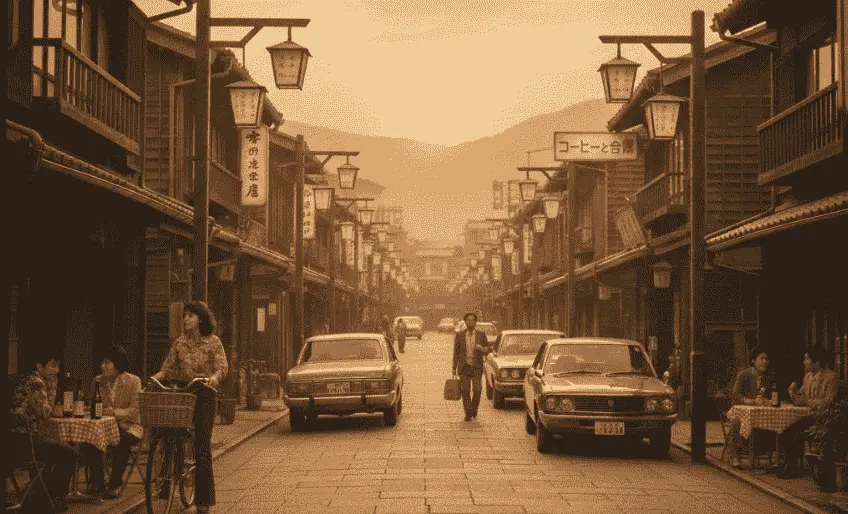
As we grow into adults, we experience many partings. However, these tend to be remembered as damp, heavy “tragedies.”
Yuming perceived death as an “ascent.” Climbing the white slope, enveloped in heat haze, and soaring into the sky without fear. The height of that gaze is far removed from the bustle of the earth, filled with a silence akin to enlightenment.
Memories from Junior High and Overlapping Landscapes
As a junior high student, I listened to these words spun by a 19-year-old girl, trying to act more mature than I was. Back then, I thought of it as “cool adult music,” but looking back now, I realize that the “high window” she depicted symbolized the sense of omnipotence unique to youth, and the loneliness that is its flip side.
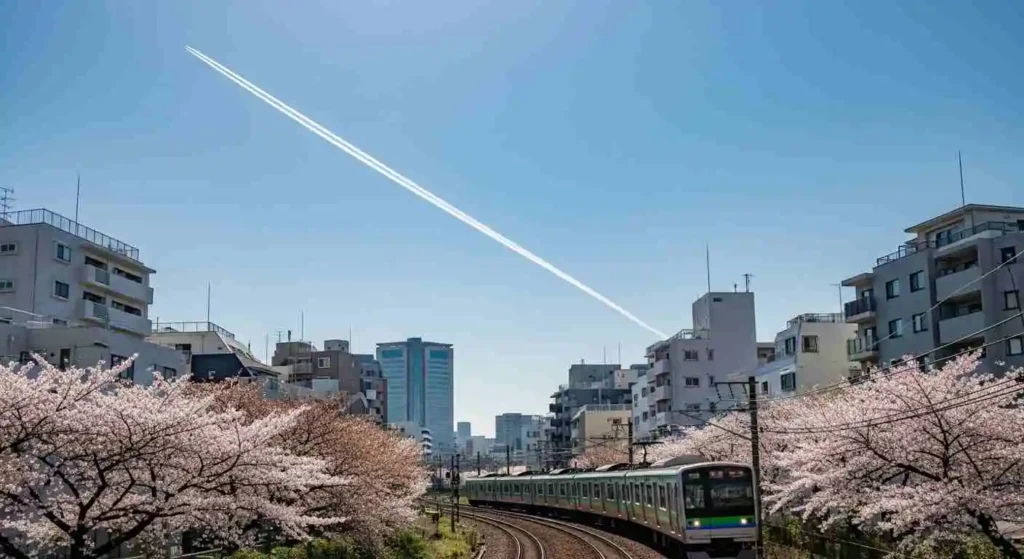
Later, the sky I saw at street corners in Tokyo during my college years or along the Inokashira Line tracks—I couldn’t help but feel that the continuation of the “Hikoki Gumo” I heard on the radio back then was right there. Myself, who was still nobody. Anxiety about the future and groundless hope. Yuming’s voice always connected our unstable daily lives to “eternity.”
The Encounter with Caramel Mama: A Soundscape of “Dry Sadness”
The brilliance of “Hikoki Gumo” also lies in its arrangement. With the legendary band “Caramel Mama”—consisting of Haruomi Hosono, Shigeru Suzuki, Tatsuo Hayashi, and Masataka Matsutoya—providing the backing, this song was breathed with eternal life.
The intro piano and the heavy yet light bassline. There is none of the “over-emotional” dampness common in Japanese music of that era. The dry, yet deep resonance perfectly expresses the trajectory of a vapor trail vanishing into the sky.
A Universality that Transcends the Era
It is astonishing that even listening back to this recording today, it doesn’t feel dated at all. Rather, in an age overflowing with digital sounds, the resonance of these organic instruments carries an even greater sense of urgency.
The rhythm etched by the piano arpeggios is like a staircase leading to the sky. Her singing voice does not flaunt skill; it has a certain trembling vulnerability while piercing straight through to the heavens. Because of this fortunate encounter between “voice” and “sound,” “Hikoki Gumo” became more than just a popular song—it became a hymn etched into the DNA of the Japanese people.
The Depth of a Sound that Symbolized an Era
1973: The Sound Resonating in That Silence
The year 1973, when the album “Hikoki Gumo” was released, was also a time when Japan’s post-war rapid economic growth was coming to an end, and the nation as a whole was beginning to feel a sense of “loss.”
In that context, Yuming sent a personal experience of death out into the world with such a stylish and universal sound. The sophisticated, urban soundscape created by Masataka Matsutoya and others serves to bring the contours of loneliness into even sharper relief.

At the time, we might have listened to this song as background music heralding the arrival of a new era. However, after several decades, as I walk through the “evening glow” of my own life, this sound permeates my body with much more depth and reality than it did back then.
Editor’s Note: What Lies Beyond the Vapor Trail
I have chosen “Hikoki Gumo” for the 9th rank.
Did you look up at the sky today?
If you found a single vapor trail there, it might be a signal from someone precious who once passed by our side.
Rather than labeling it as “unhappy,” we should quietly affirm the trajectory that person ran through with all their longing. Every time I hear this song, I feel like I can regain that kind of kindness.
The next time this song reaches your ears, I hope a cloudless blue sky spreads across the horizon of your heart as well.


コメント