- 🎧 Enjoy this article in audio
- Today is Chris Martin’s Birthday.
- Today’s Featured Song: “Viva La Vida” – (Coldplay)
- First, please enjoy the official video.
- When I first heard this song…
- Coldplay’s “Viva La Vida” ── A Symbol of the Times Woven with Music and Story
🎧 Enjoy this article in audio
🎶 English Narration
You can listen to the English narration of this article.
🎵 Japanese Narration
Press the play button to listen to the contents of this article in Japanese.
* Listening to the audio before reading the text will give you a more multidimensional understanding of the song’s background and key points.
Today is Chris Martin’s Birthday.
Today, March 2nd, is the birthday of Chris Martin (born in 1977), an extraordinary melody maker and the frontman of the monster band Coldplay, who continues to lead the 21st-century music scene. Happy Birthday!
Even a quarter of a century after his debut, I am simply in awe of his energy, which continues to drive stadiums wild all over the world, and his dedication to constantly exploring new musical approaches.
His greatest charm lies in his beautiful, soaring falsetto, his versatility in playing everything from the piano to synthesizers and guitars, and above all, his overwhelming charisma as a frontman who continually sings of “love and affirmation for the world.” The melodies he weaves resonate just as gently and powerfully in the heart of someone spending a lonely night as they do in a stadium filled with tens of thousands of people.
Today’s Featured Song: “Viva La Vida” – (Coldplay)
To celebrate Chris’s birthday, today I am introducing “Viva La Vida”, a song released in 2008 on their fourth studio album “Viva La Vida or Death and All His Friends”. It marked the biggest turning point in Coldplay’s career and shines brilliantly in music history.
First, please enjoy the official video.
First, please watch the official music video, where the heat of revolution and artistry merge. The stunning visuals, directed as if Eugène Delacroix’s painting “Liberty Leading the People” were a cracked canvas, are a must-see.
🎬 Official Credit
 Coldplay - Viva La Vida (Official Video)
© 2008 Parlophone Records Ltd, a Warner Music Group Company
2-Line Explanation
💿 Included in the 2008 album "Viva La Vida or Death and All His Friends."
An epic masterpiece featuring strings and percussion that reached number one on charts worldwide, including the US and UK.
And when talking about Coldplay, their “live performance” is absolutely essential. While the precise beauty of their studio recordings is incredible, the atmosphere of their live shows, where the band and tens of thousands of fans become completely one, is filled with overwhelming energy that could almost be described as a religious experience.
🎬🎬 Official Credit
 Coldplay - Viva La Vida (Live In São Paulo)
© 2018 Parlophone Records Ltd, a Warner Music Group Company
2-Line Explanation
🌎 Enthusiastic live footage recorded in São Paulo, Brazil in November 2017.
Accompanied by a ground-shaking chorus (chant) from the audience, this is a moving moment that proves the song is a true "global anthem."
When I first heard this song…
| My Age | Elementary | Junior High | High School | University | 20s | 30s | 40s | 50s | 60s~ |
| Release Year | 2008 | ||||||||
| When I Listened | ● |
To tell you the truth, I was already past 50 when I first really paid attention to this song.
Writing a music blog every day and facing masterpieces from various eras like this, I sometimes regret, “Why didn’t I listen to this sooner?!” But at the same time, I realize that some songs strike deeply exactly because I am at an age where I have experienced both the bitter and sweet sides of life. ( ;∀;)
Coldplay’s “Viva La Vida” was a track that struck right at the core of my musical tastes. Transcending the standard pop structure of verse, pre-chorus, and chorus, it layers strings and timpani over a constant looping rhythm, gradually and dramatically building towards the climax. This perfectly calculated build-up technique is truly masterful and gives me goosebumps every time I hear it. It’s a flawless “Good!!!”

To me, it feels like a “favorite song I discovered relatively recently,” but more than a decade has already passed since it was released to the world. How did this song capture the mood of the times and become a global hit? I would like to delve deeper by looking back at the historical background of that time.
The Historical Background of 2008: Japan and the World
2008, the year Coldplay’s “Viva La Vida” was released, was, for better or worse, a “global turning point” that will undoubtedly be written in bold letters in future history textbooks. The swell of an era where the economy, politics, and technology were all drastically changing created a miraculous synchronicity with the epic themes of this song.
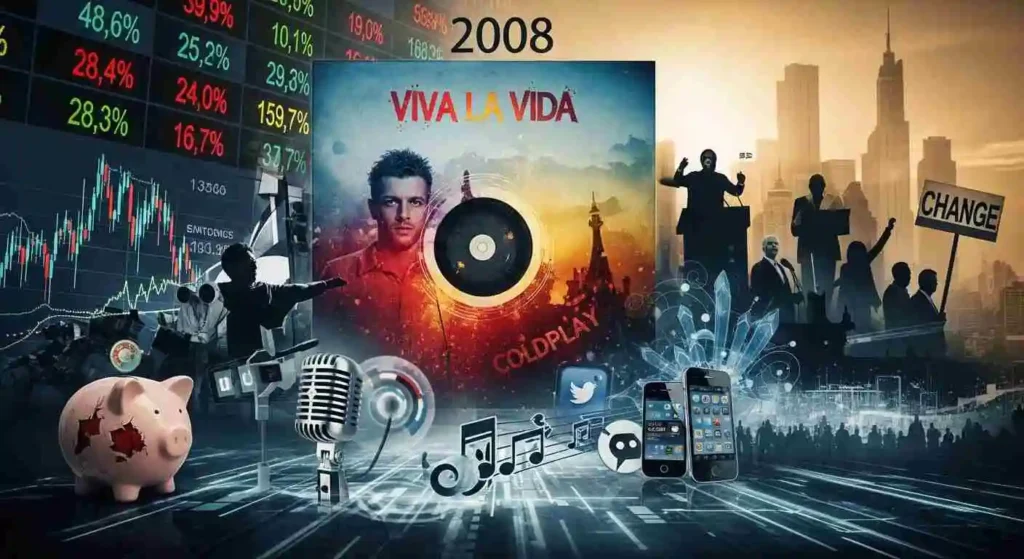
1. Global Movements: The Fall of the “Absolute King” and New Hope
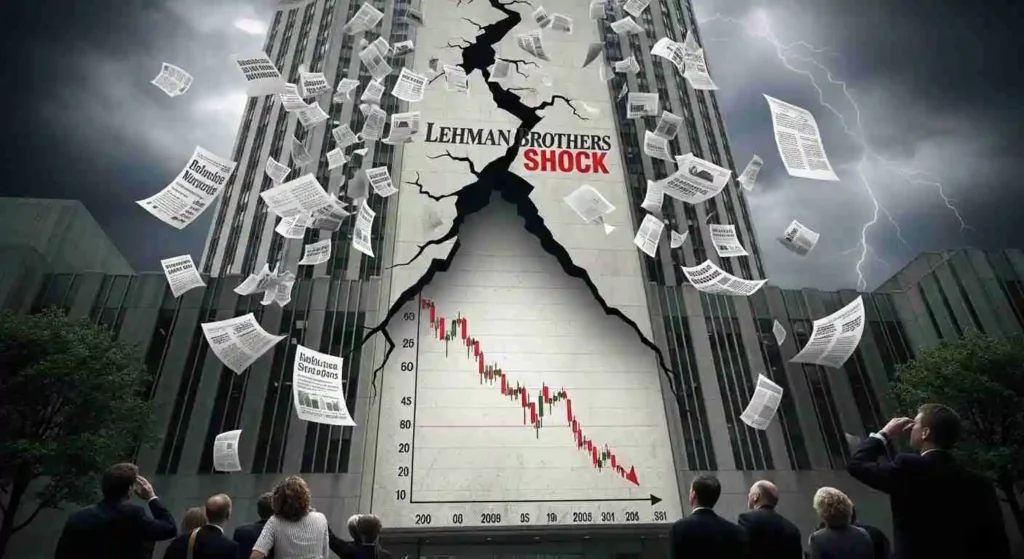
① The Lehman Shock and the Collapse of the Existing System
The biggest event symbolizing 2008 was the “Lehman Shock” that occurred in September. The sudden collapse of the mega-investment bank Lehman Brothers triggered a once-in-a-century global financial crisis. The giants of the financial world, believed to be “too big to fail,” crashed to the ground, and stock prices plummeted worldwide. Many people lost their jobs and homes.
Coincidentally, the story of downfall sung in “Viva La Vida,” where a king who “used to rule the world” loses everything and sweeps the streets, mirrored the terrifying reality of this financial crisis and became a mirror reflecting the times.
② The Election of President Obama and the Enthusiasm for “Change”
Amidst a desperate economic situation, a ray of hope generated tremendous enthusiasm in America. In the November presidential election, Barack Obama campaigned with the powerful slogans “Yes We Can” and “Change,” and was elected as the first African-American President of the United States. The passion of the people believing that the old regime (the king) was ending and a new era was beginning linked perfectly with the vitality embedded in the title “Viva La Vida” (Long Live Life).
③ The Spread of the iPhone and the “Complete Digitalization” of Music
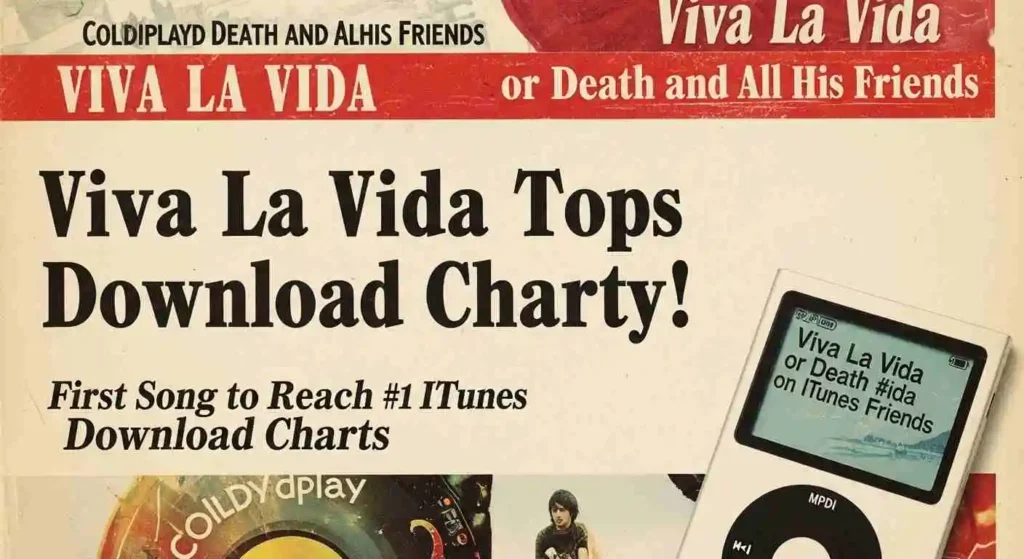
2008 was also the year the smartphone era truly began, with the “iPhone 3G” becoming a massive hit worldwide, following the original iPhone released the previous year. Facebook and Twitter rapidly increased their user bases, drastically changing the way people communicate.
The music industry’s “complete shift from CDs to digital distribution” was also cemented, as Apple’s iTunes Store dominated the music market. “Viva La Vida” became the most downloaded song and album globally on iTunes in 2008, earning the title of the “first global mega-hit of the digital age.”
2. Movements in Japan: Straying Politics and an Exhausted Society
① Economic Downturn and the Emergence of the “Temp Cut” Issue
The financial crisis originating in the US dealt a fatal blow to the Japanese economy, which relied heavily on export industries. Toward the end of the year, the “Haken-giri” (termination of temporary workers), where non-regular workers’ contracts were successively terminated mainly in the manufacturing sector, became a major social issue. A “New Year’s Temp Village” was even set up in Hibiya Park, Tokyo. It was a very heavy year, where Japan’s “past glory” as an economic superpower collapsed, and people’s anxiety about their livelihoods reached its peak.
② Prime Ministers Changing Annually and Political Distrust
Despite society being on the brink of crisis, Japanese politics was deeply confused. Prime Minister Yasuo Fukuda, who had just taken office the previous autumn, suddenly resigned in September. His successor, Prime Minister Taro Aso, also struggled with low approval ratings. The feeling of stagnation that “leaders change one after another, and no one can guide the country” instilled deep political distrust among the Japanese people at the time.

③ The Music Industry: The Golden Age of “Chaku-Uta Full” and the Diversification of J-POP
The Japanese music scene at the time was on the eve of smartphone popularization, and “Chaku-Uta Full” (full-track ringtones) for feature phones was at its peak. While songs like Thelma Aoyama’s “Soba ni Iru ne” and GReeeeN’s “Kiseki” recorded massive hits, among music fans sensitive to global trends, Coldplay’s “Viva La Vida” spread with a strong impact, becoming an exceptional ringtone and PC download hit for Western music.
Conclusion: The “Epic Catharsis” Demanded by the Times
The year 2008 was a time when “solid systems” believed in for many years crumbled like a house of cards, and the whole world swayed with anxiety and expectations for new change. The “fall from glory” sung in “Viva La Vida,” and the powerfulness to cry out “Long Live Life” nonetheless, were deeply etched in the hearts of people worldwide as the definitive soundtrack of this turbulent era.
Coldplay’s “Viva La Vida” ── A Symbol of the Times Woven with Music and Story
From here, let’s thoroughly dissect the appeal of the song itself, exploring its musical approach and the profound worldview of its lyrics.
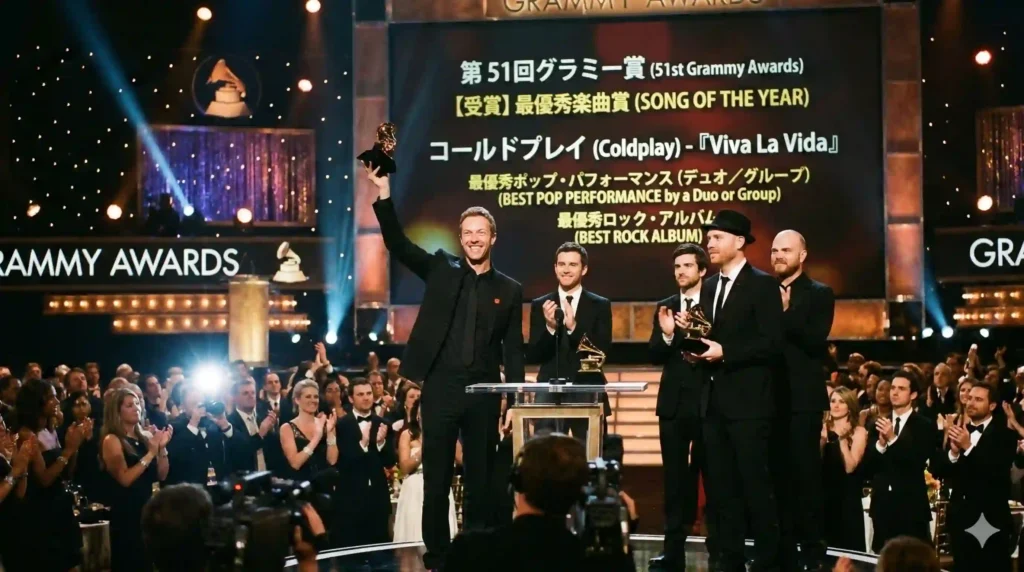
“Viva La Vida” won three awards at the 51st Grammy Awards in 2009, including the highest honor, “Song of the Year.” Loved by both critics and the public, this song is evaluated not just as a passing hit, but as a true pinnacle in music history.
A Rock Band That Abandoned Guitars? The Revolution Brought by Brian Eno
The first thing that surprises you when you listen to this song is that “even though it’s a rock band’s song, the guitar and drums are not the lead.” The entire song is led by majestic strings reminiscent of church music and the rhythm of percussion instruments like timpani and church bells.
Behind this innovative sound is the legendary producer Brian Eno, who led David Bowie, U2, and Talking Heads to global success and is also known as the founder of “ambient music.” Coldplay brought him in as a producer and temporarily dismantled all of their previous “winning patterns” of piano-led ballads and lyrical guitar rock.

Eno demanded of the band, “Use instruments you’ve never used before” and “Break the rules of the studio.” As a result, they suppressed distorted guitars and intertwined heavy percussion with repetitive cello and violin phrases, giving birth to an unprecedented sound that is orchestral yet possesses a strong, driving groove. This “structure where instruments are layered step by step and emotions are heightened” is the biggest reason why it captured the heart of even a guy in his 50s like me.
The “Monologue of a Fallen King” Depicted in the Lyrics and Biting Irony

What further enhances the magnificence of the song are the literary and enigmatic lyrics that read like a historical novel. The title “Viva La Vida” means “Long Live Life” in Spanish, but the content being sung is very cruel and ironical.
From the opening lyrics, the listener is instantly drawn into the world of the story.
I used to rule the world
Seas would rise when I gave the word
Now in the morning, I sleep alone
Sweep the streets I used to own
The protagonist of this song is a “former ruler” who was ousted from the throne by a revolution or coup. Because Eugène Delacroix’s “Liberty Leading the People,” depicting the French Revolution, was used for the album artwork, it is widely interpreted as being from the perspective of the executed French King Louis XVI, or perhaps an emperor from the Crusade era or the Roman Empire.
Scattered throughout the lyrics are numerous quotes from the Bible and history books, such as “Saint Peter won’t call my name” (meaning he cannot go to heaven) and “My castle stood upon pillars of salt and pillars of sand” (meaning power was fragile and crumbled away).
It portrays the “sense of life’s transience” realized by someone who held absolute power after losing everything. However, because this song of a tragic downfall is sung to an up-tempo and uplifting melody, it is sublimated into the ultimate hymn to humanity: “Even so, life goes on; long live life.”

As an Anthem Passed Down for Eternity
Even now, many years after its release, “Viva La Vida” has not faded; rather, its brilliance continues to grow. As a cheer song at international sports tournaments, or as a massive chorus at festivals where tens of thousands of people gather, the chorus of this song’s string melody—”Oh-oh-oh, oh-oh-oh-oh”—echoes everywhere in the world.
That is because this song is not just an “old tale of a king,” but overlaps with the lives of us living in the modern world. Success and setbacks at work, the glory of youth, and facing old age. Everyone gains something and loses something in life. Through the mouth of a king thrust down from the pinnacle of power, Chris Martin might be affirming our own “stories of loss and rebirth.”

On Chris Martin’s birthday, please surrender yourself once again to this epic sea of orchestra and story. I’m sure you will hear a new “echo of life” different from when you first heard it.

コメント