- 🎧 Listen to the Audio
- The Day the Legend of Tomoyasu Hotei Began to Run
- First, Please Enjoy the Official Audio — “Last Scene”
- When I First Heard This Song
- The Birth of “Last Scene” — 1996, A Period of Artistic Maturity
- The Aesthetic Behind the Title “Last Scene”
- The World Painted by the Lyrics — Between Rejection and Prayer
- Melodic Structure and Production — The Guitar Speaks as “Another Language”
- Why It Endures Across Time
- Conclusion — Hotei’s Affirmation of Solitude
🎧 Listen to the Audio
This article is also available as an audio narration of about three minutes.
Follow the flow of the text as it traces the lingering farewell, the sepia-toned memories,
and the quiet emotion at the heart of “Last Scene.”
Enjoy it before you read—or as an afterglow once you’ve finished.
🇺🇸 English Narration
🇯🇵 Japanese Narration
The Day the Legend of Tomoyasu Hotei Began to Run
Tomoyasu Hotei, born February 1, 1962, in Takasaki City, Gunma Prefecture. In Japan’s rock scene, there is no other artist who has established such an innovative and one-of-a-kind guitar sound.
He took the world by storm as the guitarist of BOØWY, and even after moving into his solo career, his creativity has never stopped. The guitar he plays carries an “aesthetic” and “emotion” that go beyond mere technique, possessing the power to shake the listener’s soul. Geometric-patterned guitars, refined melodies, and overwhelming live performances — all of these fuse together to create the grand rock entertainment that is Tomoyasu Hotei.
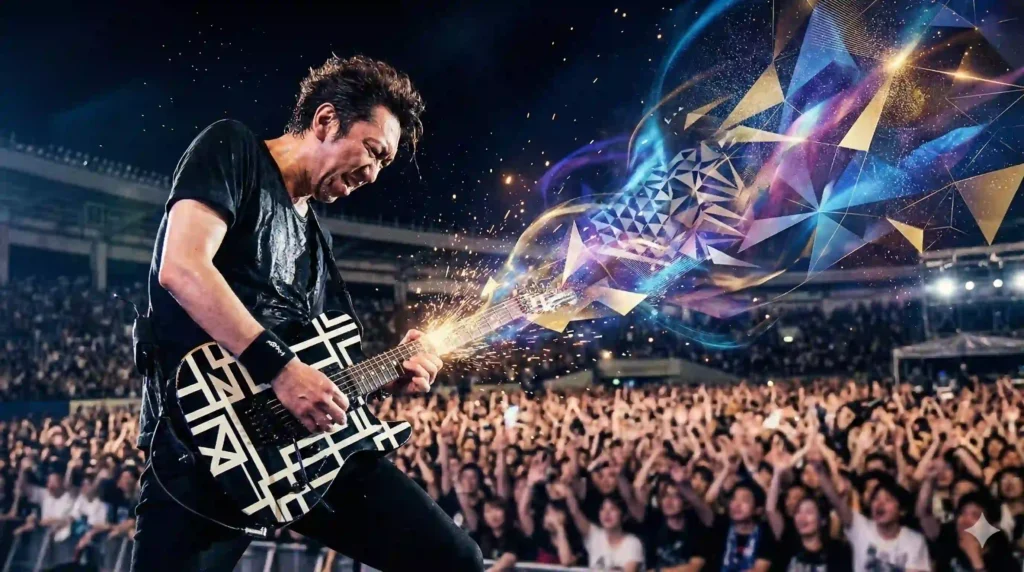
Tomoyasu Hotei goes beyond the frame of a mere “guitarist” — he is better described as an “architect of sound.” Always looking to the forefront of the world stage, he continues to update his style. At his core lies an unwavering love for the guitar and an unquenchable spirit of challenge — a solitary aesthetic that has remained unchanged since his debut.
First, Please Enjoy the Official Audio — “Last Scene”
🎬 Official Video Credits
Song: Tomoyasu Hotei – Last Scene
Artist: Tomoyasu Hotei
Release Date: January 24, 1996 (Single)
Album: “GUITARHYTHM FOREVER”
💬 Two-Line Commentary
A masterpiece Hotei-style ballad, where the beautiful tone of acoustic guitar and a bittersweet melody pierce the heart.
An exquisite love song depicting the sadness of parting and the strength to still move toward tomorrow.
When I First Heard This Song
| My Age | Elementary School | Middle School | High School | University | 20s | 30s | 40s | 50s | 60+ |
| Song Release Year | 1996 | ||||||||
| When I Heard It | ● |
I think I first heard this song fairly recently.
When it comes to BOØWY, the band he belonged to, I only liked a few individual songs rather than the band as a whole, and I actually learned Hotei’s name long after I knew about Kyosuke Himuro.
He has a strong presence, and personally he’s the type that can feel a bit intense for me — but this song is GOOD. Right in the center of my taste.
It’s melodic, yet not fragile like glass — it has a firm core. Hotei is strongly associated with rock ’n’ roll, but hearing this made me realize he sings songs like this too.
The Birth of “Last Scene” — 1996, A Period of Artistic Maturity
The Spirit of the Times and a Deepening of “Song”
“Last Scene” was released on January 24, 1996. At the time, the music scene was dominated by dance music produced by Tetsuya Komuro. Amid such digital clamor, what Hotei presented was the power of an extremely personal and organic “song.”
Since his solo debut, he had pursued the fusion of computers and guitar to the extreme in the “GUITARHYTHM” series. But after completing that grand project, he arrived at a state that could be called a “return to origins.” That was a deepening toward “songs” and “lyrical melodies” that convey emotion with just a guitar.

The Moment a Guitar Hero Became a “Poet”
The release of this song surprised many fans. It was a delicate and quiet opening that vividly defied the aggressive image of songs like “Bambina” and “Thrill.”
Yet within it was filled with a gentleness of an adult man that only Hotei could portray. Instead of overwhelming listeners with flashy guitar solos, he played each note as if cherishing it on an acoustic guitar. In this song, he set aside the mask of a guitar hero and spoke to listeners’ hearts as a “poet.”
The Aesthetic Behind the Title “Last Scene”
The Magic That Tints Endings in Sepia
Generally, the phrase “last scene” implies the end of a story — in other words, loss. But in Hotei’s “Last Scene,” the “end” is not mere severance. It is the process of freezing a moment in the long movie of life in beautiful sepia-toned memory.

What he depicts is not the sadness of the moment of parting itself, but the rich time two people shared, even the quarrels that became dear memories — the “completion of a relationship” that includes all of it.
Pour the memories into a glass and toast to a new tomorrow
As symbolized in this line, the “last scene” in this song is like a positive graduation ceremony for moving on to the next stage of life. Not collapsing in sorrow, but affirming the past with the composure to raise a glass. Here lies Hotei’s dandyism and the kindness backed by deep life experience.
The World Painted by the Lyrics — Between Rejection and Prayer
Deep Insight into “You Pretend to Be a Strong Woman”
At the center of the lyrics lies an overwhelming sense of “mature love” and “imagination toward others.” Facing separation, a woman hides her tears and tries to act brave. Hotei captures the subtleties of her heart with a gentle gaze, as if zooming in with a movie camera.

Until the very end, you pretend to be a strong woman Stubborn as you are, you try to stop the clock
In this phrase lies the ultimate generosity that even finds a loved one’s bluff endearing. The selfish wish to stop time is simply the pure desire not to part. Rather than denying it, he accepts it as “stubborn you.” This writing carries the delicacy of a short story writer, even while being a rock artist.
The “Silhouette” Visible Only Because It’s Broken
The phrase “broken silhouette” sung in the chorus is also striking. While coolly acknowledging that the relationship can never return to what it was, expressing it as a “silhouette” leaves a dreamy, lingering impression. Even as it sings of despair, deep beneath lies a fierce will to live — gratitude for the time spent together.

Melodic Structure and Production — The Guitar Speaks as “Another Language”
An Acoustic Guitar That Plays Emotions Beyond Words
The sound centered on Hotei’s acoustic guitar may appear to be a simple ballad at first glance. But hidden within is the “magic of sound” only a world-class guitarist can create.
The arpeggios flowing from the intro are quiet like falling snow, yet carry a sharp sense of sorrow. Especially from the interlude into the chorus, the thickness of the sound is calculated to match the swell of emotion.
So painfully hard tonight, this love story ends without reaching a happy ending
At this climax, his guitar is no longer accompaniment but cries out as a “second voice” equal to the vocal.

A Sense of Presence Born from Recording Precision
The use of space (silence) in this song is truly masterful. By not overusing reverb and even leaving in the squeak of fingers against guitar strings, it creates an intimate feeling as if the performance is happening right beside the listener. The raw humanity hidden within the beautiful melody may be the biggest reason this song has not faded even after more than 20 years.
Why It Endures Across Time
① Its Distance from Society Hasn’t Changed
In today’s internet society, where connections between people have grown thinner, the dense time of parting face-to-face depicted in “Last Scene” resonates as something even more precious. Feelings of “placelessness” and “loss” have not disappeared in the SNS era. Rather, quietly listening to this song alone has become a kind of spiritual luxury for modern people.

② The “Untranslatability” and Universality of the Lyrics
Motifs like “sepia,” “glass,” and “clock” are shared landscapes within everyone’s heart. Leaving ample room for interpretation, yet allowing anyone to overlay their own “last scene” from the past. This song holds a universality that becomes each listener’s own story.
③ The Embodiment of Hotei’s Own Narrative
Afterward, he continued bold challenges without being bound by hits. His move to London after turning 50, for example — a life that keeps running without “stopping the clock.” His very way of living continues to prove the “toast to a new tomorrow” sung in “Last Scene.”
Conclusion — Hotei’s Affirmation of Solitude
The final phrase of “Last Scene,”
There’s no voice here — what on earth should I believe in?
is not a punctuation mark of despair. It is a “declaration of solitude” — standing on one’s own feet in silence and beginning to walk alone.
Hotei did not reject darkness, but illuminated it and embraced it as part of himself. What he showed us was the strength of not denying weakness, and that there is a new light that can only be reached by living through pain.
Listening again to “Last Scene” on February 1, Hotei’s birthday — it proves that this masterpiece born at the end of the 20th century still beautifully illuminates the boundary between light and shadow deep in our hearts.


コメント