
🎧 Listen to This Article: “Nagori Yuki” (Audio Narration)
🎶 English Narration
This is the English narration of the article.
It introduces the key themes and atmosphere of “Nagori Yuki.”
🎵 Japanese Narration (Original)
This is the original Japanese narration.
Listen to the article in its original language.
🎸 KAZE Series – No.3: “Nagori Yuki”
Ranked No.3: “Nagori Yuki.”
There are emotions that appear only at the delicate boundary between winter and spring—feelings that cannot be fully put into words. Very few songs capture this subtle emotional fluctuation so quietly, yet leave such a lasting impression on the listener. “Nagori Yuki” is a song about parting, but rather than placing sorrow or heartbreak at the forefront, it gently accepts the passage of time itself, maintaining a uniquely restrained emotional temperature.
Before moving on, it is important to clarify the song’s position. “Nagori Yuki” was released in 1974 as a song by Kaguyahime. However, both the lyrics and music were written by Shozo Ise, who would later form the duo Kaze. In other words, while this song belongs to Kaguyahime’s catalog, it is also directly connected to Shozo Ise’s identity as a songwriter and to the worldview he would later develop with Kaze. This is why I have chosen to include it in this KAZE series—based entirely on my own perspective.
Ultra-Short Summary
This song tells the story of a young couple’s farewell,
layering personal separation with the changing of the seasons.
Caught off guard by an unexpected parting,
the protagonist slowly comes to understand that both the other person
and they themselves must inevitably change.
Through the image of lingering snow,
the song portrays a universal human experience:
time moves forward even when emotions cannot keep up.
Please Watch the Official Video First
✅ Official Video Credits
Title: Nagori Yuki
Artist: Kaguyahime
Lyrics & Music: Shozo Ise
Released: 1974
Label: PANAM (Nippon Crown)
📝 Two-Line Commentary
A folk song that calmly depicts a seasonal farewell through everyday scenery.
Its understated storytelling quietly reveals the passage of time and human growth.
Basic Song Information
Release & Album
“Nagori Yuki” was released in 1974 by the folk group Kaguyahime and included on their album Sankaidate no Uta. Both the lyrics and music were written by Shozo Ise. At the time, Kaguyahime was shifting its focus away from overt social messages toward more intimate depictions of personal emotion and everyday life, and this song emerged from that transition.
After Kaguyahime disbanded, Shozo Ise went on to form the duo Kaze with Kazuhisa Okubo. Even so, “Nagori Yuki” already contains the gentle perspective and emotionally restrained expression that would later define Kaze’s music. In this sense, the song is essential not only to Kaguyahime’s legacy, but also to understanding Shozo Ise as a songwriter.

Reception and How the Song Spread
The original version of “Nagori Yuki” did not become an instant, explosive hit upon its release. Instead, it gradually gained recognition among folk music listeners, quietly expanding its audience through word of mouth. Later, as other artists covered the song, its name became widely known, but the original recording retains a youthful simplicity and an unpolished charm that later versions often smooth out.
In particular, the way the song avoids overt emotional assertion is a trait that would continue to appear in Shozo Ise’s later works. This restrained style is one of the key reasons why the song has continued to be listened to across generations and eras.
Themes and Worldview of the Song
The Protagonist’s Background and Position
The protagonist of this song is portrayed as a young person standing at a turning point in life—such as moving away to study or relocating to the city. The farewell is unavoidable, yet it arrives before the heart is fully prepared. As a result, the protagonist cannot express themselves with strong words, and instead tries simply to accept the reality unfolding before them.
What is particularly striking is that the protagonist does not try to stop the other person. There is lingering attachment and confusion, but more than that, there is a sense that the other person’s choice cannot be denied. This attitude reflects both emotional immaturity and a sincere attempt to respect the other person’s decision.
The Meaning of Seasonal Imagery
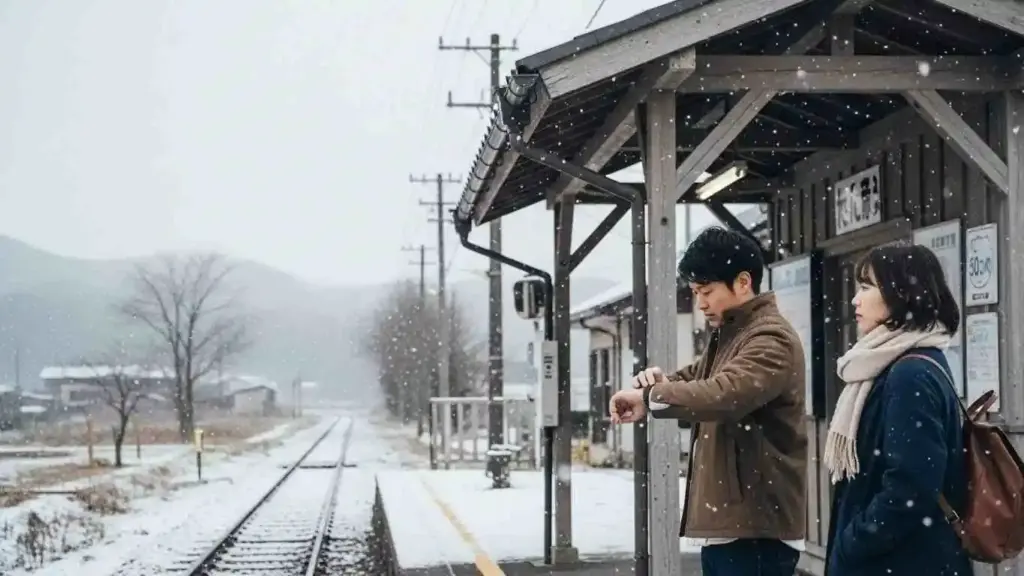
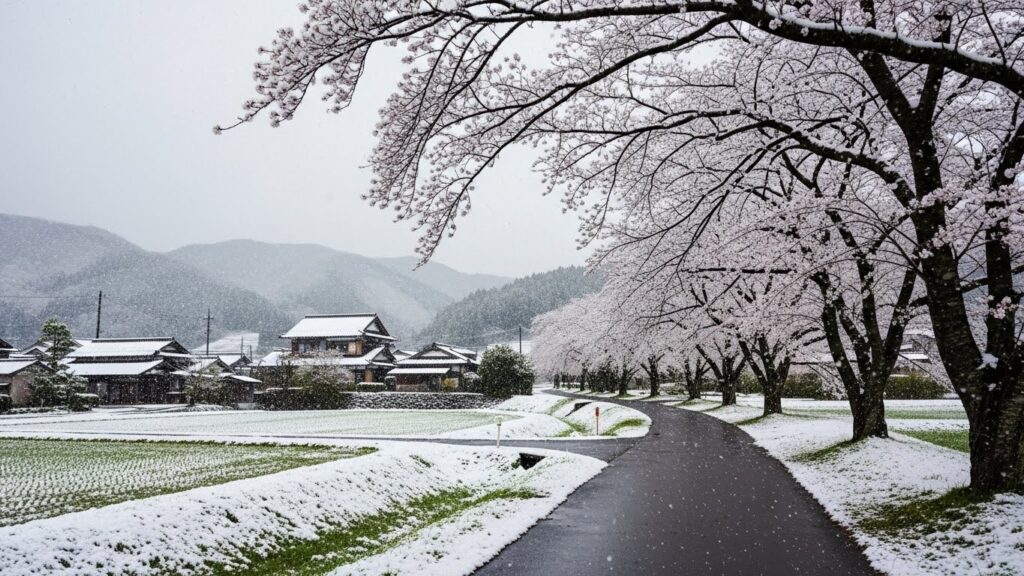
What defines the first half of “Nagori Yuki” is its treatment of the seasons. Snow normally symbolizes winter, yet in this song it appears just before spring arrives. The phrase “nagori yuki” itself does not sound unnatural in Japanese. In fact, although it was not commonly used before the song’s release, its sound felt so natural and beautiful that after this song, it became established as a seasonal expression in the Japanese language.
A season that should be over, yet lingers on— this state mirrors the protagonist’s emotional condition. The past is not fully over, but returning to it is no longer possible. The single phrase “nagori yuki” perfectly captures this transitional state without excess or deficiency.

In this way, the first half of the song is guided less by concrete events and more by sensory elements such as atmosphere and temperature. These elements naturally overlap with the listener’s own memories and experiences, allowing the song to be received as something deeply personal. In the second half, the song explores how these suspended emotions begin to change.
The Core of the Lyrics and Their Interpretation
The Essence Revealed Through a Brief Lyric
When examining the core of this song, there is one line that cannot be ignored.
It is the moment when the phrase “nagori yuki” itself appears.
What matters here is that the lyrics do not describe the snow itself.
They do not speak of its beauty or its coldness,
but simply present the situation that
“although it is already time to part, the snow still remains.”
With just this brief phrase, the listener understands instinctively:
—the farewell has been decided, but the feelings have not yet caught up.

The lyrics neither state emotions outright nor explain them. Yet both the situation and the inner state are conveyed simultaneously, thanks to the precision of this word choice. “Nagori yuki” functions as both a landscape and a direct representation of the protagonist’s emotional state.
What the Protagonist’s Emotional Shift Reveals
As the song progresses into the latter half, the protagonist’s perspective gradually begins to change. In the beginning, they are overwhelmed by the sudden farewell and unable to fully process the atmosphere of the moment. Later, however, their awareness turns toward where the other person is heading and the time that lies ahead.
What is depicted here is not emotional resolution. The sadness does not disappear, nor does complete acceptance arrive. Instead, the song portrays a slow movement toward understanding that the farewell must be accepted as reality. Because of this shift, the story avoids sentimentality and remains grounded in the flow of real time.

The Appeal of the Sound and Vocal Performance
Sound Determines the Pace of the Seasons
The performance of “Nagori Yuki” is not designed to heighten emotion.
Rather, the role of the sound in this song is singular:
—to allow time to move forward slowly.
The acoustic guitar maintains a steady rhythm. It neither rushes nor pauses. This unchanging progression sonically represents the reality that the seasons are moving steadily toward spring.

If the rhythm were to swell with emotional emphasis, the protagonist’s feelings would move to the foreground. Instead, the actual performance allows time to advance first, leaving emotions behind. As a result, the listener unconsciously absorbs the song’s premise: even when feelings lag behind, the seasons still change.
The phrase “nagori yuki” lingers not because the sound highlights it, but because the sound offers no emotional support at all.
A Voice That Sings Without Drawing Conclusions
Shozo Ise’s vocal delivery is not aimed at expressing emotion directly.
His voice remains gentle, with minimal inflection.
It neither cries out in sorrow nor declares resolve.

Through this style of singing, the protagonist ceases to be an “emotional narrator.” They are not someone who shouts their feelings, but simply a person standing within the events as they unfold.
As a result, the listener does not feel pulled into the song so much as placed beside the protagonist, observing the same scenery. Rather than receiving someone else’s intense emotions, the listener recalls their own memories— thinking, “Yes, there really was a time like this.”
“Nagori Yuki” is not bound to a specific generation or romantic experience
because the vocal does not represent a single, definitive emotion.
It sings, yet reaches no conclusion.
It tells a story, yet leaves feelings unresolved.
It is precisely this ambiguity that makes listeners return to the song again and again.
Why This Song Belongs in the Best 15
How It Differs from Other Songs
Many of Shozo Ise’s songs deal with farewells. What makes “Nagori Yuki” exceptional, however, is that it places at its center not the farewell itself, but the emotions that cannot yet catch up to it.
Moreover, through the phrase “nagori yuki,” the song introduced a new form of seasonal imagery into the Japanese language. It is rare for a phrase born from a song to take on an independent life beyond the music itself. In that sense, this work holds influence that extends beyond music alone.
A Final Line That Invites You to Listen Again
“Nagori Yuki” is a song that sounds different depending on one’s age and experience. When young, it is heard as a song about parting. With time, it begins to resonate as a reflection of oneself standing at a turning point in life.
Moving forward despite unresolved feelings— this reality is captured through a single phrase and a quiet melody. That is why this song continues to be spoken of today. Its ranking at No.3 is, in itself, a recognition of that universality.

コメント