
◆ Explore the History of [Off Course] Here — A Prelude to Ultimate Sonic Refinement
- 🎧 Enjoy this article with audio
- No. 15 is “Nemurenu Yoru” (Sleepless Night).
- First, please listen to the YouTube video
- [Analysis] The Paradoxical Landscape of Freedom Brought by the “Absence of Love”
- The Quiet Passion and Atmosphere of the Era Reflected by the Sound
- The Phantom Beyond the Door — The “Humanity” Where Resolve Wavers
- Escape into “Dark Darkness” — The Reversing Metaphor of Light and Shadow
- What Sleepless Nights and the Sound of Rain Awaken
- Conclusion: Why I Chose This Song for “No. 15”
🎧 Enjoy this article with audio
You can quickly grasp the main points of this article with audio first.
Recommended for those who want to understand the key points in a short time before reading.
🎶 English Narration
This explains the content of this article in English audio.
⌛ Playback time: Approx. 3 minutes
🎵 Japanese Narration
You can also listen to the same content with a Japanese narration.
⌛ Playback time: Approx. 3 minutes
* Listening to the audio before reading the text will help you understand the history and sound evolution of Off Course more multidimensionally.
No. 15 is “Nemurenu Yoru” (Sleepless Night).
When looking back on the history of the group Off Course, this song cannot be left out. Released in 1975, this track marked an important turning point, shedding their previous image as a “delicate and somewhat fragile folk duo” and foreshadowing their transformation into a “rock band” with a stronger beat and bare emotions.

It is a quiet, yet firm aesthetic of rejection, distinct from youthful elation. This time, I would like to unravel this masterpiece from such a perspective.
Interpretation
I no longer need the days of suffering bound by you.
I was supposed to be free, but my heart remains somewhat empty.
On sleepless nights and rainy days, the feelings I almost forgot revive.
Even if I try to move forward, only the memories of love quietly chase after me.
First, please listen to the YouTube video
* Since the official video is not published, I have linked a video shared by fans. If there are any copyright issues, I will promptly remove it. (Please click the image below!)

Credits
Song Title: Nemurenu Yoru (Sleepless Night)
Artist: Off Course
Lyrics/Music: Kazumasa Oda
Released: 1975 (Single / Included in the album 'The Smell of Wine')
Brief Commentary
A representative early Off Course song that contrasts the sense of liberation and emptiness of losing love.
A work that sharply expresses the end of romance and inner wavering to a light sound.
[Analysis] The Paradoxical Landscape of Freedom Brought by the “Absence of Love”
Every time I listen to this song, I feel a certain sense of refreshment. This is because the protagonist completely denies the sweetness and warmth generally associated with the word “love”.
While many love songs lament “I can’t live without you,” the protagonist of this song declares, “I will never return to you.” Even if the other person sheds tears in front of him and kneels to beg, his resolve remains unshaken. What is depicted here is not the weakness of a man who cannot let go of his lingering affection, but the strong will of an individual trying to break free from the “binding” called love.

We have always lived tied by invisible chains named “someone’s expectations” or “roles.” At times, it was a comfortable sense of solidarity, but at the same time, it was a factor that wore us down.
When deciphering the lyrics of “Nemurenu Yoru,” the passage “Everyday without love is a free everyday” pierces like a sharp knife. Because there is love, people get hurt, get bound by words, and become unable to move. If so, by throwing away that love entirely, one tries to obtain a “solitary freedom” where no one can blame them. Isn’t this paradoxical theory of happiness the core of this song?
The Quiet Passion and Atmosphere of the Era Reflected by the Sound
Looking at the arrangement, you can see how the Off Course of that time was searching for a new sound. The impressive acoustic guitar cutting in the intro and the heavy bass line intertwining with it. While retaining the gentleness of folk, the carved rhythm certainly contains the dynamism of rock.
Kazumasa Oda’s transparent high-tone voice functions in this song not to emphasize “sadness,” but rather as a device to highlight the “cold-hearted decision.” The melody, sung matter-of-factly yet dismissively rather than exploding with emotion, paradoxically leaves a deep lingering resonance in the listener’s heart.

The mid-1970s was a time when the enthusiasm of the student movements had passed, and people began to turn their eyes back to the “individual’s” inner self. Instead of seeking answers within a group, they found their own answers alone in the night.
Gazing out the window on a sleepless night, listening closely to the sound of rain. Such a personal landscape is beautifully crystallized by this sophisticated sound.
The Phantom Beyond the Door — The “Humanity” Where Resolve Wavers
In the middle of the song, a sudden tear occurs in the heart of the protagonist, who had been stating so coldly as if convincing himself: “I will never return” and “No one can blame me.”
If she were to open “that door” right now and enter the room, what would become of him? He says he doesn’t know.
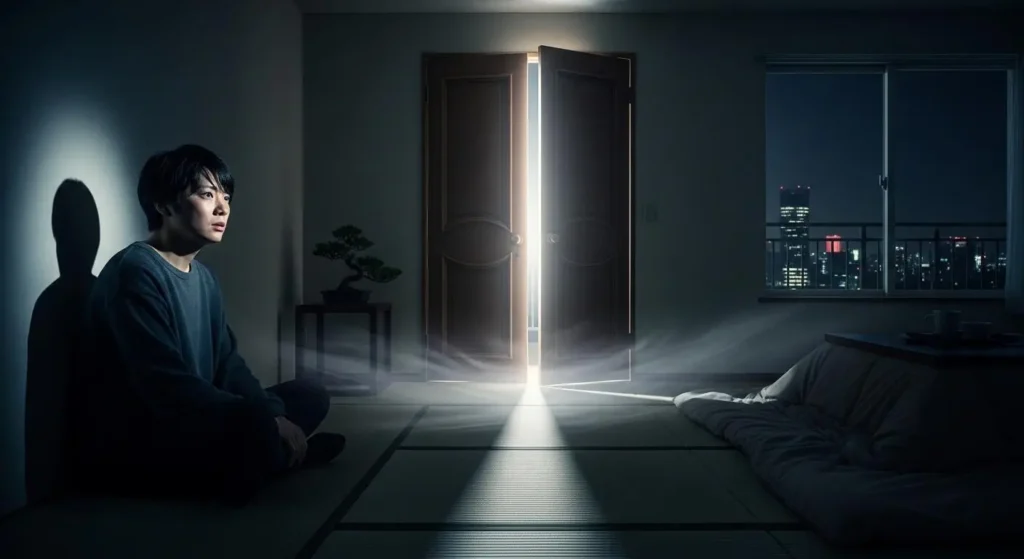
The Overwhelming Reality Lurking Behind the Bravado
In this very passage lies the awesomeness of the psychological depiction drawn by Kazumasa Oda. No matter how much he arms himself with the logic that “Everyday without love is freedom,” if the person he once loved appears before his eyes, that resolve might crumble in an instant. Even though he was supposed to have escaped the pain of being immobilized by love and hurting each other with casual words, his heart is violently shaken. Listeners cannot help but catch their breath at that overwhelming reality.
Looking back, my own life was like that too. People sometimes make firm decisions and put on armor to protect themselves. Even though we have made up our minds that this is absolutely what we should do, that this is the right answer, in a fleeting moment, our footing wavers thinking, “If another door had opened back then.” The true nature of such human weakness, or lingering affection that cannot be severed, is depicted so vividly in this song that it hurts.

Escape into “Dark Darkness” — The Reversing Metaphor of Light and Shadow
And the scene of the escape imagined by the wavering protagonist is even more striking. If she were to appear, he asks himself if he could slip past her and burst out into the “dark, dark, dark darkness.”
Normally, the place where a loved one is present is warm “light,” and leaving it means falling into cold “darkness.” However, in the worldview of this song, those values are completely reversed. That room swirling with the emotion of love is a stifling, unfree space for him, and no matter how dark and lonely it may be, the “darkness” spreading outside is the place that promises absolute freedom.

The fathomless fear of isolation emphasized by repeating the word “dark” three times. Even so, the figure asking himself if he is prepared to jump into that darkness drifts a certain dark and tragic resolve, contrary to the pop and light melody.
What Sleepless Nights and the Sound of Rain Awaken
Towards the end of the song, like waves approaching and receding, it enters an impressive repetition of the chorus.
On sleepless nights or rainy days, the love I had almost forgotten revives. This quiet refrain spreads a deep resonance and ripples throughout the entire song.

The Beautiful Curse Named Memory
What is important here is the exquisite sense of distance of “almost forgot,” rather than completely forgotten. Memories sealed deep within the heart amidst the hustle and bustle of busy daily life show their faces quietly but surely on quiet nights echoing only with the sound of rain.
Even though he was supposed to have thrown away love and gained freedom, he is ultimately caught in the gravity of “the memory of past love.” Perhaps no one can ever be completely free.
Now that I have distanced myself a little from the rush of my active working years, the texture of this “reviving memory” permeates my heart all the more. It is by no means a regret, nor do I want to turn back time. It’s just that, as a fragment of passion that certainly existed in my life, I gently take it out and gaze at it only on rainy nights. The sound of this song beautifully colors such a mature way of facing solitude.
Conclusion: Why I Chose This Song for “No. 15”
The delicate lyricism of folk songs and the dynamism of rock as a band sound. And the intricate psychological depiction where conflicting emotions intersect. The sprout of energy as Off Course transforms from a mere folk duo into a massive music group driving the era powerfully pulsates in this “Nemurenu Yoru”.
Bravado and weakness, freedom and isolation, and indelible memories. I introduced this masterpiece, which overlaps with fragments of my own life, to everyone as No. 15, the opening of my selfish Best 15 [Off Course Edition].

コメント