
◆◆ Explore the History of [Off Course] Here — A Prelude to Ultimate Sonic Refinement
- 🎧 Enjoy this article via audio
- 🎧No. 14: “Ame no Furu Hi ni” (On a Rainy Day)
- First, please listen to the song on YouTube
- The Prelude of Raindrops and Memories of Higashi-Matsubara
- A Vivid “Red Parasol” Blooming in a Sepia Landscape
- The Unringing Phone and the True Nature of the Unseasonable Chill
- The Affinity Between Delicate Sound and “Rain”
- A Turning Point for Off Course as Told by the Historical Context
- A Requiem for Days Gone By
- Conclusion:
🎧 Enjoy this article via audio
You can quickly check the main points of this article through audio first.
Recommended for those who want to grasp the essence before reading.
🎶 English Narration
This article’s content is explained via English narration.
⌛ Duration: approx. 3 min.
🎵 Japanese Narration
You can also listen to the narration in Japanese.
⌛ Duration: approx. 3 min.
* Listening to the audio first will help you gain a more multi-dimensional understanding of Off Course’s history and their evolving sound.
🎧No. 14: “Ame no Furu Hi ni” (On a Rainy Day)
When discussing the early steps of Off Course, their third album, “Wine no Nioi” (The Scent of Wine), released in 1975, is a monumental work. It marks the moment they transitioned from a simple folk duo into a more refined and unique musical world. Positioned as the first track on Side A, this song, “Ame no Furu Hi ni,” serves as a prologue that opens a new door for them.
The scenery of a quiet rain and the subtle shifts of emotion deep within the heart. In this article, I would like to explore the charm of this song through the cinematic beauty of its “soundscape” and my own reminiscences of days gone by.
Interpretation
Everyone experiences numerous partings and sheds tears in the flow of time.
Yet, you always remain alone within that sorrow.
Holding a red parasol, you let time slip backward to past days whenever the rain falls.
Because I still love you, my heart flutters at the sound of the telephone breaking the silence.
But there is no longer any certain kindness or heart to be found; only an unseasonable chill seeps deep into my chest.
First, please listen to the song on YouTube
*Since the official video has not been released, we have linked a video shared by fans. If there are any copyright issues, we will respond promptly by deleting the link. (Please click the image below to listen!)

Credits
Song Title: Ame no Furu Hi ni (On a Rainy Day)
Artist: Off Course
Lyrics & Composition: Kazumasa Oda
Arrangement: Off Course
Release: 1975 (From the album "Wine no Nioi")
Two-Line Summary
A delicate and beautiful acoustic ballad that opens the album "Wine no Nioi." A masterpiece that captures rainy day melancholy and lingering feelings for a past love through painterly descriptions.
The Prelude of Raindrops and Memories of Higashi-Matsubara
As the intro to this song begins, my heart instantly time-travels back decades. The quiet yet distinct acoustic guitar arpeggios are like raindrops tapping irregularly against a windowpane.

Arpeggios Resonating in the Silence of a Small Room
During my student days, I lived in an old apartment in Higashi-Matsubara, Setagaya. A tiny four-and-a-half mat room made of wood and mortar. On rainy days, the scent peculiar to old building materials would linger, and the room would be wrapped in a soft, moist gloom.
I would sip freshly brewed instant coffee while listening to “Ame no Furu Hi ni” playing from the stereo. Looking back now, that time of silence—completely cut off from the outside world—might have been a very luxurious and pure moment of solitude.
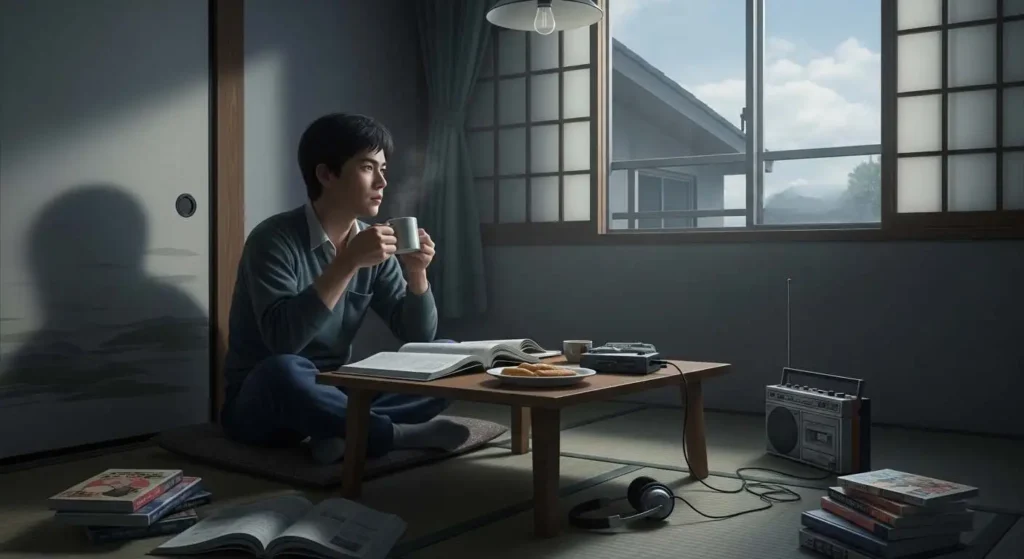
Recalling Memories Away from the Bustle of Working Life
During the hectic days after entering society, rain often became merely “something that makes commuting a hassle” or “something that ruins plans.” In those years when I was always chased by time and not even allowed to stop. However, only when I hear this song do the raindrops turn into a special melody, bringing back that slightly ennui-filled yet rich time spent in that small student room.
A Vivid “Red Parasol” Blooming in a Sepia Landscape
Looking into the world of the lyrics, we find a cinematic beauty that is quintessential Kazumasa Oda. In the protagonist’s line of sight stands “you,” burdened with loneliness and standing alone amidst past sorrows.

Colors Emerging in Monochrome Memories
The phrase “red parasol” leaves a truly vivid impression. In a rainy street scene that is generally hazy in gray or sepia, only this “red” stands out with abnormal clarity, like a scene from a movie.

The “Red” as a Switch for Memories
It is not just rain gear; it feels like a switch for her to sink into past memories, or perhaps a small shield to protect herself from the pouring reality.
As we age and gain more layers to our lives, we forget many things, for better or worse. But in an unexpected moment, a certain scent, color, or sound can suddenly pry open the heavy doors of past memories. The “red parasol” in this song serves as a symbol of vivid, slightly heart-wrenching memories that sleep in the depths of each listener’s heart.
The Unringing Phone and the True Nature of the Unseasonable Chill
The sound of a telephone suddenly ringing in a quiet night. The description of “still feeling a flutter” at that inorganic sound reveals a helpless human lingering and an uncontrollable swaying of the heart.

The Contrast Between Faint Hope and Cruel Reality
The other person’s heart is no longer here. Even if words are exchanged, the certain kindness of the past can no longer be felt. Though the head understands this painfully well, a corner of the heart still clings to a faint “maybe.”
This helpless dilemma is not just the bitterness of young love, but the very “aimless emotion mixed with loss and expectation” that we have experienced many times in various stages of life.
And finally, the “unseasonable chill” arrives.

This does not merely refer to a drop in temperature. It represents the way the heart suddenly cools when one reaches out for warmth but it is not found. Or perhaps it expresses the definitive temperature difference that has grown unnoticed between oneself and the person once loved.
The Affinity Between Delicate Sound and “Rain”
A major charm of this track lies in its sound production, which expresses the melancholic world of the lyrics without any excess or deficiency. It is no exaggeration to say that the acoustic charm possessed by Off Course at that time is crystallized in its most beautiful form.
The Exquisite Distance Between Vocals and Instruments
Kazumasa Oda’s crystal-clear vocals do not overload the song with excessive emotion. While singing of sadness and lingering regret, the voice remains somewhat detached, quietly blending in as part of the scenery.
The Richness of “Read Between the Lines” Created by the Aesthetics of Subtraction
The backing performance is also very simple. Quietly plucked guitars and a restrained rhythm. Instead of filling every gap with sound, the arrangement deliberately leaves “silent spaces.”

Because of this margin, which could be called the “aesthetics of subtraction,” listeners can project their own memories and emotions into it. In the gaps of minute sounds, like raindrops hitting the ground and splashing, we overlap our own “those days.”
A Turning Point for Off Course as Told by the Historical Context
The album “Wine no Nioi,” released in 1975, is a work of extremely significant meaning in the history of the group Off Course.
Emergence from Folk and the Run-up to Refinement
In their early days after debut, they also explored a more earthy, “four-and-a-half mat folk” approach. However, from this album onward, their inclination toward sophisticated “city pop” or “AOR (Adult Oriented Rock)” began to become prominent.

A Declaration of Intent to Open the Album
One cannot help but feel their strong confidence and aesthetic sense in choosing to place this quiet and introspective “Ame no Furu Hi ni” as the first track on Side A of this turning-point album. Rather than attracting listeners with a flashy sound, they quietly and deeply seep into the heart with a lyric poem of overwhelming quality. This song might have been a quiet declaration of intent by those who would later grow into a giant group dominating the Japanese music scene.
A Requiem for Days Gone By
During our active years, we were always required to keep running forward. Stopping to look back was considered a waste of time, and it feels as though we only pursued efficiency and results.
“Adult Solitude” That Gently Wraps the Pain
However, now that I am able to slow my pace a little, what this song teaches me is the “richness of looking back.”
The pain of a heartbreak that once burned the chest, the unseasonable chill born from a helpless misunderstanding—through the filter of long years, everything becomes an irreplaceable gradation of life. The phantom of that person walking through a rainy town with a red parasol is not something that tortures me; it is a precious fragment of memory that proves hot blood indeed flowed through my life.

Conclusion:
Off Course has countless massive hits and flashy, dramatic masterpieces. The reason I chose this quiet, early album track as No. 14 is due to its “overwhelming power to evoke imagery” and its “universal way of staying close to solitude.”
Every time I listen, a sepia-toned rainy street corner spreads before my eyes, and a vivid red parasol blooms there. It awakens the “unseasonable chill” sleeping deep in my chest and finally wraps it gently.
In “My Personal Best 15: Off Course Edition,” if the previous No. 15, “Nemurenu Yoru,” was a prelude of “motion,” then this No. 14, “Ame no Furu Hi ni,” is a prelude of “stillness.” Through these two songs, Off Course’s musical world would go on to develop even more deeply and beautifully.

コメント