
◆ Explore the History of [Off Course] Here — A Prelude to Ultimate Sonic Refinement
- 🎧 Enjoy This Article in Audio
- No. 11 is “Ai no Uta” (Love Song)
- First, Please Listen to the Audio in the YouTube Video
- Scenery of My Youth and Surprise at a Premature “Philosophical View”
- An Aloof Soundscape and Scenery Description
- The “Ultimate Affirmation” and Self-Acceptance Reached After Years Have Passed
- The Thoughts Put Into the 11th Place Ranking
- In Conclusion
🎧 Enjoy This Article in Audio
You can quickly grasp the main points of this article through audio.
Recommended for those who want a brief overview before reading.
🎶 English Narration
An audio summary of this article in English.
⏳ Playtime: Approx. 3 min
🎵 Japanese Narration
You can also listen to the same content with Japanese narration.
⏳ Playtime: Approx. 3 min
* Listening to the audio before reading will help you better understand the worldview of the song and the key points of the article.
No. 11 is “Ai no Uta” (Love Song)
Coming in at No. 11 in my personal Best 15 [Off Course] Edition is their early masterpiece, “Ai no Uta.”
For me, this song carries a quiet weight, like a kind of “philosophical book of life,” going far beyond the framework of a simple love song.

Precisely because I am slowly unraveling the history of music now, it seeps deeply and quietly into my heart. This time, I would like to approach the charm of this song, which continues to emit such a mysterious gravitational pull, from a slightly different angle.
A Liberal Translation of the Lyrics
In the passing of time, I want to live holding onto only unchanging feelings.
No matter what words I line up, I cannot fully express my deep love for you.
Even in the middle of a path I walk alone, the seasons and memories awaken your warmth.
That is why I will turn even sorrow into gentle memories and look forward.
First, Please Listen to the Audio in the YouTube Video
*Since the official video has not been released, I have linked a video shared by fans. If there are any copyright issues, I will promptly remove it. (Please click the image below!)

Credits
Lyrics: Kazumasa Oda
Composition: Kazumasa Oda
Arrangement: Off Course
(*Included in the album "Wine no Nioi" released in 1975)
Next is Kazumasa Oda’s official video. Please compare the two. The atmosphere is quite different.
Japanese Credits
Song Title: Ai no Uta
Vocals: Kazumasa Oda
Lyrics/Composition: Kazumasa Oda
Album: "Tsutaetai Koto ga Arunda"
Master Rights: BMG Funhouse
Two-Line Commentary
A love ballad that quietly depicts the joy and simultaneous sorrow born from loving someone deeply.
A work themed around the anxiety that grows the more fulfilled one becomes, and the trembling heart that continues to choose love nonetheless.
The Differences Between These Two Songs
Both of these videos feature the masterpiece “Ai no Uta” written and composed by Kazumasa Oda, but the difference lies in the fact that one is the “original version from the Off Course era” and the other is a “self-cover version later released by Kazumasa Oda as a solo artist.”
Because the historical background of their production and the approaches taken are fundamentally different, a significant difference in taste arises. Their respective characteristics are as follows:
The First Video: Off Course Version (Original)
[The Warm Acoustic Folk Taste of the 70s]

- Background: This is the early original version included in the 1975 album “Wine no Nioi.”
- Sound: A very simple and rustic arrangement mainly featuring acoustic guitar and piano. The fragrance of 70s folk and soft rock remains strong.
- Vocals: The greatest highlight is the beautifully synchronized chorus work (harmony) by Kazumasa Oda and Yasuhiro Suzuki. Combined with the resonance of acoustic instruments, it creates an intimate and nostalgic atmosphere.
The Second Video: Kazumasa Oda’s Solo Version (Self-Cover)
[The Refined Modern Pop Taste of the 90s]

- Background: As seen in the video’s thumbnail, this is a self-cover version included in the 1997 album “Tsutaetai Koto ga Arunda.”
- Sound: With the addition of synthesizers, electric guitars, and a clearly contoured drum beat, it has drastically changed into a more profound and dynamic arrangement. The thickness of the sound has increased, resulting in an urban and refined sound.
- Vocals: Rather than a harmony with Mr. Suzuki, it pushes his own mature solo vocals to the forefront. The chorus is also a multi-track recording of his own voice, creating a more dramatic and large-scale expression.
Even with the same melody and words, the first one makes you feel “the handmade warmth of two young men’s voices and acoustic instruments,” while the second presents “a more dramatic and perfected sonic world as an established solo artist.”
The shift in expression over the years from an acoustic band sound to refined solo pop-rock is the reason why they sound completely different.
Scenery of My Youth and Surprise at a Premature “Philosophical View”
The Message That Reached Me as a High School Student Under the Sky of My Hometown, Oita
Here, let me pull slightly on the threads of my personal memory.
1975, the year the album “Wine no Nioi” featuring this song was released. I was spending my high school days in my hometown of Oita Prefecture. At the time, I was living terribly unbalanced days, a mixture of impending decisions about my path, the vague anxieties peculiar to a teenager, and unfounded expectations for the future. It was a time when I had too much unformed ego on my hands, wondering who on earth I could become as I was about to step out into the wide world.

How did this “Ai no Uta” sound to the ears of my high school self, who was holding onto such glaring, immature emotions? When I first heard it, the overriding surprise was, “What a quiet, philosophically detached adult song this is.”
The Shock of “I Don’t Even Need Honor” Flowing from a Cassette Tape
After all, the protagonist of the song quietly but firmly declares, “I don’t need eternal life, or even honor.” To me as a high school student, who was just beginning to unconsciously crave to carve out my own life, obtain something, and leave proof of my existence in society, that message seemed like a landscape far away, beyond my comprehension.
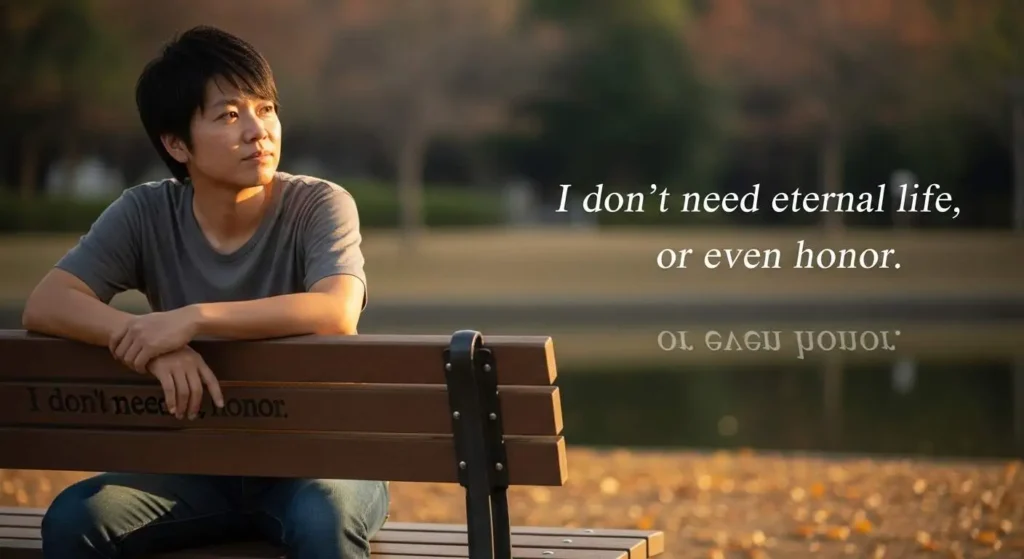
However, as I repeatedly listened to that clear singing voice flowing out, I felt my heart mysteriously calm down. The state of mind that life is sufficiently fulfilled just by “having met you,” rather than seeking grand success or eternity.
It was not a thought that my teenage self could immediately reach, but it is a song that quietly yet certainly shook the values of my younger self.
An Aloof Soundscape and Scenery Description
The “Twilight” Atmosphere Brought About by the Aesthetics of Subtraction
What absolutely cannot be left out when talking about this song is the beauty of its perfectly calculated sound.
The Japanese music scene at the time was in a transition period, gradually coming to favor flashy arrangements and heavy sounds. But what about this “Ai no Uta”? What is here is a thorough “aesthetics of subtraction.”
The Blank Space That Reflects the Listener’s Memories
The bare minimum finger-picking of an acoustic guitar, and the perfect chorus work unique to Off Course that gently envelops the feeling of helplessness. By stripping away excessive decoration, the scene of a “lonely twilight” emerges vividly in the listener’s heart, almost like a scene from a movie.

Instead of filling the space completely with music, by intentionally leaving a rich “blank space,” we listeners can freely project our own “gentle memories” stored in our drawers onto the space of the song.
The “Ultimate Affirmation” and Self-Acceptance Reached After Years Have Passed
The Current Perspective After Running Through My Working Years and Stopping
The Scenery Seen After Stepping Down from the World of Competition and Evaluation
I wrote that to my high school self, the state of mind in this song, “I don’t even need honor,” seemed like a distant world. However, as an enormous amount of time spanning decades has passed since then…
My days working in the corporate world, buffeted by the logic of the organization and spending dizzying days. There was certainly a sense of fulfillment and achievement there, but at the same time, it was also a daily life constantly side by side with the feeling of being worn down by continuously competing with something and pursuing visible evaluations such as numbers and results.

Having somehow finished running through such a season, now that I am finally able to walk through my daily life at my own pace, I think it is natural that this song presses upon my heart with a completely different texture than it did in my high school days.
The “preciousness of just a single encounter,” which was once hidden by youthful ambition and impatience, now resonates in my heart as an extremely real feeling as I enter the autumn of my life.
External evaluations such as status, fame, and social position will eventually fade and be let go of with the passage of time. However, the memories of being deeply connected with someone in the deep parts of your heart, and the very fact that you were able to meet that person, will never deteriorate no matter how much time passes. I believe this song is a quiet “ultimate affirmation” for us living the second half of our lives.

The Cruelty and Beauty of Continuing to Hold an Unchanging Heart
The True Temperature Emitted by “Gentle Memories”
What lies in the background of this song is the bittersweetness and sorrow of life, which is never just a shining happy ending. The passion of youth passes by, and some loves change shape or are lost. The flow of time is heartless, and sometimes even cruel.
Even so, to wish that “I want only my heart to remain unchanged.” And the attitude of unsparingly offering the warmest, gentlest memories one has, if the other person happens to turn around at a lonely twilight. This depicts a form of unconditional love that asks for nothing in return.

Rather than trying to strongly possess the other person or flaunt one’s own existence, one gently watches over them from a slight distance and offers one’s own memories to be close to the other’s loneliness. Isn’t that an expression of deep and quiet affection that can only be sung by an adult who has experienced various losses and knows the weakness and fragility of human beings?
The Thoughts Put Into the 11th Place Ranking
An Overwhelming Presence Dwelling in Silence
Off Course has many dynamic hit songs that drive tens of thousands of audience members wild. If I were to rank them solely on “musical flashiness” or “public recognition,” there might be other songs that should be ranked higher than this one.
It might be a slightly exaggerated expression, but when viewed against the theme of “Eternity and Solitude”—which is also the title of my blog—this early hidden masterpiece begins to shine.

Precisely because it does not have an exaggerated arrangement, it transcends eras to gently snuggle up to the listener’s “solitude” and quietly ask what “eternity” is.
In Conclusion
A Song You Want to Listen to Once Again at Twilight
This time, I took a deep dive into Off Course’s “Ai no Uta,” getting a little sentimental in the process.
If any of you happen to experience a twilight where you suddenly feel lonely, please brew some warm tea and lend your ear to this song. I am sure that the “gentle memories” sleeping deep within your heart will softly show their faces.

コメント