- 🎧 Enjoy this article in audio
- Today is Dennis DeYoung’s Birthday
- YouTube Video (Please enjoy the official video first)
- When I First Heard This Song
- The Watershed of 1979: The Ripples Caused by Cornerstone
- Tommy Shaw’s Innovation and Dennis DeYoung’s “Accordion”
- The Dissonance of “Tranquility Base” in the Lyrics
- “Acted” Unplugged as Told by the Video
- Dennis and Tommy: A Miracle Born of Oil and Water
- The “River” Flows Forever
🎧 Enjoy this article in audio
🎶 English Narration
Click the play button to listen to the English narration of this article.
🎵 Japanese Narration
You can also listen to the content of this article in Japanese.
* Listening to the audio before reading the text will help you better understand the background and key points of the song.
Today is Dennis DeYoung’s Birthday
February 18th marks the birthday of Dennis DeYoung, a founding member of Styx—the titans of American Prog-Hard Rock—and the man who built the band’s golden era.
Born in Chicago in 1947, he brought theatrical drama and the grandeur of classical music into rock. The soaring, distinctive vocals and heavy keyboard work heard in songs like “Babe” and “Come Sail Away” continue to shine with a unique brilliance, even amidst the heyday of Arena Rock.
※ “Babe” was written by DeYoung as a birthday present for his wife, Suzanne, and became Styx’s only single to reach No. 1 in the US. (He also provided the vocals for this track).
“Boat On The River” – The Lyrics
Take me back to my boat on the river
I need to go down, I need to come down
Take me back to my boat on the river
And I won't cry out anymore
Time stands still as I gaze in her waters
She eases me down, touching me gently
With the waters that flow past my boat on the river
So I don't cry out anymore
YouTube Video (Please enjoy the official video first)
Credits
Artist: Styx
Song: Boat On The River
Album: Cornerstone (1979)
Written by: Tommy Shaw
Label: A&M Records
Quick Commentary
A representative ballad of Styx, featuring a rustic folk melody and the impressive sound of a mandolin.
While it didn't become a massive hit in the US, it is a unique masterpiece that reached No. 1 on charts across various European countries.
When I First Heard This Song
| My Age | Elementary | Middle School | High School | University | 20s | 30s | 40s | 50s | 60s+ |
| Song Release | 1979 | ||||||||
| When I Heard It | ● |
I first heard this song during the autumn and winter of 1979, shortly after the release of the album Cornerstone, which features “Boat On The River.”
At the time, I was captivated by “Babe,” which was playing frequently on the radio, and I picked up the album while still under its spell.
Of course, “Babe” is an undoubted masterpiece, but for me, “Boat On The River,” with its rustic folk sound filled with deep melancholy, became the track that truly resonated with my heart. Its melody and lyricism seeped quietly but surely into the depths of my chest.
Listening to it again after a long time for this introduction, I realized once more—using a cliché expression—that this is a true masterpiece that “touches the heartstrings.”
The Watershed of 1979: The Ripples Caused by Cornerstone
Cornerstone as a Turning Point
The album Cornerstone, featuring “Boat On The River,” was released to the world in the autumn of 1979. This year is positioned as a distinct turning point in global music history.
In the US at the time, the shock of punk rock had temporarily subsided, and New Wave was beginning to rise in its place. Existing rock styles were forced to reorganize, and tension between genres was high. Particularly in Chicago, Styx’s home base, backlash against the disco boom reached its peak. It was an era where music culture itself carried ideological conflicts, exemplified by the “Disco Demolition Night,” a radical exclusion movement that erupted on a stadium scale.

From Heavy to Sophisticated — Steering the Band
Amidst such turbulence, Styx shed the heavy stylistic beauty of progressive hard rock they had maintained up to their previous work, *Pieces of Eight*, and steered boldly toward a more pop and sophisticated sound.
Symbolism in the Album Title
The album title Cornerstone means a foundation stone, but it can also be interpreted as symbolizing the band standing at a “corner” where they turned in a new direction. It wasn’t an extension of the past, but a declarative work that chose a future-oriented redefinition.
Intersection of Success and Backlash
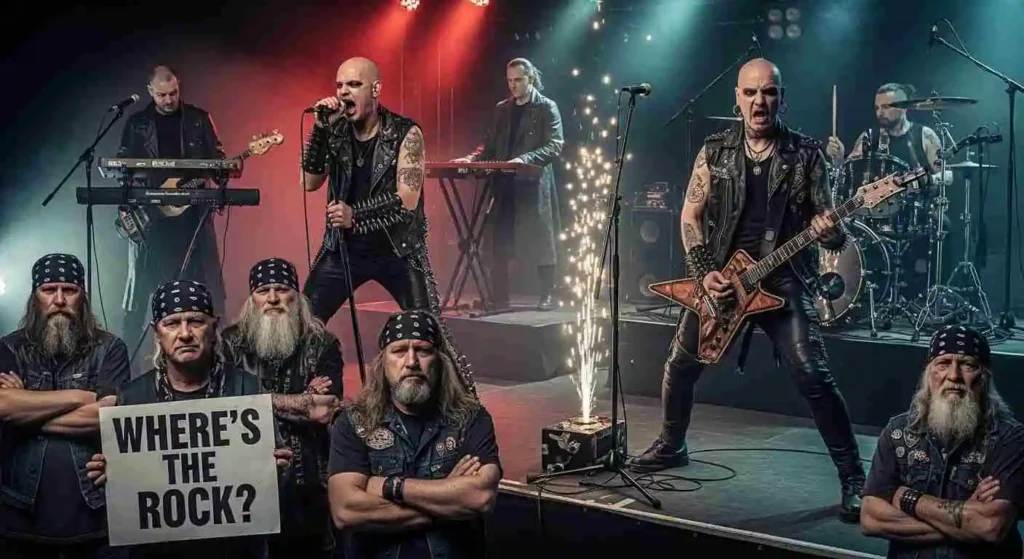
Naturally, this change wasn’t universally welcomed. Criticism erupted from longtime hard rock supporters, claiming the band had “sold out to corporate rock” or “gone soft.” However, the result was a No. 2 record on the US charts and the birth of the band’s biggest hit, “Babe.” From the perspective of commercial success, that change of direction achieved clear results.
Exceptional Success in Europe
In the shadow of that glamorous success, another song was quietly but surely making its presence felt. “Boat On The River,” which was cut as a single but didn’t achieve major results in the US, hit No. 1 across European countries like Switzerland, Germany, and Austria, garnering explosive support.
Why Europe and not America? The key lies in the song’s unique structure, which “deviated from the framework of a rock band.” It is here that the essence of the song’s cultural crossover potential was hiding.
Tommy Shaw’s Innovation and Dennis DeYoung’s “Accordion”
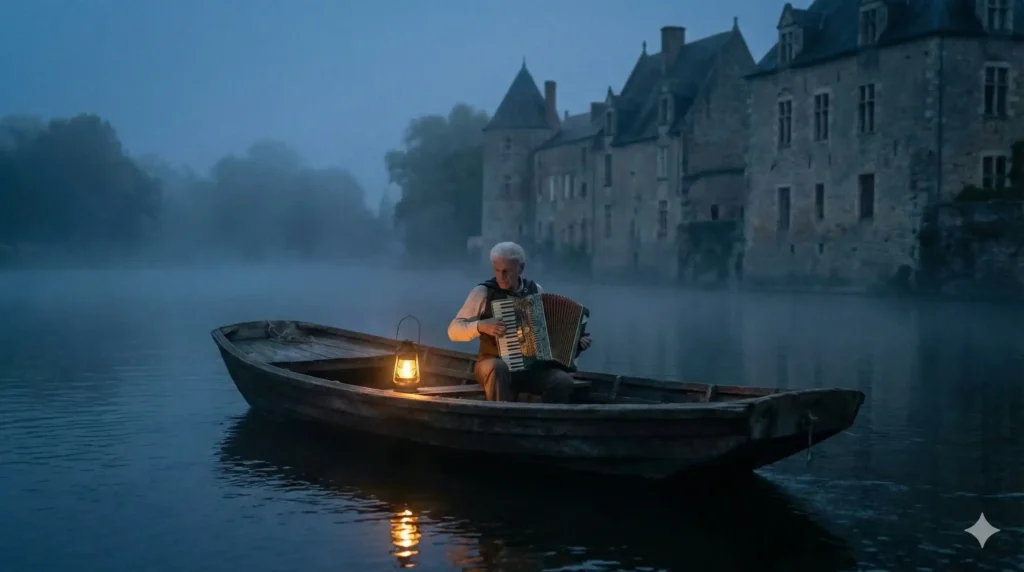
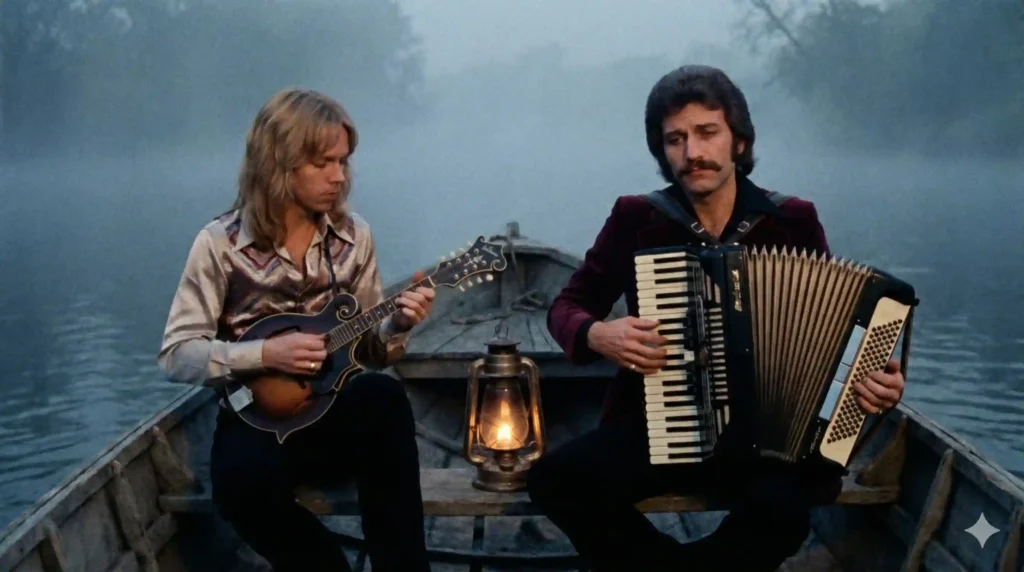
The song was written and composed by Tommy Shaw. Known for his hard guitar play, it was shocking to see him put down the electric guitar entirely and pick up a mandolin. However, what decisively defined the stateless and sorrowful world of this song was the sound of the accordion played by today’s birthday protagonist, Dennis DeYoung.
Deviation from the Rock Ensemble
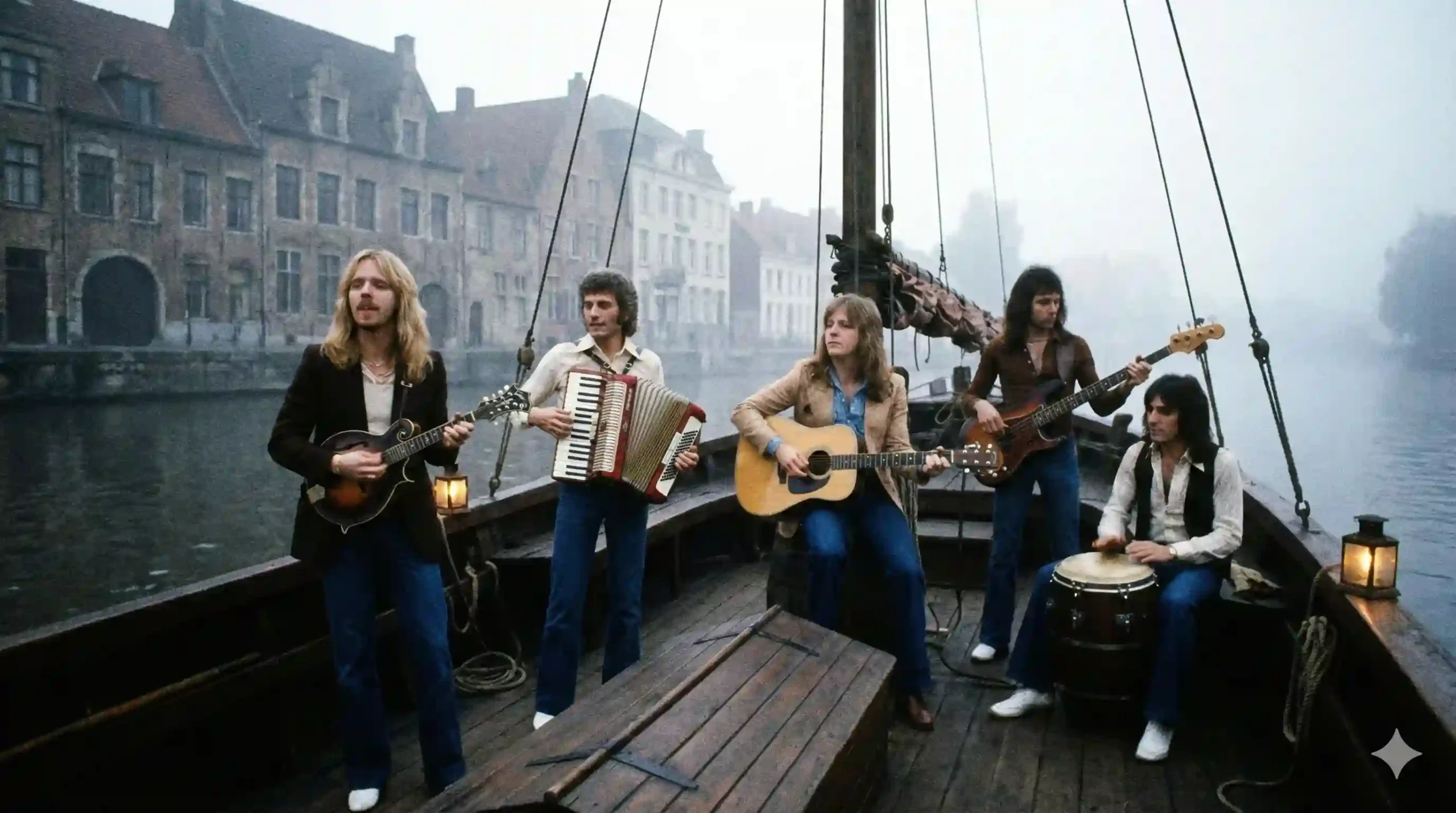
If you watch the YouTube video (official video), you’ll see the members sitting in a circle inside a dimly lit studio set. It is not the standard rock band arrangement—drums in the back, vocals in the front. It is staged as if they are improvising in a corner pub or on the deck of an old ship.
Here, Dennis DeYoung is not surrounded by his usual fortress of massive synthesizers. He is holding a single accordion. The phrases he plays evoke not the dry winds of the American Midwest, but the winds dampening the back alleys of Paris or perhaps the vast plains of Eastern Europe.
Life Breathed in by the “Bellows”
Using an accordion in a rock band was extremely unorthodox at the time. It might have been normal for roots rock like The Band, but for arena rock stars to feature this instrument so prominently was an adventure.
However, Dennis maximized the “breathing” sensation of the instrument’s bellows. Tommy Shaw’s mandolin carves out a finely trembling tremolo. Dennis’s accordion weaves thick, sorrowful melodies through those gaps. The sound of wood, leather, and air rubbing together—sounds that electronic synthesizers can never replicate—circulates the blood through this song.
The Dissonance of “Tranquility Base” in the Lyrics
Checking the lyrics, a very interesting term appears in the chorus.
And all roads lead to Tranquility Base
Where the frown on my face disappears
“Tranquility Base.” This is the proper name for the site on the Moon (Mare Tranquillitatis) where Apollo 11 landed in 1969.
Sci-Fi Terminology Mixed into a Pastoral Landscape
At first glance, this song is composed of extremely Earthly and pastoral motifs like “River” and “Boat.” The warm tones of the acoustic instruments even evoke primitive, pre-civilization scenery. Yet, Tommy Shaw suddenly throws in a cosmic, or near-future, word: “Moon Base.”

Two major interpretations can be made regarding the lyrical world of this song.
I. “Absolute Silence” as a Metaphor for Escapism
The first is the interpretation of “Absolute Silence” as a metaphor for pure escapism.
At the time, Styx was in the midst of tight tour schedules and the immense pressure of big business. The desperate cry to “take me back to the river” can be read as a desire to escape the hustle and bustle of show business.
There is no rest anywhere on Earth; unless one goes to a place as isolated and distant as the moon, the “frown” will not disappear. Perhaps such a desire for extreme solitude and silence is embedded in these words.
II. Cold Silence Born from the Contrast of Organic and Inorganic
The other interpretation focuses on the contrast structure of “cold silence” inherent in this song.
The ensemble of mandolin and accordion possesses an organic resonance. Over that soft soundscape, inorganic space terminology is sung plainly. This subtle sense of incongruity born from this heterogeneous combination may have been a uniquely Styx-style progressive trick not found in simple folk songs.
Amplification Effect by Dennis DeYoung’s Harmony
Dennis DeYoung’s harmony vocals also amplify this lyrical world three-dimensionally.
If Tommy Shaw’s voice is the main melody embodying a “personal, desperate wish,” Dennis’s chorus envelops it with an irresistible force, like “fate” or “the flow of the river itself.”
Especially in the bridge section, the high-range chorus work synchronizes closely with the tone of the accordion, creating a gravitational pull that tears the listener’s consciousness from reality and drags it strongly into the song’s world.
This multi-layered structure is likely the factor that gives “Boat On The River” a unique depth, keeping it from stopping at being just a lyrical ballad.
“Acted” Unplugged as Told by the Video
The official YouTube video is peppered with visual tricks that double the song’s appeal. They aren’t just playing; they are skillfully “acting” out the song’s worldview. More than a decade before MTV Unplugged became a boom, they had already established that style.
The Identity of the Dissonance: The “Double Bass”
In the video, bassist Chuck Panozzo is holding a massive double bass (upright bass) instead of his usual electric bass.
Usually, even in a rock band’s ballad corner, it’s rare to switch out the bass. However, to express the Eastern European or Gypsy music atmosphere held by this song, he dared to choose this heavy instrument. The visual effect is immense. The massive wooden body on screen implants the impression that “this is not the usual corporate rock Styx” the moment before a sound is even made.
John Panozzo’s Aesthetics of “Not Hitting”
Pay attention to the movements of drummer John Panozzo as well. He isn’t sitting at a drum set. He holds percussion instruments like bongos between his knees, tapping them with his fingertips as if flicking them, without using sticks.
For a rock drummer, putting down sticks and hitting with bare hands means sealing away their greatest weapons: power and volume. However, the “aesthetics of subtraction” John showed here was the song’s winning factor. Because of the small rhythms born from his delicate finger movements, the “breathing sounds” emitted by Dennis’s accordion stand out as the protagonist of the song.
Dennis and Tommy: A Miracle Born of Oil and Water
This song is Tommy Shaw’s work, but it would not have existed without the presence of today’s main character, Dennis DeYoung.
Fusion of the Rock Kid and the Theater Youth
Tommy Shaw was a “Rock Kid” from Alabama, heavily influenced by Southern Rock and Folk. In contrast, Dennis DeYoung was from Chicago, possessing a “Theater Youth” temperament that loved drama and classical music.
Normally, these two are like oil and water. In fact, in the band’s later years, they would conflict over musical differences, but in “Boat On The River,” they showed a miraculous fusion. Dennis’s dramatic direction (decoration) sat perfectly atop Tommy’s indigenous melody sense (foundation). Dennis elevated a song that might have ended as a “simple folk song” in Tommy’s hands alone into a “dramatic theater piece.”
Dennis’s Contribution as a Counterpart to “Babe”
In the album Cornerstone, the US No. 1 hit “Babe,” written by Dennis, was a refined, urban ballad. On the other hand, Tommy’s “Boat On The River” was a folk song drifting with an earthy scent.
It is said that Dennis strongly recommended including this song—the polar opposite of his own “Babe”—on the album. Recognizing a talent he didn’t possess and adding color to it with his specialty, the accordion. This producing ability was the true essence of the musician Dennis DeYoung, and perhaps his pride as a bandleader.
The “River” Flows Forever
Even now, more than 40 years after its release, “Boat On The River” continues to be covered around the world. Especially in Germany and Russia, it is treated almost like a beloved national folk song.
A song of a man going down the river aiming for “Tranquility Base.” Perhaps it is a momentary rest brought to our hearts—living in a busy modern society—by Dennis DeYoung’s accordion. His sorrowful melody continues to function like a boat carrying tired souls, transcending language barriers.
To Dennis DeYoung, who remains active even as he turns 79 this year, I offer my heartfelt respect and a Happy Birthday.
コメント