🎧 Listen to This Article
You can quickly explore the key points of this article through narration.
Recommended if you would like to get a feel for “Epitaph” and understand the overall flow of the article before reading.
🎵 English Narration
An English narration introducing the content of this article.
🎶 Japanese Narration
A Japanese narration introducing the content of this article.
Listening first will help you grasp the atmosphere of “Epitaph” and the key points of the article more easily.
🎹 May 16 Is Robert Fripp’s Birthday
Today, May 16, marks the birthday of Robert Fripp, guitarist and founding member of King Crimson.
Born in 1946 in Wimborne Minster, Dorset, in southwestern England, Fripp became one of the founding members of King Crimson when the band began its activities in 1969. Through countless changes in personnel and musical direction, he remained the central figure in the band throughout its long history.
King Crimson’s music brought together powerful guitar work, jazz influences, improvisation, and meticulously constructed compositions. The starting point was their extraordinary 1969 debut album, In the Court of the Crimson King.
To celebrate Robert Fripp’s birthday, I would like to revisit one song from that album that made an especially powerful impression on me: “Epitaph.”
First, watch King Crimson’s official video on YouTube.
🎼 Credits — Music, Lyrics & Performance
Music: Robert Fripp / Ian McDonald / Greg Lake / Michael Giles
Lyrics: Peter Sinfield
Performance:
 Robert Fripp — guitar
 Greg Lake — vocals / bass
 Ian McDonald — Mellotron / woodwinds and others
 Michael Giles — drums / percussion
✍️ In Two Lines:
A nearly nine-minute epic from King Crimson’s 1969 debut album, In the Court of the Crimson King.
The immense sound of the Mellotron and Greg Lake’s commanding voice surround Peter Sinfield’s vision of a world seemingly moving toward catastrophe.
🎼 Credits — 2015 Live Performance
📍 Date: November 20, 2015
📍 Venue: Queen Elizabeth Theatre, Toronto, Canada
Robert Fripp — guitar
Jakko Jakszyk — guitar / vocals
Mel Collins — saxophone / flute
Tony Levin — bass / Stick
Pat Mastelotto — drums / percussion
Gavin Harrison — drums
Bill Rieflin — drums / keyboards
✍️ In Two Lines:
King Crimson revisits the 1969 classic “Epitaph” with its remarkable three-drummer lineup in 2015.
The grandeur of the original melody and Mellotron remains intact, while the expanded ensemble adds even greater depth and weight.
When I First Heard This Song
| My Age | Elementary | Junior High | High School | University | 20s | 30s | 40s | 50s | 60+ |
| Song Released | 1969 | ||||||||
| When I Heard It | ● |
When “Epitaph” was released in 1969, I was still in elementary school. So naturally, I did not hear it at the time.
I discovered King Crimson years later, during my university days, when I was living in a small apartment in Higashi-Matsubara, Tokyo.
I can no longer remember exactly what led me to buy In the Court of the Crimson King. Perhaps it was that unforgettable album cover, or simply the reputation the record had already acquired. Whatever the reason, I eventually brought the album back to my apartment and put it on the turntable.
And when I listened to it, the song that astonished me most was “Epitaph.”
This is not a song that overwhelms you with sheer volume from the opening seconds. Instead, the Mellotron gradually expands, and as Greg Lake’s voice enters, the sound seems to grow until it fills the entire room.
“Just how much bigger is this sound going to become?”
If I had to describe what I felt the first time I heard “Epitaph,” that would probably be the closest expression.
Of course, there is no need to turn the volume up to a level that could damage your hearing. Still, this is not a song I would recommend playing quietly through a tiny speaker. At a comfortable but substantial volume, the expansion of the Mellotron and the depth of the low frequencies become part of the experience.
Another unforgettable track on the same album is the roughly twelve-minute “Moonchild.” But for me, the song that first made me realize just how extraordinary King Crimson could be was “Epitaph.”
1969: The Beginning of King Crimson
Five Young Men and the First King Crimson
King Crimson held its first full rehearsal on January 13, 1969.
The original lineup consisted of Robert Fripp, Greg Lake, Ian McDonald, and Michael Giles, together with Peter Sinfield, who provided the lyrics and also worked on the band’s stage lighting.
What is striking is how young they were. Fripp, born in 1946, was only 22 or 23. Greg Lake was 21, while Ian McDonald and Michael Giles were also still in their twenties.
These young musicians brought together musical elements that had often existed in separate worlds: jazz, classical music, psychedelic rock, improvisation, and carefully structured composition.
Their debut album, In the Court of the Crimson King, released on October 10, 1969, would go on to become one of the essential albums in any discussion of progressive rock.
1969: A World in Motion
1969 was a year of enormous change, not only in music but throughout society. The Vietnam War continued, anti-war movements spread across the United States and elsewhere, and in July, Apollo 11 achieved the first human landing on the Moon. The Woodstock festival followed in August.
In Britain, the Beatles released Abbey Road, the final album they recorded together, in September. Rock still carried the tremendous momentum of the 1960s, but musicians were rapidly expanding its possibilities.
Into this atmosphere came King Crimson, bringing extended compositions, jazz-influenced improvisation, literary lyrics, and the enormous sound of the Mellotron into rock music.
What Makes “Epitaph” So Special?
The Mellotron and Its Immense Wall of Sound
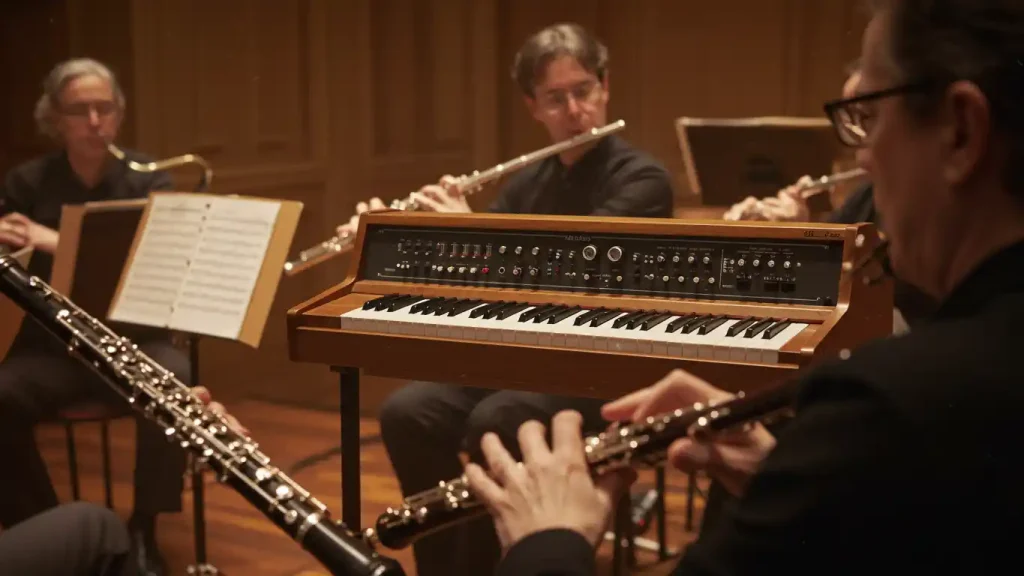
One of the first things that captures your attention in “Epitaph” is Ian McDonald’s Mellotron.
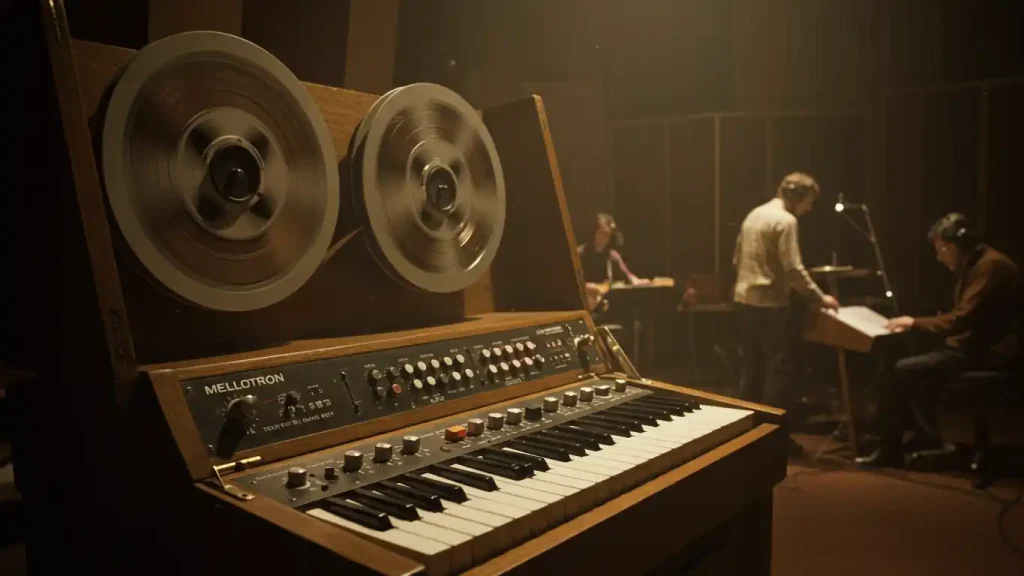
The Mellotron is an electromechanical keyboard instrument that plays prerecorded sounds from magnetic tape when its keys are pressed. Its mechanism is very different from that of a modern digital sampler, and the instrument has a distinctive texture, with subtle fluctuations that became part of its character.
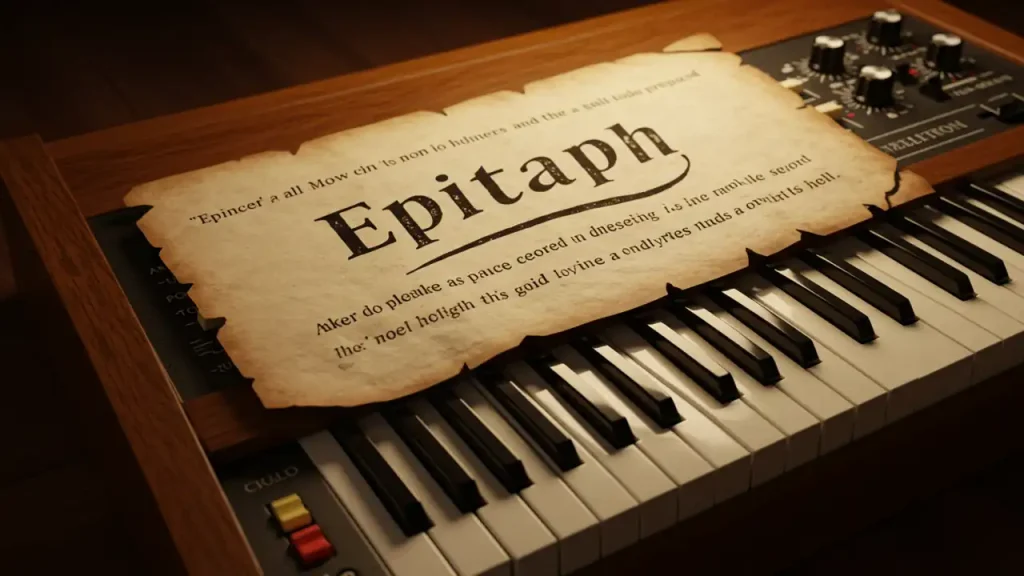
In “Epitaph,” the Mellotron is much more than background accompaniment. It creates the musical landscape itself. Layers of sound resembling a large string section accumulate, and the scale of the music seems to expand as the song progresses.
Michael Giles’s drums and timpani, Fripp’s guitar, and Greg Lake’s bass are added to that foundation, creating a sustained sense of tension that makes the song’s nearly nine-minute running time feel surprisingly short.
Greg Lake’s Voice at the Center of the Music
Another essential element is Greg Lake’s vocal performance.
Lake would later achieve worldwide success with Emerson, Lake & Palmer, but at the time of “Epitaph” he was only 21 years old. Even at that age, he moves from a deep lower register to powerful higher notes without being overwhelmed by the massive instrumentation around him.
What impresses me most is that he does not need excessive vocal theatrics to communicate the emotion of the song. He allows the melody itself to carry the weight. That is why the musical center remains clear even when the Mellotron grows to enormous proportions around his voice.
The Meaning Behind the Title “Epitaph”
Peter Sinfield’s lyrics are equally important to the character of the song.
The word “epitaph” refers to an inscription written on a tombstone or memorial for someone who has died.
The lyrics present images of humanity possessing knowledge but being unable to move in the right direction, of a society beginning to fracture, and of confusion over what the future might hold.
At the center of the song is the memorable line “Confusion will be my epitaph.”
What Sinfield describes is more complicated than a simple vision of “the end of the world.” Humanity possesses knowledge, yet remains uncertain about how that knowledge should be used. That contradiction and anxiety run through the entire song.

The Fascination of Comparing the 1969 and 2015 Versions
The Toronto performance shown near the beginning of this article was recorded on November 20, 2015, allowing us to hear “Epitaph” performed 46 years after the original recording.
The 2015 King Crimson lineup consisted of Robert Fripp, Jakko Jakszyk, Mel Collins, and Tony Levin, together with three drummers: Pat Mastelotto, Gavin Harrison, and Bill Rieflin.
That lineup might suggest a much more flamboyant performance than the 1969 version. In reality, however, the musicians remain remarkably faithful to the essential character of the original while adding greater weight to the rhythm and lower frequencies.
They do not simply reproduce a song recorded 46 years earlier. Instead, they preserve its essential identity while performing it as the King Crimson of their own era.
That approach says a great deal about a band that repeatedly changed its personnel and musical language while somehow remaining unmistakably King Crimson.
Bonus: What Is Progressive Rock?
Whenever King Crimson is discussed, one term almost inevitably appears: “progressive rock.”
Progressive rock developed primarily in Britain from the late 1960s into the early 1970s. Rather than remaining within the conventional format of a short pop song, musicians incorporated elements of classical music, jazz, folk, electronic music, and other styles.
Common characteristics include extended compositions and suites, unusual time signatures, complex structures, the use of instruments such as Mellotrons and synthesizers, lyrics inspired by literature or science fiction, and concept albums designed to create a unified world across an entire record.
Of course, not every progressive rock album contains all of these elements. It may be more useful to think of progressive rock as the result of musicians asking one fundamental question: “How far can rock music go?” The many answers to that question produced an extraordinary range of styles.
🎼 A Brief Timeline of Progressive Rock Artists and Albums
| Year | Artist | Album / Development | Significance |
|---|---|---|---|
| 1967 | Pink Floyd | The Piper at the Gates of Dawn | An early landmark of British psychedelic rock |
| 1969 | King Crimson | In the Court of the Crimson King | A defining early work of progressive rock |
| 1970 | Emerson, Lake & Palmer | Emerson, Lake & Palmer | A bold fusion of classical music and rock |
| 1971 | Yes | Fragile | Includes “Roundabout” |
| 1972 | Genesis | Foxtrot | Includes the epic “Supper’s Ready” |
| 1973 | Pink Floyd | The Dark Side of the Moon | A hugely successful concept album |
| 1974 | King Crimson | Red | A move toward a harder, heavier sound |
| 1975 | Renaissance | Scheherazade and Other Stories | Classical arrangements and distinctive female vocals |
| 1976 | Camel | Moonmadness | A landmark of melodic British progressive rock |
| 1979 | Pink Floyd | The Wall | A large-scale narrative concept album |
| 1983 | Marillion | Script for a Jester’s Tear | A defining album of the 1980s neo-progressive movement |
| 1992 | Dream Theater | Images and Words | A landmark in the development of progressive metal |
| 1999 | Porcupine Tree | Stupid Dream | A significant example of progressive rock’s later evolution |
More Than 50 Years Later, “Epitaph” Still Does Not Sound Old
“Epitaph” was released in 1969.
Yet when I first heard it during my university years, I do not remember thinking of it as “old rock.”
Even today, when the Mellotron begins to spread across the music and grow in scale, I still feel something close to the astonishment I experienced when I first heard the song in that apartment in Higashi-Matsubara.
The guitar does not dominate the track. The tempo does not race forward. Yet for nearly nine minutes, the song refuses to let go of the listener.
It begins quietly, and before you realize it, you are standing inside an enormous wall of sound.
For me, that remains the extraordinary power of “Epitaph.”

音楽ファン同士の交流・リクエストはこちら / Connect & Request Songs Here