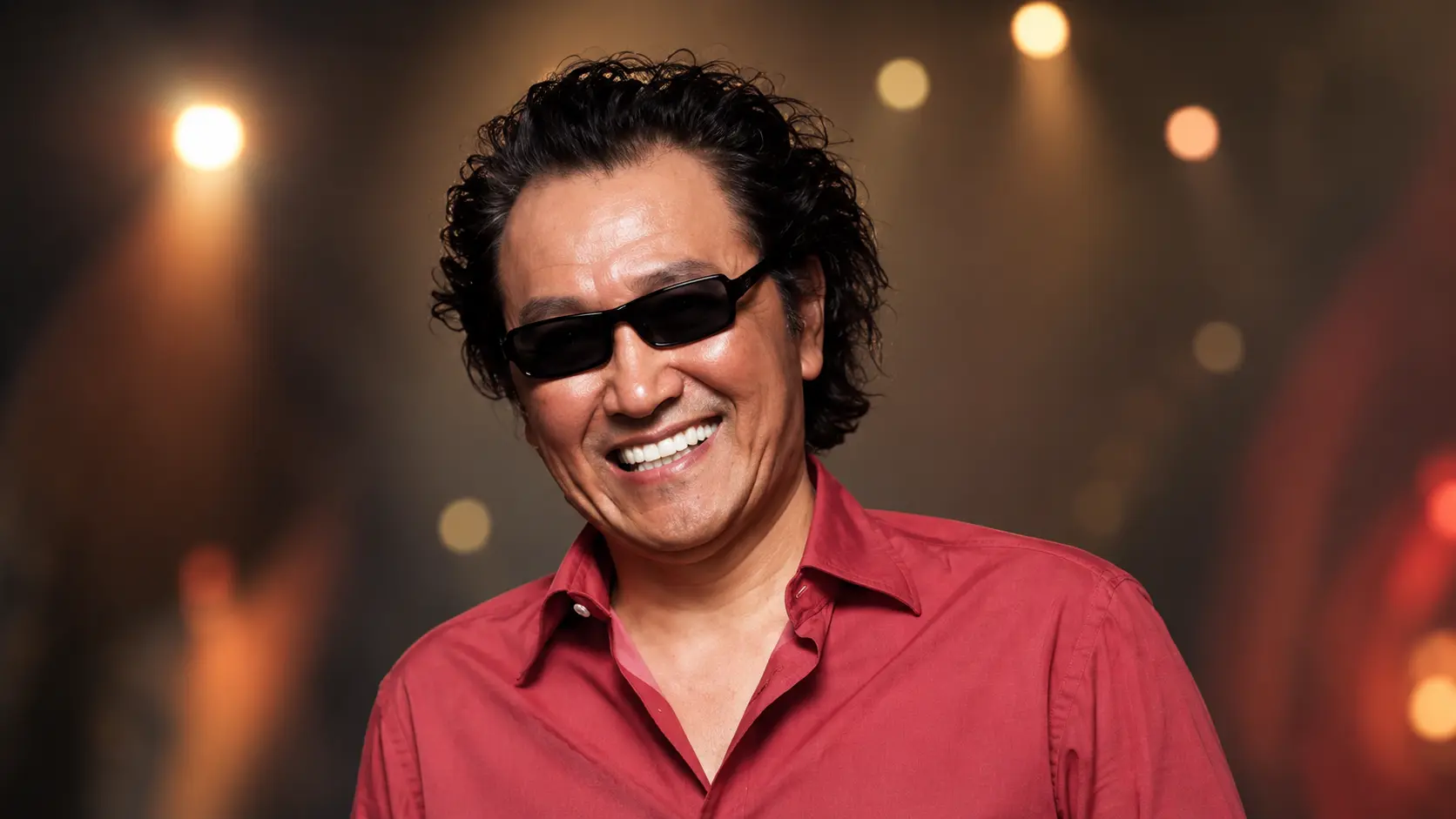
Click here for Yosui Inoue’s History!
- 🎧 Enjoy This Article via Audio
- Ranked 7th is “Higashi e Nishi e” (To the East, To the West)
- First, Please Listen to the YouTube Videos
- A Quiet Abnormal Weather Named “Everyday Life”
- The Boundary Between Genius and Madness Invading the Mind
- The Texture of a Dry Sound
- An Ending That Melds Into the Noise of Daily Life
🎧 Enjoy This Article via Audio
Get a quick grasp of the main points of this article through narration.
Recommended for those who want to catch the vibe of the music and the overall flow before reading.
🎶 English Narration
Introducing the content of this article in English audio.
⌛ Playtime: Approx. 4 mins
🎵 Japanese Narration
Introducing the content of this article in Japanese audio.
⌛ Playtime: Approx. 3 mins 40 secs
Listening to the audio before reading will help you deeper understand the worldview of the song and the key points of the article.
Ranked 7th is “Higashi e Nishi e” (To the East, To the West)
Coming in at 7th place is “Higashi e Nishi e,” which was included in the album “Yosui II ~Sentimental~” released in December 1972 and later released as a single cut.
This song was the exact moment I first became vividly aware of the artist named “Yosui Inoue.”
I was certainly drawn to the beauty of the flowing melody, its rhythm, and the overwhelming freshness that the song itself exuded. Yet, at the same time, each word of the lyrics that flew into my ears was a string of language that existed nowhere in my vocabulary or daily life back then, and it is true that I felt an indescribable, eerie sense of discomfort.
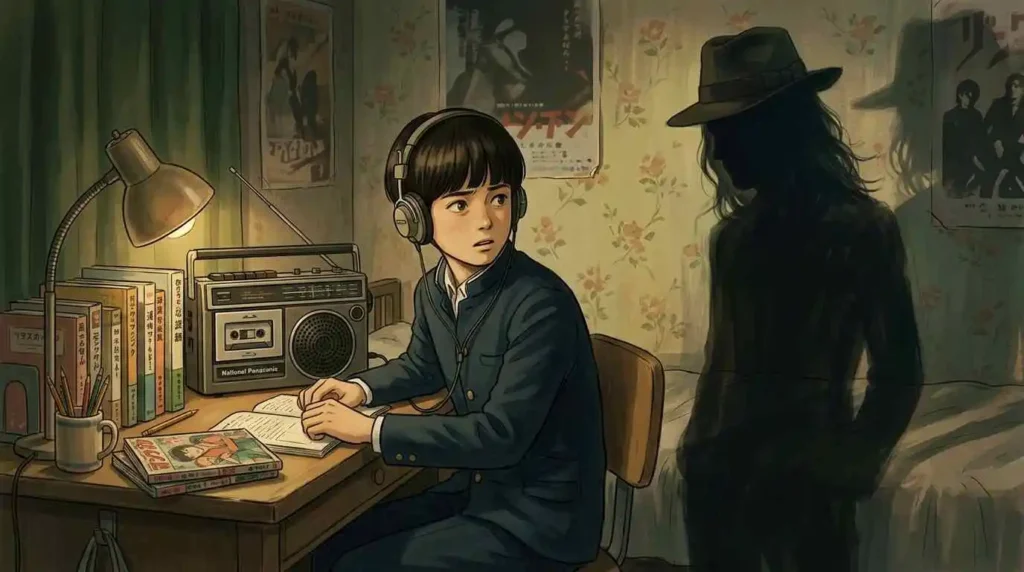
Is this man a genius, or is he completely out of his mind?
Isn’t Yosui Inoue the kind of man who stands composed right in the dead center of that razor-thin line?――Without exaggeration, the younger me back then genuinely held a sensation that bordered on fear.
The world depicted by the lyrics of this song is not merely the bustle of the city or the typical impatience of youth. What lies there are fragments of an utterly absurd daily life, observed through a defiant, fearless gaze that views it all somewhat aloofly and humorously.
This time, I would like to focus on the “distortion of everyday life” and the “unfading dynamism of the sound” that this song possesses, stepping deep into its inner layers.
The Worldview of “Higashi e Nishi e” (Super Translation)
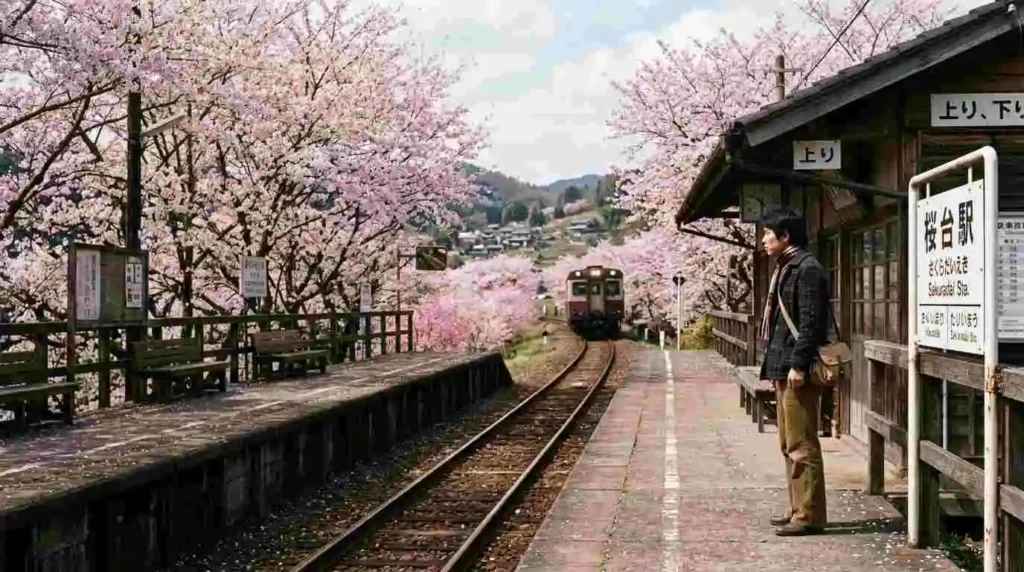
Unable to sleep, both mind and body remain restless, with only the urge to go somewhere racing ahead.
Swept into a packed train within a daily routine where all you can do is laugh, one still attempts to head toward a dreamed-of journey.
In the season of cherry blossoms, the desire to go see you is there, yet ominous crows fly across the sky.
The voices shouting "Hang in there!" sound less like encouragement and more like a forced chant pushing my anxious, unsettled self forward.
💡 You might also like: Click here for the original lyrics (External Site)
First, Please Listen to the YouTube Videos
"Higashi e Nishi e" Common Credits
Song Title: Higashi e Nishi e
Singer, Lyricist, Composer: Yosui Inoue
Original Release: 1972 / Album: "Yosui II Sentimental"

"Higashi e Nishi e" is one of Yosui Inoue's signature tracks, written and composed by himself.
Here, we will compare how the same song alters its expression depending on the era and performance style through four different sound sources.
First is the studio recording version. Please click the image below.
男性_2-1024x572.webp)
Audio: 1972 Version
Format: Studio Recording
A source where the voice of a young Yosui Inoue directly connects with the impatience embedded in the lyrics.
The unpolished singing style delivers the raw texture of words like sleepless nights, packed trains, and dreamed-of journeys just as they are.
The following three tracks are all live recordings from different eras. Please click each corresponding image.
Audio: April 14, 1973 Shinjuku Kosei Nenkin Kaikan Live
Format: Live Recording
In this 1973 live recording, the contours of the vocals are rougher than in the studio version, pushing the momentum of the words forward.
Through a performance that captures the venue's atmosphere, the repetition of "Ganbare" (Hang in there) transforms from an encouragement into an urgent chasing sound.
Audio: 1992 SPARKLING BLUE Nippon Budokan Live
Format: Live Video
In the 1992 Nippon Budokan live show, rather than the urgency of his younger days, a sense of scale that broadly releases the song toward the audience comes to the forefront.
With vocal ease and the expanse of the stage, "Higashi e Nishi e" echoes as a live staple that transcends time.
Audio: From the Album "Hikigatari Passion"
A solo acoustic live recording from Fukuyama Arts Foundation on July 6, 2007.
Album: "Hikigatari Passion" (Released in 2008)
Format: Acoustic Solo Live Source
In the Hikigatari Passion version, the accompaniment is stripped back, bringing the presence of Yosui Inoue's voice and words much closer. It is a performance where the anxiety, absurdity, and loneliness deep within the song are laid bare, rather than the imagery of packed trains or journeys.
(* On this blog, based on copyright considerations for non-official distributions, we do not embed videos directly. Instead, we use a format where custom-prepared images link to external sites.)
A Quiet Abnormal Weather Named “Everyday Life”
An Unsettling Private Life Lurking Behind a Beautiful Melody
When the intro of this song poured out of the speakers, what first caught my ear was the sophisticated acoustic guitar strumming and a melody that possessed a fresh, urban sensibility.
Even within the music scene of that era, its freshness stood out immensely, and I remember being genuinely drawn in, thinking, “What a cool song.”
However, as I surrendered myself to that pleasant melody and began playing back the sung words one by one inside my head, a sudden restlessness began to stir around my chest.
What I was confronted with there was an entirely private, unhealthily mismatched cycle of daily life.
The figure of “me,” wide awake in the middle of the night because of a daytime nap, facing the morning with a lack of sleep.
To make matters worse, the alarm clock announcing the morning is cast aside as an unfeeling entity, compared to a mother’s nagging.

Hearing this choice of words that vividly captured a small distortion of everyday life left me with a hesitant, slight surprise. It was neither the damp, small-room lyricism that previous folk songs had sung about, nor was it a youthful, fresh sentimentality.
A worldview never heard before—somehow dismissive, yet strangely raw and vivid—was expanding right there.
The Laughter of an Old Woman on the “No-Mercy Festival Train”
As the song progresses, the unsettling premonition transforms into a certain, absolute “eeriness.”
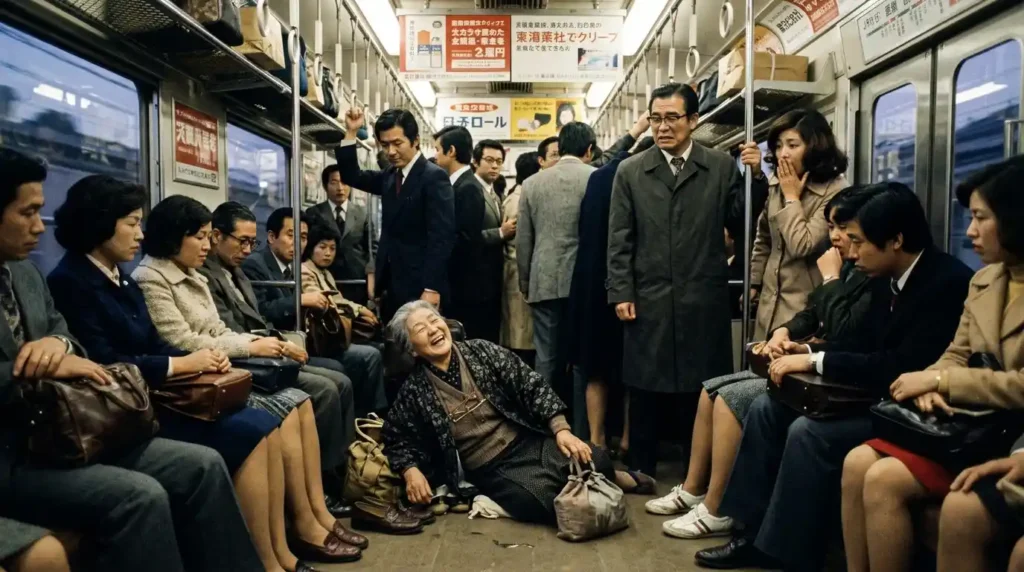
The camera flies out of the room, capturing the scene of a packed commuter train, but the depiction is entirely out of the ordinary.
- The masses crammed into the carriage, unable to move, looking as if even their breathing might be stopped.
- A intense sense of incongruity from intentionally calling such an extreme space an “unforgiving festival train.”
- And to top it off, a scene reminiscent of a horror film where an “old woman who fell onto the chaotic floor laughs.”
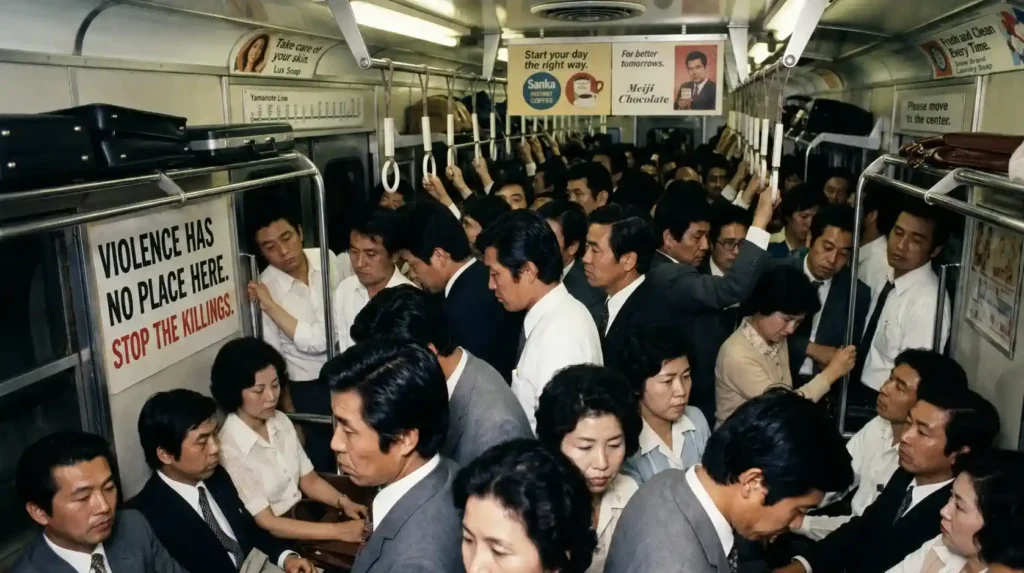
When this passage leaped into my ears, I truly felt a certain kind of strangeness.
A packed train where everyone is supposed to be terrified of being late, or desperately enduring just to make a living, is what Yosui calls a “festival,” making the laughter of an unidentified old woman echo within it.
It felt as though he was drawing a massive satire of society itself—blindly rushing along the invisible tracks of high economic growth.
Instead of singing about a miserable reality in a miserable way, he sets it to a pop melody and serves it up, saying, “Look, it’s a fun festival.” I found myself drawn into the presence of this unfathomable perspective.
The Boundary Between Genius and Madness Invading the Mind
A Verbal Heavy Drug Unleashed at the Peak of Joy
As the lyrics move further along and finally arrive at the station scene where he meets the long-awaited “you,” the discomfort inside my chest deepens its color even more.
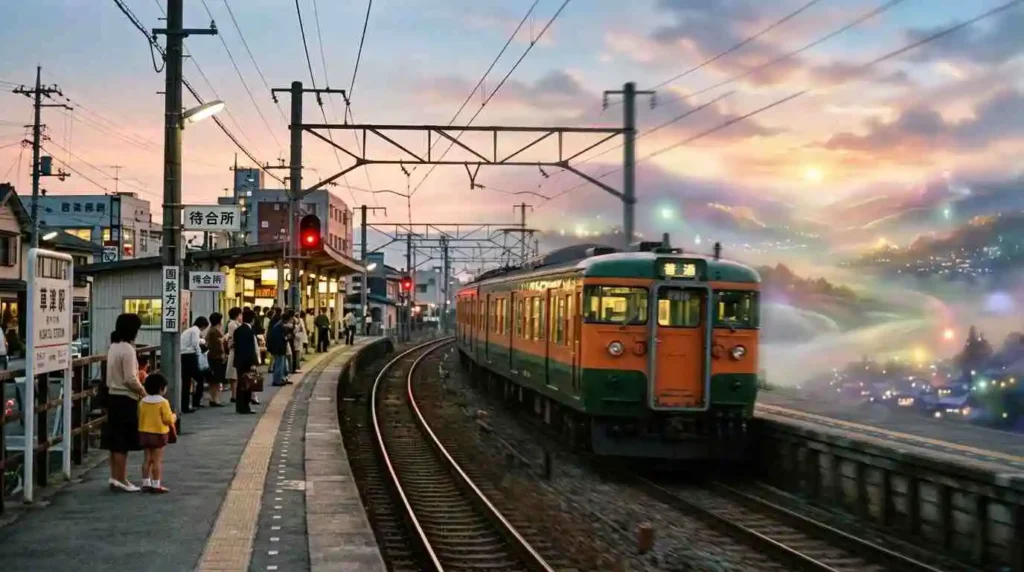
What is depicted there is the scenery of joy, finally meeting a lover on a station platform where cherry blossoms bloom in full swing. It is a place that should naturally be a scene from the happiest love song imaginable.
Yet, Yosui chose to express her figure at the peak of that rapture with a word akin to a heavy drug, rarely used in popular music: “losing her mind” out of sheer happiness.
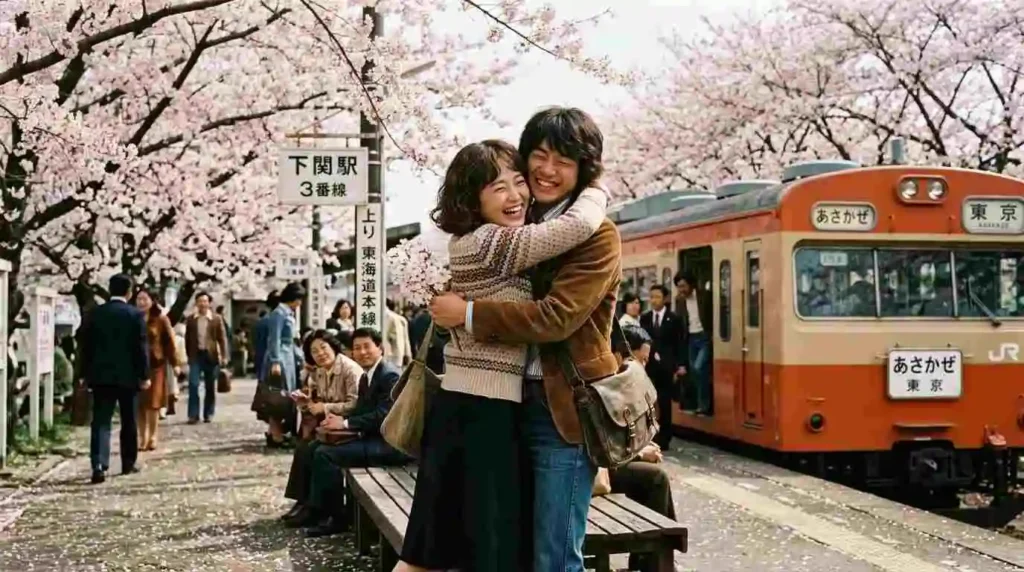
Furthermore, what dances in the sky to bless the scene are not white doves, but black crows—the very symbol of ill omen—and the surrealism of describing them as rejoicing as if competing with humans.
When these words slipped into my ears, an indescribable feeling welled up in my chest. Is this an advanced literary expression, or is it simply a random scribble of words that popped into his head without any context?
The younger me back then genuinely suspected the latter. Is this songwriter a genius, or is he out of his mind? An unfathomable depth, standing calmly right in the “dead center of that razor-thin line” between the two, looking over at us. That was precisely the first powerful impression I formed of the existence known as Yosui Inoue.
A Defiant Cheer Called “Ganbare”
And then, the immensely famous call of “Ganbare, minna ganbare” (Hang in there, everyone hang in there) that is obsessively repeated at the end of each verse.
When this is sung with the fresh sound of the song itself and Yosui’s clear, high-pitched voice, it sounds at first glance like an exhilarating anthem of encouragement. In fact, there was an aspect to how society back then accepted this phrase as a sort of catchphrase.
However, when you listen to this word after processing the context built up so far—“the mismatched private life,” “the madness of the packed train,” and “the lover who has lost her mind”—where the balance of the world has gone somewhat awry, it carries a completely different resonance.
It feels like a detached gaze, casting off the people who keep running east and west without even knowing their destination in a chaotic world, as if saying, “Well, you might as well run along with all your might.”
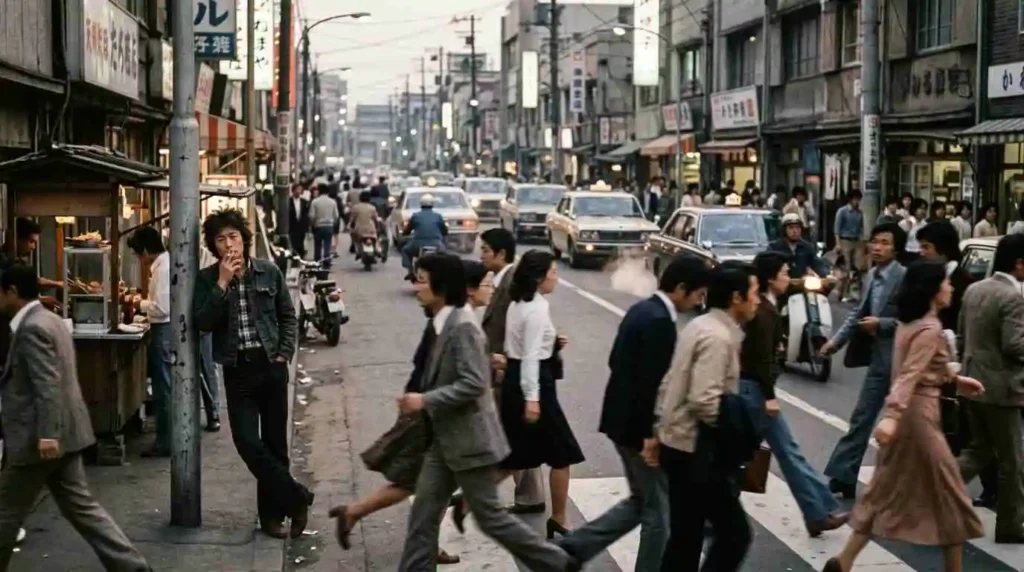
Why does a word like “Ganbare,” which is supposed to be positive, echo in such a manner?
Abruptly confronted with that unknown worldview, the younger me back then was left holding nothing but a strangely peculiar sensation that defied explanation.
The Texture of a Dry Sound
An Unemotional, Calm Resonance
A major factor that prevents “Higashi e Nishi e” from ending as a mere “folk song with strange lyrics” lies in the very texture of its sound.
Speaking of Japanese folk music back then, the mainstream consisted of earthy, heavy guitar resonances that seemed to ooze the grime of daily life. However, the acoustic guitar strumming heard from this track is astonishingly light and dry, like crisp air.
The particles of that sound, which seem to completely bar any excess emotion, were an unfamiliar, alien thing that the younger me was touching for the very first time.
- A low-end rhythm that shows absolutely no flashy developments designed to heighten emotion.
- An ensemble that maintains a steady pace calmly, with a precision that could almost be called mechanical.
- An arrangement thoroughly controlled, never swaying into sentimentality.
The combination of this “calm rhythm” and “dry guitar tone” coolly wraps around the madness of the packed train and the distortions of everyday life drawn in the lyrics, as if it were someone else’s business.
Through that sober resonance stripped of lyricism, the strangeness of those lyrics stood out all the more, making me feel as if an inescapable breathlessness was being further amplified.
An Ending That Melds Into the Noise of Daily Life
The Unending Distortion Brought by the Fade-Out
The track does not reach an end by concluding at a dramatic climax; instead, it meets its finale in the form of a curtain-fall where the volume gradually gets smaller along with the obsessively repeated words of “Ganbare.”
The song does not snap shut; it moves away bit by bit.

Because of that, one receives the illusion that the unmerciful calling and the laughter of the old woman are directly connected, just as they are, into one’s own daily routine or onto the commuter train one is bound to board tomorrow.
Without providing a single clear answer or salvation to the absurd world he presented, Yosui simply lets the music blend into the noise of living and walks away.
Faced with this way of ending, the younger me back then could do nothing but carry the sensation of having an entirely unknown worldview thrust upon him, dragging that unsettled feeling indefinitely.
I believe this is an essential early track that one must listen to first when attempting to understand the artist named Yosui Inoue.

音楽ファン同士の交流・リクエストはこちら / Connect & Request Songs Here