
◆Click here for Yosui Inoue’s History!
- 🎧 Enjoy This Article in Audio
- Ranked 21st is ‘Wine Red no Kokoro’ (Heart of Wine Red)
- First, Please Listen to the YouTube Video
- A Structure as a ‘Psychological Suspense’ Wearing the Skin of Kayokyoku
- The Era Captured by Katz Hoshi’s ‘Acoustic Image Bereft of Warmth’
- Japanese Rhetoric that Forces the Reading of the ‘Back of Words’
- A Miracle Where Two Talents, Koji Tamaki and Yosui Inoue, Intersected
- In Closing
🎧 Enjoy This Article in Audio
You can quickly grasp the main points of this article through narration.
Recommended for those who want to catch the vibe of the music and the flow of the article before reading.
🎶 English Narration
An English audio introduction to the contents of this article.
⌛ Duration: Approx. 2 mins 50 secs
🎵 Japanese Narration
A Japanese audio introduction to the contents of this article.
⌛ Duration: Approx. 2 mins 40 secs
* Listening to the audio before reading helps you better understand the world of the music and the main points of the article.
Ranked 21st is ‘Wine Red no Kokoro’ (Heart of Wine Red)
Looking back at the Japanese hit charts of 1983, one realizes that the streets were beginning to fill with the scent of a new era, clearly distinct from the context of conventional Kayokyoku (Japanese pop music) up to that point.
As a symbol of this, shaping itself as a sophisticated, urban love song while swiftly painting the whole of Japan in its color, was Anzen Chitai’s ‘Wine Red no Kokoro‘. (This song was released on November 25, 1983, as Anzen Chitai’s 4th single. It marked their very first number-one spot on the Oricon weekly charts and became a monumental hit, crowning the number-two spot on the annual chart of the following year, 1984.)
However, the true dread—or rather, the spine-chilling abyss—of this piece resides precisely in the version self-covered and resung by Yosui himself.
A masterpiece that Koji Tamaki sang passionately as the pinnacle of romanticism was dismantled by the lyricist, Yosui Inoue, as if through the gaze of an observer who sees through everything from behind the scenes of the stage.
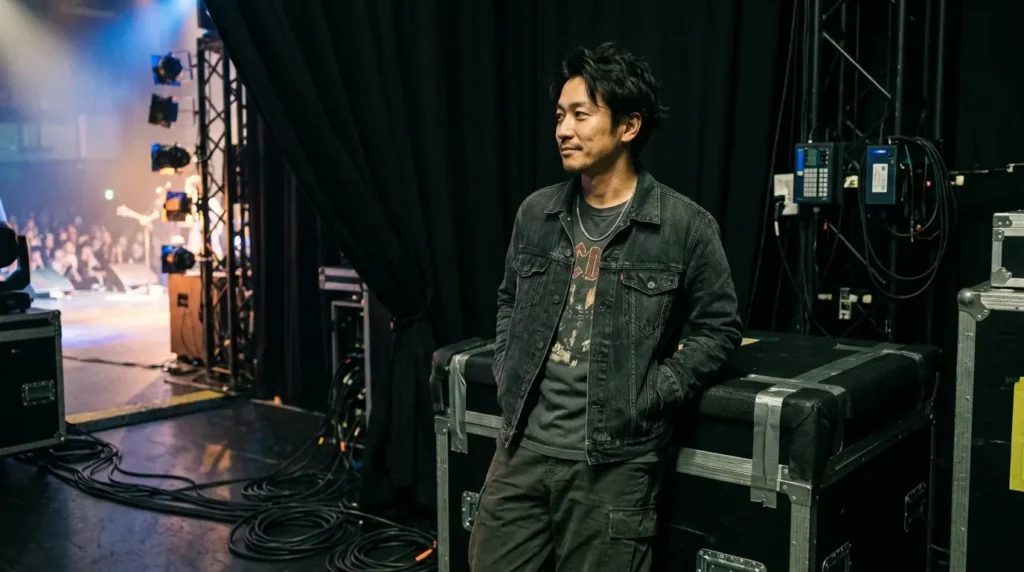
The reason I have placed this immensely famous song at 21st in my personal Best 30 is that I wanted to once again carefully untangle the bare human psychology that lies beneath the smart maneuvering inherent in this song.
Literal Translation: What the World of the Lyrics Portrays
Rather than enjoying love as one pleases, I want to disappear entirely along with the unforgettable memories.
If the fading wine-red heart sleeping deep inside you is real, I want you to love me even deeper.
Rather than getting drunk on complaints or parting words, I want to hold you again and again, to confirm our feelings if only for tonight.
I want you to offer up once more to this night the passion remaining unburnt within you.
First, Please Listen to the YouTube Video
Please click the image below. (Links to the YouTube video)

'Wine Red no Kokoro' (Self-Cover Version)
 Lyrics: Yosui Inoue / Composition: Koji Tamaki / Arrangement: Katz Hoshi
 ※A monumental self-cover by Yosui himself, recorded in his 1984 album '9.5 Carats'. Setting itself apart from the urban melancholy of Anzen Chitai's original version, a unique acoustic space is constructed where listlessness and sensuality coexist.
In addition, there are precious live recordings performed with different approaches over changing eras. Please listen and compare the different shades of ‘Wine Red’ that Yosui poured into each night.
Please click the image below. (Links to the YouTube video)

'Wine Red no Kokoro' (From the 1992 'Guide Time' Live) An arrangement wearing the atmosphere of the early 1990s. Within a restrained band sound, Yosui's vocals penetrate even flatter, yet surely, into the depths of the listener's ear—a stage where the aesthetics of subtraction shine brilliantly.
Please click the image below. (Links to the YouTube video)

'Wine Red no Kokoro' (2000s Acoustic Live) A version where you can thoroughly enjoy Yosui's singing voice, which has gained even greater depth over the years. Within the acoustic resonance stripped of ornaments, each and every word rules the space heavily and with a sense of speed in this thrilling masterpiece performance.
(※Currently, most of the audio sources of Mr. Yosui Inoue existing on the Internet are not official distributions. Therefore, based on copyright considerations, this blog adopts a format of linking to external sites from uniquely prepared images instead of directly embedding the videos.)
A Structure as a ‘Psychological Suspense’ Wearing the Skin of Kayokyoku
Many people have accepted this song as an “adult, slightly luxurious love story of a man and a woman passing each other by.” This is because Anzen Chitai’s sophisticated performance flowing from the television, Mr. Koji Tamaki’s handsome appearance, and his raspy voice tinged with sadness were the perfect “correct answer” in the music scene at the time.
However, the moment Yosui stood before the microphone himself and echoed that low-register falsetto, the romantic mist enveloping the song cleared away in an instant, and a completely different landscape appeared. It is not a sweet whisper exchanged in the corner of a stylish bar, but the composition of a mental power game unfolded in an inescapable room.
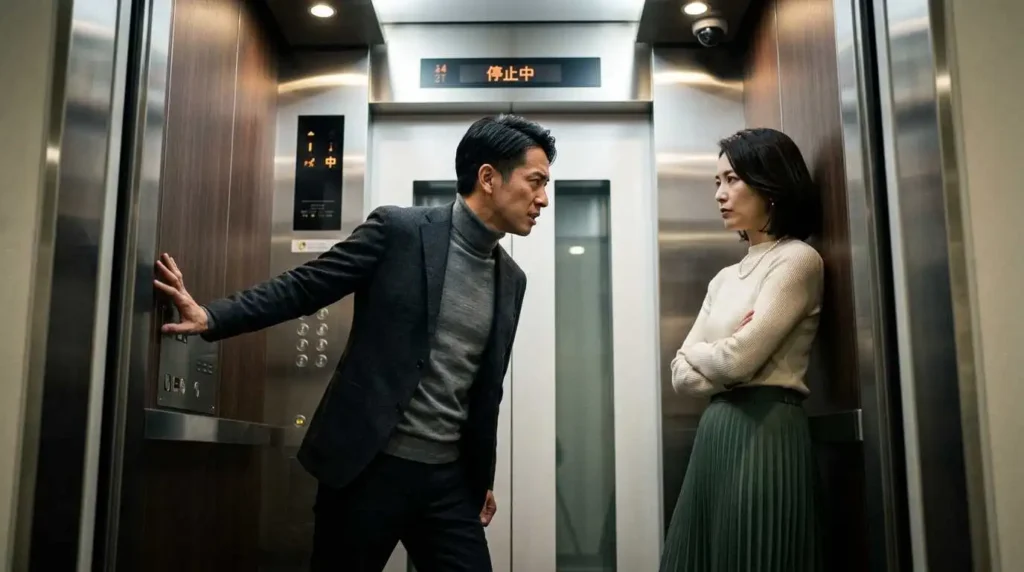
- The provocation of ‘loving as one pleases’: Appearing to push the partner away, it is actually a trap to prevent escape.
- The condemnation of ‘if one forgets’: A gaze that gently, yet relentlessly, denies the weakness of clinging to past memories.
- The boundary line of ‘once the wine is opened’: A calculated move to unlock the lock of reason and drag the partner into one’s own territory.
Yosui here completely strips bare the psychology of the proud woman standing frozen because she has “no choice but to be shy” out of fear of getting hurt. The protagonist of this song is by no means a kind man with broad acceptance. Rather, the figure of a man emerges who is deeply sadistic, waiting quietly for the partner’s psychological collapse, and yet cradling a bottomless loneliness.
The Era Captured by Katz Hoshi’s ‘Acoustic Image Bereft of Warmth’
While Anzen Chitai’s original arrangement expressed a new-music-like coloring at the cutting edge of the time and dynamic fluctuations of emotion, the arrangement by Mr. Katz Hoshi, who handled Yosui’s self-cover, features an acoustic design thoroughly “not carried away by sentiment.”
In the mid-1980s, while synthesizer technology was developing rapidly and many songs ran toward brilliant and excessive decorations, the tightness of the bassline and drums in ‘Wine Red no Kokoro’ within the album ‘9.5 Carats’ was anomalous.
Over a solid rhythm section from which unnecessary reverberation has been shaved off, the way ominous electronic sounds float gives the illusion of walking alone on the pavement of a freezing city night.
The era on the eve of the frantic bubble economy that we lived through was a time when everyone jumped into the vortex of gorgeous consumption and enjoyed tokenized wealth. However, on the other side of that, individual inner worlds must have been a time when they were terribly thin, losing sight of true connections with others.
This acoustic image constructed by Mr. Katz Hoshi completely rejects the surface-level gorgeousness of such an era and captures the “spiritual hunger” lurking behind material wealth truly magnificently.
Japanese Rhetoric that Forces the Reading of the ‘Back of Words’
What makes Yosui Inoue excellent as a lyricist is that he evokes completely different scenes in the listener’s mind while using the vocabulary of common pop songs. Even in this ‘Wine Red no Kokoro,’ beautiful romantic descriptions such as ‘swaying’ or ‘drawn to each other’ are lined up at first glance, but the reality is the presentation of an extremely dry relationship.
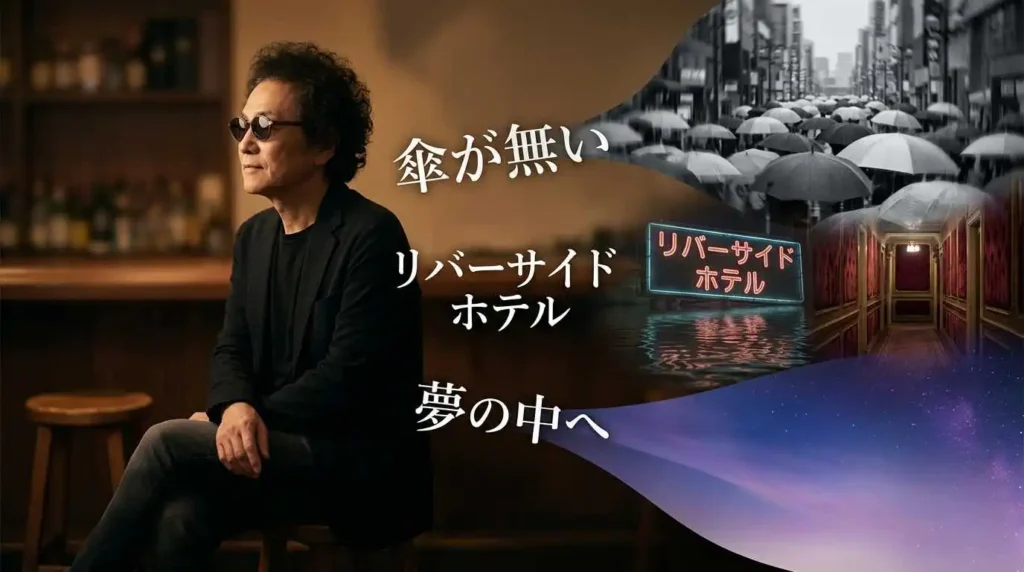
Breakaway from Showa Lyricism
For example, the clear humidity or sentimentality characteristic of the Showa era, as typified by the masterpiece ‘Acacia no Ame ga Yamutoki’ (When the Acacia Rain Stops) sung by Sachiko Nishida, does not exist here at all.
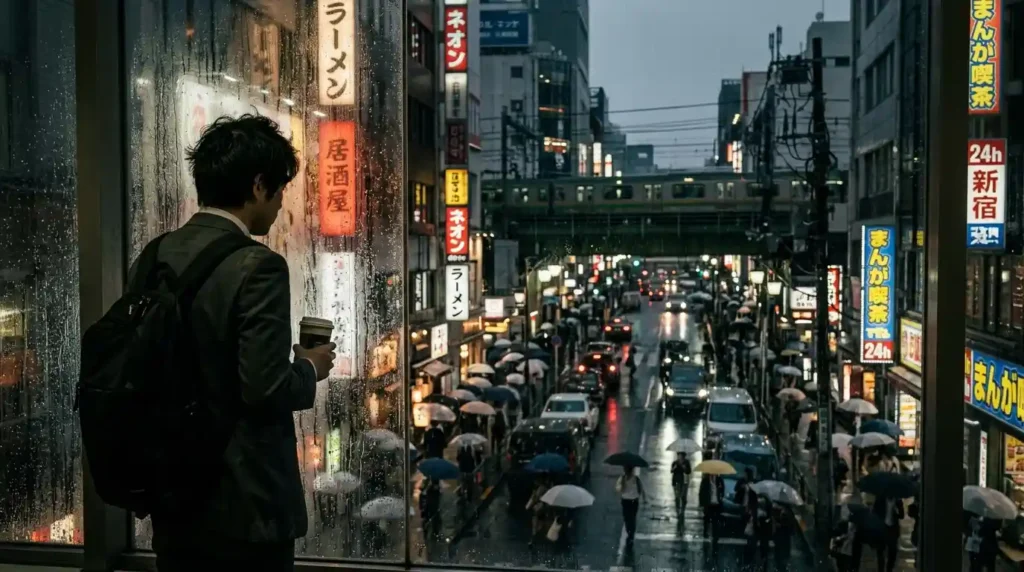
The props and situations that appear are thoroughly inorganic, and that is precisely why the listener feels a sensation as if their feet are being swept out from under them while surrendering their body to the beauty of the melody.
The tantalizing ‘seeming to burn but not burning’
The embodiment of adult cunning, searching each other’s hands.
The defense wall named ‘Pride’
A persistent approach that foresees even the pleasure when it is broken down.
The contradiction of hiding one’s true feelings and dressing up with pretenses, yet wishing somewhere inside to have the depths of one’s heart peeked into. The words spun by Yosui magnificently crystallize such two-sidedness that any human being possesses within the framework of entertainment.
A Miracle Where Two Talents, Koji Tamaki and Yosui Inoue, Intersected
In talking about this song, it is impossible not to mention Mr. Koji Tamaki’s genius as a melody maker, who is the composer. The melodies he created carry a melancholy that touches the heartstrings of Japanese people no matter where you cut it, and at the same time, possess sophisticated chord progressions reminiscent of Western music.
The Romanticism of ‘Yang’ and the Aesthetics of ‘Yin’
If Anzen Chitai’s original is a romanticism of “Yang” that envelops the listener with great passion and melancholy, Yosui’s self-cover is thoroughly penetrated by the aesthetics of “Yin.”
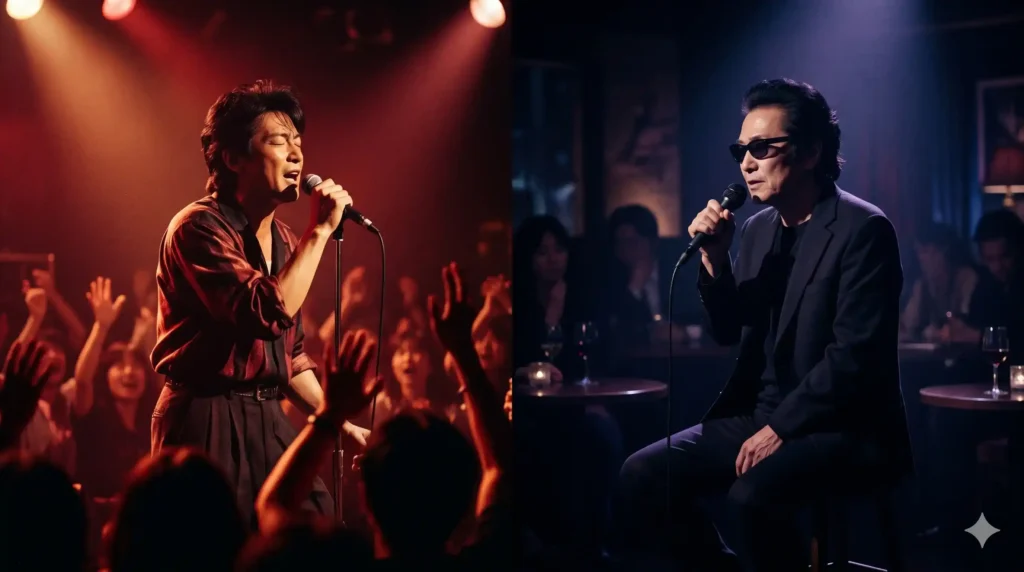
Into a beautiful, dramatic vessel created by Mr. Tamaki’s fresh sensibility, Yosui dares to pour a slightly poisonous essence. I know of no other example where the world view changes so drastically with just one singer’s approach.
A Record of a Happy Complicity
Yosui sings as if to prove the “true home” of the words he created, while paying respect to Mr. Tamaki as a rare vocalist.
It is filled with a tension that quietly shakes the listener’s inner world, holding a resonance like a somewhat listless guide of a play rather than a wrap-around singing style like Anzen Chitai’s. It is not a debate over which is superior, but a record of a happy complicity showing the expanding possibilities of a single song remains here.
In Closing
The red indicated by the title ‘Wine Red no Kokoro’ is not a mere red of passion. It is the color of matured adult emotions that deepens in flavor as time passes, sometimes even appearing dark.

Listening to Yosui’s self-cover is akin to an experience of quietly tasting the astringency of that wine, or even the faint bitterness left after it passes down the throat, all by oneself. Giving an eternal, “unsettling beauty” to a melody that was supposed to be consumed as a brilliant popular song, Yosui’s singing performance is indeed an outstanding footprint in the Japanese pop world.
When listening to this song while tilting a glass in the silence of the night, we still become unable to escape from the labyrinth of words set up by Yosui.

音楽ファン同士の交流・リクエストはこちら / Connect & Request Songs Here