
🎧 Enjoy This Article in Audio
You can quickly grasp the main points of this article through narration.
Recommended for those who want to catch the vibe of the music and the flow of the article before reading.
🎶 English Narration
An English audio introduction to the contents of this article.
⌛ Duration: Approx. 2.5 mins
🎵 Japanese Narration
A Japanese audio introduction to the contents of this article.
⌛ Duration: Approx. 2.5 mins
* Listening to the audio before reading helps you better understand the world of the music and the main points of the article.
Today is Brian Eno’s Birthday.
On May 15, 1948, in Suffolk, England, a magician was born who would later transform the landscape of modern music. His name is Brian Eno.
A stark contrast to his flashy, maverick persona during his early days in Roxy Music, he introduced the concept of “Ambient music,” completely shifting the paradigm of music from an “object to be consciously listened to” to a “space that exists like the air.” His behind-the-scenes footprint in music history is massive, including the production of David Bowie’s “Berlin Trilogy,” Talking Heads, and U2.
_202605140709-1024x572.webp)
“By This River,” the track I am introducing today, is a masterpiece included in his acclaimed 1977 album “Before and After Science.” While it wasn’t a massive hit as a single, it has continued to quietly and deeply permeate the minds of creators across eras, notably being featured in films like the Italian movie “The Son’s Room” (2001) and “Y Tu Mamá También” (2001).
My Interpretation
By the river, we are stranded, looking at the sky.
Though we are together, the distance between our hearts is as vast as the ocean.
I can no longer quite remember why we came here.
Your words and my replies seem to arrive from some other time.
Credits
Brian Eno "By This River (2004 Digital Remaster)"
Lyrics & Music: Brian Eno / Dieter Moebius / Hans-Joachim Roedelius
Album: "Before and After Science"
Producers: Brian Eno / Rhett Davies
Brief Commentary
A highly lyrical piece by Brian Eno that depicts the quiet time of two people stranded by a river, using images of a falling sky and distant conversation. The minimalist melody and faint electronic sounds slowly ripple memories, distance, and a sense of stagnation like the surface of the water.
Credits
Brian Eno & Roger Eno "By This River (Live at The Acropolis)"
Lyrics & Music: Brian Eno / Dieter Moebius / Hans-Joachim Roedelius
Performers: Brian Eno / Roger Eno
From: "Eno (Original Motion Picture Soundtrack)"
Label: UMC / Universal Music Catalogue
Brief Commentary
This is a live version of the 1977 classic "By This River," quietly reprised by Brian Eno and Roger Eno at the Acropolis. The profound depths of time and the gentle expanse of silence brought by the brothers' performance are added to the lonely floating sensation of the original track.
When I First Heard This Song
| My Age | Elementary | Junior High | High School | University | 20s | 30s | 40s | 50s | 60s~ |
| Release Year | 1977 | ||||||||
| When I Heard It | ● |
I first encountered this song during my university days. It was a time when the London Punk movement was completely destroying old rock values, while the footsteps of more introspective and experimental post-punk and new wave were steadily beginning to be heard.
Looking at Japan, it was the year Pink Lady swept television with back-to-back million-sellers, and the Candies announced their disbandment. Amidst the city overflowing with glamorous and enthusiastic Kayokyoku (Japanese pop), the music Eno created felt entirely alien, like a communication log arriving from another planet.
To be honest, my initial image of Brian Eno was somewhat preceded by the notion of “slightly overly logical and difficult intellectual music.” It doesn’t explode with emotion through flashy guitar solos, nor does it shout passionate words of love. However, when I casually dropped the needle on “Before and After Science,” this song flowed out, carrying a cold yet undeniable “gravity” unlike any music I had heard before.

Bare Lyricism Floating in a Sea of Electronic Sound
When discussing the artist Brian Eno, one cannot avoid his self-identification as a “non-musician.”
Rather than outstanding instrumental technique, he poured his passion into manipulating the texture and arrangement of sounds themselves, like a puzzle. However, in “By This River,” an extremely human and trembling poetic sentiment is pushed to the forefront.

Co-written with Moebius and Roedelius of the German electronic music unit Cluster, this song is composed of a minimal number of sounds, yet it possesses a mysterious magnetic field that forcibly draws the listener’s consciousness into deep introspection.
- Intellectual Composition: The perfect contrast between meticulously calculated inorganic electronic sounds and a rustic, warm piano melody.
- Universal Loneliness: A frozen echo that awakens the nostalgia for “somewhere that is not here” that everyone harbors.
- Foresight as a Producer: An acoustic design that seemingly foresaw the isolation of the 21st-century digital society back in the late 1970s.
Even now, he continues to influence how we perceive our world as a thinker who transcends the boundaries of music.
The Pinnacle of Subtraction: The Sound That Dominated the Nights of Setagaya
At the time, I was living in a small, four-and-a-half tatami mat apartment in Tokyo. I vividly remember playing the B-side of this album on my turntable over and over again in the heavy, dead-of-night air after the last Inokashira Line train had passed and the hustle and bustle of the city had completely faded away.
The air of my dead-silent room late at night and the minimal sequence of sounds Eno constructed fit together perfectly, like pieces of an intricate puzzle.
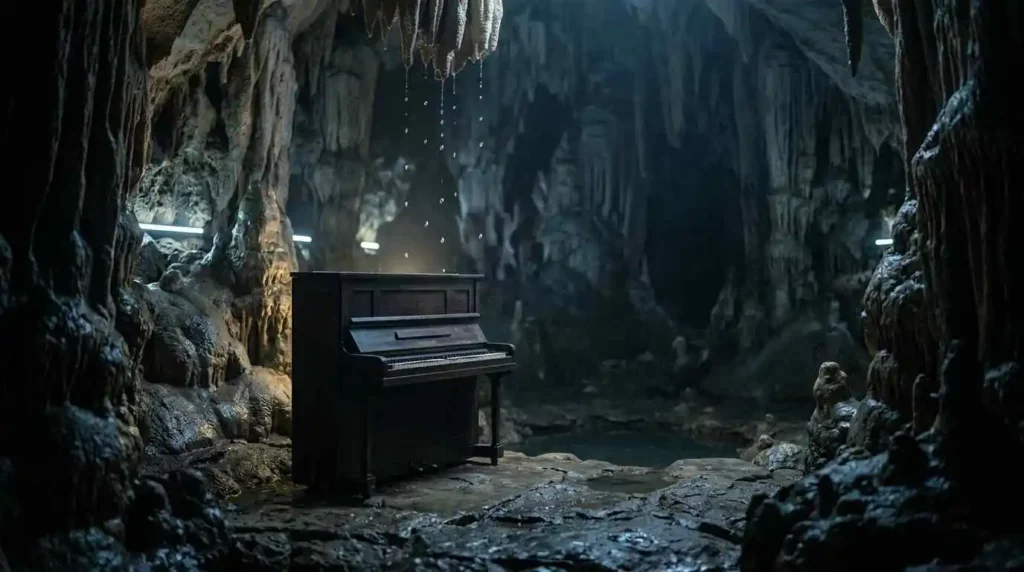
Here, the “aesthetics of subtraction” is expressed in its ultimate form. There are no fierce drum beats to forcefully stir up emotions, nor any overly dramatic orchestral arrangements. They simply do not exist here.
There is only the monotonous piano chord dropping rhythmically like water droplets in a deep cave, paired with the synthesizer echoing behind it like morning mist. It’s a stripped-down, skeletal piece of music, entirely devoid of ornamentation, as if a dead tree in midwinter were sharply extending its bare branches into the freezing sky. That stoic stance pierced deeply into my heart at the time.
Severed Communication and the Drifting Self
Two Gazes That Never Intersect
The true brilliance of this song lies in its lyrical worldview, which is as cold and penetrating as its stoic soundscape. What is depicted here is a thorough “severance of relationships.”
From the very opening line, “Here we are, Stuck by this river,” the protagonists are already unable to go anywhere. A river is inherently a symbol of the “progression of time,” flowing continuously from upstream to downstream. However, they can neither ride its current nor cross to the opposite shore; they are simply anchored to the water’s edge as if their feet were caught in the mud.
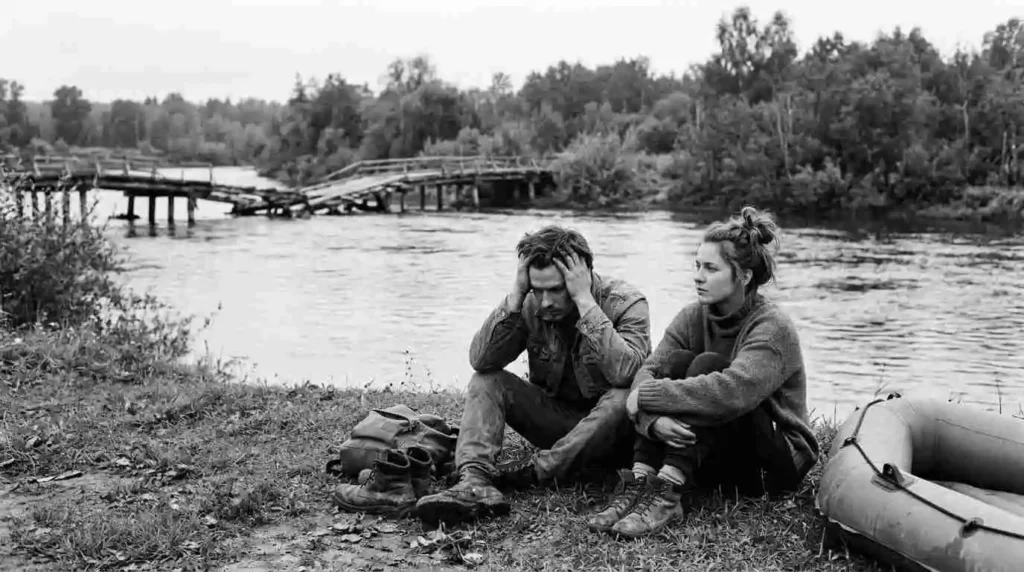
What’s even more ruthless is the line, “You talk to me, As if from a distance.”
The voice of the person who should be right in front of you sounds terribly far away, as if through thick glass. And you yourself can only give a superficial reply, “With impressions chosen from another time,” that is, piecing together scraps of past memories.
The Beauty That Rejects Easy Empathy
This does not simply depict a romantic misunderstanding or the sentimental sorrow of a broken heart. It captures the essential loneliness of human beings trying somehow to patch up the reality in front of them by gathering fragments of past memories, and the absolute limits of communication, viewed with an extremely cold, scientific gaze as if looking through a microscope.
Even towards the end of the song, there is no emotional explosion that brings catharsis. The piano melody continues to repeat the same phrase over and over, like footsteps wandering endlessly through a maze with no exit. There are no passionate depictions of trying deeply to understand each other, nor any fierce clashes of emotions. It’s simply a state of staring at the same gray sky, each sealed inside their own transparent vacuum pack.
However, it is precisely this overwhelming sense of loneliness that, paradoxically, resonates so strongly with the deep-seated desolation that settles at the bottom of the listener’s heart.
In Conclusion: On His Birthday
Almost half a century has passed since Brian Eno released this song. In a world “After Science,” where technological innovation advances and everything is digitized and sped up, the undiminished “helplessness” of humanity is condensed into this track.
We live in an era where we are constantly forced to be connected with someone via communication networks. In our daily lives, where we feel like we might be swallowed by an overwhelming torrent of information, we sometimes feel an intense sense of isolation despite being in a crowd. In such moments, this world of silence that Eno presented in the late 1970s functions not merely as an escape, but as a mirror to reaffirm the true contours of ourselves.
His music, which permits no compromises, does not conveniently erase the loneliness we carry. However, that cold melody quietly continues to present the immutable fact that “human beings are inherently lonely creatures.”
On his birthday, please try listening to “By This River” once again. The ripples of sound, stripped of waste to the absolute limit, will surely sway the quiet surface of the lake sleeping within your heart.

音楽ファン同士の交流・リクエストはこちら / Connect & Request Songs Here