
- 🎧 Listen to this article
- Today Marks the Birthday of Christopher Cross
- First, please enjoy the official video on YouTube.
- When I First Heard This Song
- Sweeping America in 1981: The Impact Launched from the Skyscrapers
- The Early 1980s Paradigm Shift and the Maturity of AOR
- An Ensemble Assembled Like Precision Machinery
- The Dynamics of “Moon” and “City”: The Lyrics’ Ultimate Choice
- A Portrait of Christopher Cross as a “Noble Guitarist”
- Final Thoughts: An Eternal Light Shining Over the Skyscrapers
🎧 Listen to this article
You can quickly check the key points of this article via audio.
Highly recommended for those who want to grasp the main points before reading.
🎶 English Narration
The content of this article is explained in English audio.
⏳ Duration: Approx. 3 min
🎵 Japanese Narration
The same content is also available in Japanese.
⏳ Duration: Approx. 3 min
* Listening to the audio before reading will help you understand the world of the song and the key points more deeply.
Today Marks the Birthday of Christopher Cross
On May 3, 1951, in San Antonio, Texas, a genius singer-songwriter was born who would eventually reach the pinnacle of the AOR (Adult Oriented Rock) world. That man is Christopher Cross.
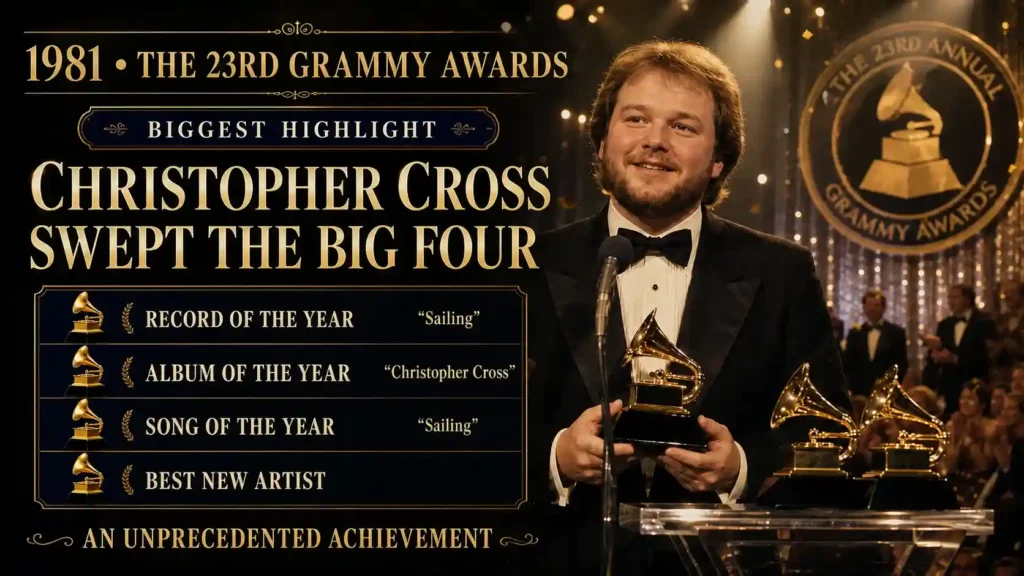
While he began his career in local hard rock bands, his delicate yet powerful high-tenor voice resonated far better with the sophisticated urban night than with gritty guitar riffs. His self-titled debut album, released in 1979, achieved success that can only be described as a seismic shock to the industry. At the following year’s Grammy Awards, he accomplished the unprecedented feat of sweeping the “Big Four” categories: Record of the Year, Album of the Year, Song of the Year, and Best New Artist.
His music is often symbolized by the flamingo icon that frequently appears on his album covers. Like the bird standing quietly on one leg, his sound possesses a flamboyant elegance while maintaining a sense of noble isolation. It remains one of the most delightful mysteries in music history that such meticulously calculated “urban sounds” were birthed from the vast plains of Texas.
The ultimate highlight came at the 23rd Grammy Awards in 1981.
He became the first artist in history to sweep all four major categories alone.
This brilliant record remained an unmatched, singular achievement for nearly 40 years until Billie Eilish finally repeated the feat in 2020.
His music is frequently hailed as the pinnacle of “AOR.” His crystal-clear vocals, which vividly contrast with the rugged image of Texas, combined with the precise ensemble of top-tier studio musicians where not a single note is misplaced, create a timeless standard. The elegant and comfortable sound design—much like the flamingo on his covers—continues to stand as a monumental achievement in sophisticated pop music to this day.
A Poetic Interpretation of the Lyrics
"If you find yourself caught between the Moon and New York City, the best thing you can do is simply fall in love. In the boundary between harsh reality and unreachable dreams, please be true to your heart. For only the magic of love can truly set you free."
First, please enjoy the official video on YouTube.
English Credits
Christopher Cross: "Arthur's Theme (Best That You Can Do)"
Theme song for the motion picture "Arthur"
2-Line Commentary
Christopher Cross's definitive ballad, famously known as the theme for the movie "Arthur."
A masterpiece that layers the euphoria and heartache of falling in love over a sophisticated, gentle melody.
When I First Heard This Song
| My Age | Elem. | JHS | HS | Univ. | 20s | 30s | 40s | 50s | 60s+ |
| Release Year | 1981 | ||||||||
| When I Heard It | ● |
The first time I heard this song was in 1981, the year it was released.
As I’ve mentioned before, this year became a massive turning point in my life. It was the milestone year when I said goodbye to the long-familiar life of a student and began my journey as a working professional.
While my heart swelled with hope and expectation, the leisure time I once enjoyed during my university days vanished in an instant. I no longer had the luxury of spending hours facing my record collection, carefully unraveling the depths of each album as I once did. Yet, in the midst of those hectic days, this song provided a moment of tranquility, much like a cooling breeze in the city.
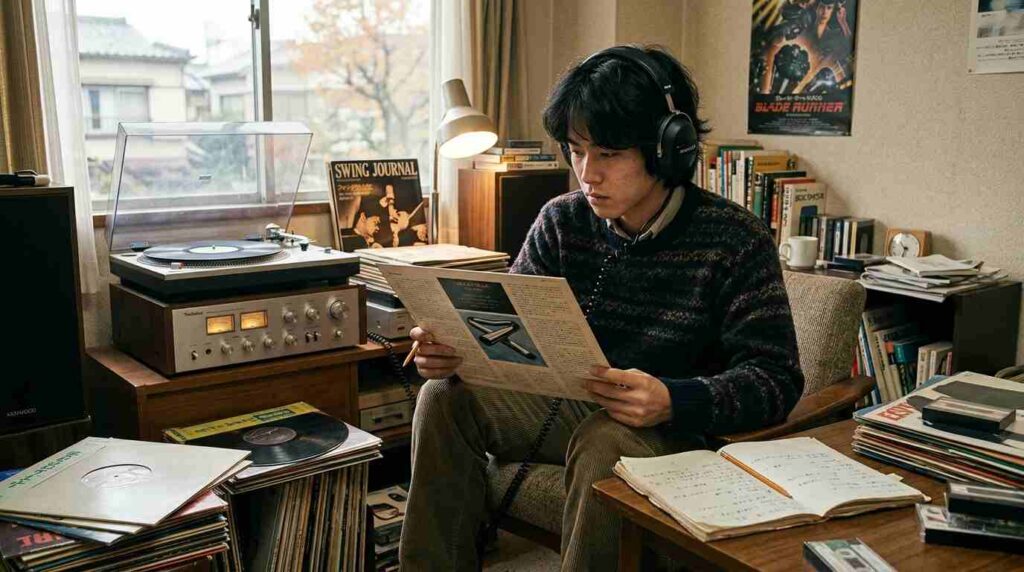
To be honest, I wasn’t originally the type of listener who favored singers with a crystal-clear tone like Christopher Cross. However, at that specific moment in my life, the sheer transparency of the sound resonated with me in a way that was surprisingly natural, soaking deep into my soul. Perhaps it was a perfect resonance between my personal circumstances at the time and the quiet intensity of the music. The raw, youthful memories of my first year in society—both the novelty and the hardship—are vividly resurrected even now by this beautiful melody.
Sweeping America in 1981: The Impact Launched from the Skyscrapers
This immortal masterpiece, “Arthur’s Theme (Best That You Can Do),” was born in August 1981. From the moment of its release, this cool, clear voice began to dominate radio stations across the nation, as if the heat of a summer night were being chilled by a Manhattan breeze.
By October of that same year, it claimed the #1 spot on the Billboard Hot 100. What is truly remarkable is that the charts at the time were filled with heavy duets like Diana Ross & Lionel Richie’s “Endless Love” and flashy pop hits signaling the rise of MTV.
Amidst that landscape, the sheer power of this song—capable of transporting a listener to Midnight on Fifth Avenue with just the first note of the saxophone—possessed a vividness akin to “sonic teleportation.”

A “Reaction” That Swept the Oscars and Golden Globes
It wasn’t just the public that reacted; professionals, too, stood in awe of the song’s perfect structure. In 1982, it won both the Academy Award for Best Original Song and the Golden Globe for Best Original Song. It elevated the story of the movie “Arthur” beyond being a mere soundtrack, turning it into an anthem that symbolized an entire era.
In Japan, the decision to give it a title involving “Serenade” reinforced its character as a “prayer for the night.” For Japanese audiophiles and car enthusiasts of the time, this song became the ultimate reference for testing the quality of a car stereo. It was embraced explosively as an indispensable piece of a sophisticated urban lifestyle.

The Early 1980s Paradigm Shift and the Maturity of AOR
The year 1981, when this song was released, was also the year I proudly became a member of the workforce.
During this time, the music industry was undergoing an extremely dramatic transition. The punk craze and disco fever of the ’70s had settled, and audiences were seeking a more intellectual “Adult Rock” that focused on the finest details of production.
This movement would later be called “AOR” (Adult Oriented Rock). It wouldn’t be an exaggeration to say that the genre—pioneered by Boz Scaggs and armed with the precise technical prowess of TOTO—saw its ultimate completion in 1981 with Christopher Cross’s “Arthur’s Theme.”

The Movie “Arthur” as the Perfect Stage
One cannot discuss the birth of this work without mentioning its fortuitous encounter with the movie “Arthur.” Starring Dudley Moore, the film depicts Arthur—a playboy who, despite his immense wealth, is starved for affection and drowns his loneliness in champagne. To express his unstable yet pure soul, the era’s top musical minds were assembled.
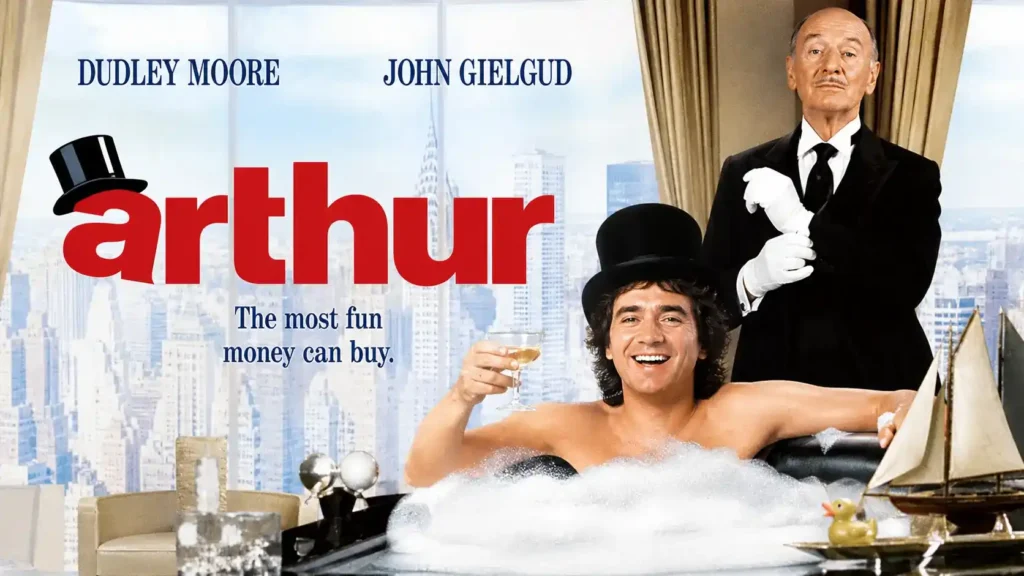
Legendary pop maestro Burt Bacharach, his partner and sorceress of words Carole Bayer Sager, and the Australian virtuoso Peter Allen. When Christopher Cross’s “crystal thread” was woven through the high-grade fabric prepared by these heavyweights, the song was tailored into a dress that would go down in music history—far surpassing its role as a mere movie theme.
A Saxophone Like a Knife Cutting Through the Urban Hustle
Perhaps the greatest factor that makes this song an immortal classic is the alto saxophone melody that rings out from the very beginning. It was performed by the jazz legend Ernie Watts.

This saxophone tone is not a mere decoration. It is a sharp, metallic brilliance that feels as if the light of headlights reflecting off the wet asphalt of Manhattan after a rain has been directly converted into sound. Rather than feverishly stoking emotion, it possesses a cool texture that lowers the listener’s temperature by a few degrees—much like the cold air of midnight. Because of this introduction, we instantly forget reality and are lured into the shadows of the skyscrapers.
An Ensemble Assembled Like Precision Machinery
Supporting the lead are top musicians who symbolized the AOR scene of the time. What is remarkable here is the absolute control over sonic “density.”
Throughout the entire song, flashy drum rolls and aggressive bass lines are completely sealed away. In their place, the protagonists are the transparent chords of the Fender Rhodes electric piano and a rhythm that is as accurate as the gears of a high-end mechanical watch. Each instrument is placed like a puzzle piece that snaps perfectly into place, ensuring the sound never becomes muddy even when layers overlap. This “aesthetic of subtraction” is the key to sonicizing the sophisticated loneliness of the city.
The Dynamics of “Moon” and “City”: The Lyrics’ Ultimate Choice
The core of the song is condensed into the chorus line: “Caught between the Moon and New York City.” Within this phrase, a universal human hesitation is etched, transcending the boundaries of a simple love song.

The “Moon” mentioned here is a symbol of unreachable romantic ideals or spiritual freedom. In contrast, “New York City” refers to the unavoidable, cold reality where desires swirl and success and failure live back-to-back.
Everyone has nights when they lose their sense of direction between these two massive magnetic fields—the part of ourselves that seeks spiritual heights and the part that struggles through the daily competition for survival on the ground. Carole Bayer Sager described being stuck between the two as being “Caught.” A state of absolute isolation, like being lost in an endless maze. Christopher Cross’s transparent voice vividly depicts this limbo with the objectivity of a scientist observing cells under a microscope.
Love as a “Survival Guide”
The prescription offered for this dead-end is the line: “The best that you can do is fall in love.”

This is by no means an invitation to a sugary escape from reality.
It is an existential proposal: when you can’t find a place in your dreams (the Moon) or in reality (the City), the only anchor that can keep you tethered to this world is the heart that cares for someone else. It is about injecting the irrational magic of love into a contradiction that cannot be solved by logic or calculation. The song boldly declares that this is the smartest and only solution for surviving the jungle of the skyscrapers.
A Portrait of Christopher Cross as a “Noble Guitarist”
For many listeners, he may primarily be seen as a “ballad singer with a beautiful voice.” However, his musical essence is also deeply rooted in his role as an exceptional guitarist.
In his youth, he was such a virtuoso that he became the subject of legend for standing in for Ritchie Blackmore on stage. In this work, rather than flaunting that technique, he pours his talent into the way the chords are stacked to support the foundation of the song. The jazzy resonance—rarely seen in typical pop—adds a mature depth to his vocals, preventing it from ending as just a sweet ballad.
The flamingo on his album jackets continues to stand tall on one leg without needing to flap its wings frantically. That image is the very embodiment of Christopher Cross’s musical life—constantly pursuing his sound with a craftsman’s dedication, unaffected by trends. Even after the massive success of the early ’80s, he has remained sincere in his relationship with sound. This integrity is why, more than 40 years later, his music still delivers a fresh sense of wonder to our ears.

Final Thoughts: An Eternal Light Shining Over the Skyscrapers
Christopher Cross’s voice does not try to offer easy encouragement. It simply floats quietly in the urban night sky as an unwavering fact.
“It’s okay to be lost—just fall in love.”

We find that simple yet difficult message within this serenade time and time again, and each time, we feel our breathing become just a little bit easier. On May 3rd, the day this great talent was born, please reach out once more to this jewel of a song. For those of you caught between the Moon and New York City, it will surely be the ultimate prescription.
Happy Birthday, Christopher Cross!

音楽ファン同士の交流・リクエストはこちら / Connect & Request Songs Here