
◆ Explore the History of [Off Course] Here — A Prelude to Ultimate Sonic Refinement
- 🎧 Enjoy this article in audio
- #5 is “Tashika na Koto” (Certain Things)
- First, please listen to the official YouTube audio
- The “Sharp Loneliness” Heard Under the Sky of Higashi-Matsubara, and the “Warm Acceptance” in 2005
- From a “Thirst for Dramatic Drama” to the “Affirmation of a Quiet Everyday Life”
- The Gentleness of the “Sound of the Wind,” Realized at the End of Days Kept Fighting
- What the Sharpened, Simple Sound Image Conveys
- Why This Song is Necessary for My Ranking
- Overwhelming Affirmation. That is a Cheer for Our Own Lives
🎧 Enjoy this article in audio
You can easily check the main points of this article with audio first.
Recommended for those who want to grasp the main points quickly before reading.
🎶 English Narration
This explains the content of this article in English audio.
⏳ Playtime: Approx. 3 minutes
🎵 Japanese Narration
You can listen to the same content with a Japanese narration.
⏳ Playtime: Approx. 3 minutes
* Listening to the audio before reading the text will help you understand the song’s worldview and the article’s main points more comprehensively.
#5 is “Tashika na Koto” (Certain Things)
Looking at the title of this article, some longtime fans might be tilting their heads and thinking, “Huh?” That’s right. This “Tashika na Koto” is not an Off Course song. It is a solo work by Kazumasa Oda, released in 2005.
“Why include a solo song in an Off Course ranking?”
I know it deviates from my own rules.
In 2005, I was in my late 40s, right in the middle of the busiest period of my corporate life.
I went to the office around 7 AM every day, and considered myself lucky if I could get home before the day was over. I had maybe one day off a month.
Even back then, it was a violation of labor laws, but the times weren’t as strict. Furthermore, there was an overwhelming atmosphere around me where “falling behind meant being a loser” and you’d be seen as “incompetent.” To put it bluntly, everyone was brainwashed and intoxicated by that kind of world, and it was a fact that we even felt it as our emotional crutch.

It was during such a time that I encountered this song. It’s a love song, but I found myself overlapping the lyrics with my family.
Using work as an excuse, I had neglected my family for years, leaving everything to my wife. I remember the lyric, “Can I really protect you?” piercing right through me.
Because of all this, when I tried to sum up the “story that the band Off Course had drawn” in my heart, I really wanted to introduce this song here.
Super Translation: “A Super Translation of the Lyrics”
I want you to realize that the casual moments of everyday life are what's truly important.
Even when we're apart, I continue to think of you in the same time and the same wind.
Rather than hesitation or anxiety, I want to choose the feeling of believing.
I haven't been able to put it into words, but I have loved you all along.
First, please listen to the official YouTube audio
■ Japanese Credits (Official)
Song Title: Tashika na Koto
Artist: Kazumasa Oda
Lyrics / Composition: Kazumasa Oda
Release: 2005
Label: Ariola Japan (Sony Music Group)
■ 2-Line Commentary
A ballad that quietly depicts the "certainty of love" found in casual everyday life.
It sings of feelings that remain unchanged even when apart, and the strength to keep believing in the other person.
The “Sharp Loneliness” Heard Under the Sky of Higashi-Matsubara, and the “Warm Acceptance” in 2005
Please let me organize the timeline. It was 1981 when I lived alone in Tokyo (Higashi-Matsubara, Setagaya Ward) and graduated from university.
Back then, the Off Course sound that I poured from my stereo in my 4.5-tatami mat apartment had a somewhat “glass-like fragility.” To love is to be hurt, to pass each other by, a process of constantly losing something. As a young man in my early twenties, I resonated deeply with that prickly loneliness peculiar to youth.
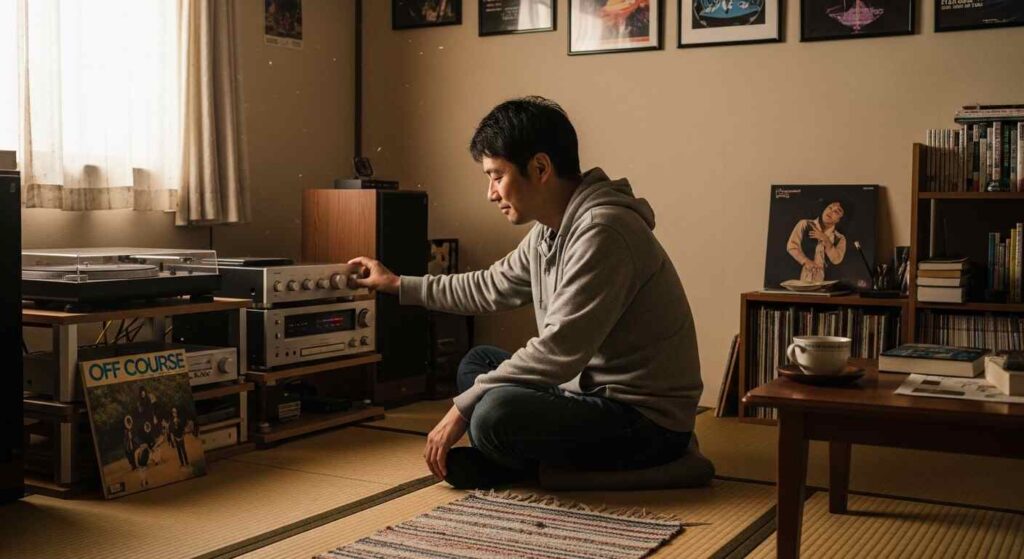
Kazumasa Oda’s crystal-clear high-tone voice felt like a star shining in the winter night sky—beautiful, but somewhat cold and out of reach. We were drawn to that “unreachability,” projecting the pain of our own youth into their songs. The more you scream for love, the more it slips away into a sense of nothingness. That was the core of Off Course’s charm that drove us crazy back then.
Then, exactly 24 years passed. The year was 2005.
I was already in my mid-40s, right in the middle of my “active working years,” rushing recklessly while being battered by the rough waves of society. The pale young man who once walked the student town of Higashi-Matsubara had become a busy adult, with a family to protect and heavy responsibilities in an organization. In the gaps of those hectic days, this song “Tashika na Koto” suddenly jumped into my ears.
It was a faint shock.
The same Kazumasa Oda, who once sang so sharply and sometimes even cruelly about the “pain of love,” was now singing, “The most important thing is not something special, but to keep looking at you with the same feelings in our ordinary days,” with boundless gentleness, as if affirming everything.

From a “Thirst for Dramatic Drama” to the “Affirmation of a Quiet Everyday Life”
Back in 1981, we tended to seek love and happiness in “special events” and “dramatic dramas.” There was a time when I even thought it wasn’t love unless something happened.
However, a quarter-century after graduating from university. Having experienced various situations, and endlessly accumulating the pressure of my working years and the seemingly monotonous repetition of everyday life, the true shape of happiness gradually changed.
The greatest power this song has lies in how it depicts the “nothingness, just the everyday life that is there” as the most precious miracle in life. Behind the words “I want to believe rather than doubt,” there is the maturity of an adult who has experienced countless doubts, betrayals, and emotional scars in the past. It’s not a naive belief born of being unhurt, but a resilient strength that chooses to “believe” anyway, knowing all too well that if you live long enough, the scars on your heart won’t disappear.

Precisely because we lived through the numerous stories of “partings” and “missed connections” and those desperate questions depicted by Off Course in the 1980s, the defenseless gentleness and tolerance of this “Tashika na Koto,” released in 2005, pierced deep into my chest with overwhelming persuasiveness.
The Gentleness of the “Sound of the Wind,” Realized at the End of Days Kept Fighting
Now that I spend a peaceful time in the city of Oita, I suddenly feel it. When I’m gripping the steering wheel of my car on a day off, listening to the innocent laughter of my grandchildren from the back seat. Or when I’m sharing a table with my wife of many years, exchanging trivial conversations.

It is exactly in those “ordinary days” we might overlook that an irreplaceable truth is hidden.
The younger me might have dismissed Kazumasa Oda’s message that “the most important thing is not something special, but looking with the feelings of right now” as mere lip service. But now, having repeated various losses and gains and having come to understand the subtleties of life a little, these words resonate with overwhelming reality. He has brilliantly verbalized the state of mind that we finally reached after many long years.
What the Sharpened, Simple Sound Image Conveys
The change in musical approach cannot be overlooked either. In Off Course’s golden era, their sound was characterized by meticulously calculated synthesizer programming and complex, multi-layered chorus work. It was cutting-edge sound for its time and a symbol of their perfectionism.
However, the arrangement of this “Tashika na Koto” is surprisingly stripped down. The warm resonance of the acoustic guitar and the strings that gently nestle close. And above all, Kazumasa Oda’s vocal, singing as if carefully placing each and every word. There is a purity in discarding excessive decoration and competing only with the “raw power” of the melody and voice. This simplicity of arrangement brilliantly embodies the song’s message of “the preciousness of ordinary days.”

Why This Song is Necessary for My Ranking
Now, let’s return to the question at the beginning. Why did I place this song at #5, even bending my own rules?
It is because this is the perfect “answer song” to the numerous “questions” Off Course kept singing.
The severance felt in “Sayonara,” the impatience held in “Yes-No,” the impulse exploded in “Ai wo Tomenaide”—perhaps all of these were the headwaters meant to flow into this vast ocean called “Tashika na Koto.” I even get that illusion.
If Off Course’s story had ended with the pain of that young, unripe era… The memories of youth within us might have remained as somewhat stinging old wounds. However, because Kazumasa Oda brought this song into the world through his solo career, it feels as if even the pain we once carried has been gently affirmed as a “necessary process.”

Overwhelming Affirmation. That is a Cheer for Our Own Lives
“Tashika na Koto” goes beyond the framework of a mere love song; it is a grand hymn to humanity that affirms life itself. And at the same time, it is the highest compliment and a warm cheer from him for our own lives, which we have lived clumsily yet desperately.
Summary: A Masterpiece for Loving Through Ordinary Days
Kazumasa Oda’s crystal-clear voice has lost none of its purity over the years. However, the “sharpness that could cut if touched” from the past has subsided, replaced by a “deep warmth that envelopes everything.”
Every time I see the sky after the rain, every time I hear the sound of the wind, I sometimes remember this song. And then, noticing the “small happiness” that is right here now, I wish to keep looking at my loved ones with these exact feelings.

The masterpiece “Tashika na Koto,” as if filling the final piece in the grand tapestry of Off Course’s history. I accept objections, but it is my soulful #5.

音楽ファン同士の交流・リクエストはこちら / Connect & Request Songs Here