
◆ Explore the History of [Off Course] Here — A Prelude to Ultimate Sonic Refinement
- 🎧 Listen to this article via audio
- Rank #7 is “Natsu no Owari” (End of Summer)
- First, please listen to the song via YouTube
- Escapeless sadness called “The Cycle of Seasons”
- The “Transparent Membrane” created by the sound
- The cruel past tense: “The Kind Lover”
- The racing “End of Summer” and the stationary “Me”
- Why is “Natsu no Owari” #7? — The axis of the series
- Time flows smoothly, and we live in the now
🎧 Listen to this article via audio
You can quickly check the key points of this article via audio first.
Recommended for those who want to grasp the essentials in a short time before reading.
🎶 English Narration
The content of this article is explained with English audio.
⌛ Playback time: approx. 3 min
🎵 Japanese Narration
You can also listen to the same content in Japanese.
⌛ Playback time: approx. 3 min
* Listening to the audio before reading the text will help you understand the world of the song and the key points more dimensionally.
Rank #7 is “Natsu no Owari” (End of Summer)
One of the absolute masterpieces from the period when Off Course began to establish their unique “soundscape” beyond the boundaries of folk. That is “Natsu no Owari” (End of Summer), which I am introducing today.
Included in the 1978 album “Selection 1973-78” or “FAIRWAY,” this track features Kazumasa Oda’s transparent high-tone voice singing of a perfected solitude while still retaining a hint of youth.
This song quietly yet sharply carves out the “cruel purity” and the “awe of irreversible time” that our generation experienced.

The summer heat fades, and the wind brushing against your skin suddenly carries a chill. I know of no other song that so brilliantly captures that indescribable sense of impatience felt at the change of seasons.
Interpretation of the Lyrics
Faded love and seasons overlap, making memories of those days feel somewhat nostalgic and beautiful.
Even knowing we can never go back, your kindness and the words you left behind remain quietly in the depths of my heart.
Like the end of summer, your presence gradually fades, eventually becoming something out of reach.
Yet, just as you once loved me, time flows on unchanged while we each love someone else.
First, please listen to the song via YouTube
*As the official video has not been released, I have linked to a video shared by fans. If there are any copyright issues, I will respond promptly by deleting it. (Please click the image below!)

Credits
Song: Natsu no Owari (End of Summer)
Artist: Off Course
Lyrics/Composition: Kazumasa Oda
Album: FAIRWAY (1978)
Two-Line Commentary
A ballad depicting the sense of loss felt at the end of summer and the quiet lingering afterglow of time passed.
The restrained melody and lyrics delicately express feelings that drift away with the season.
Escapeless sadness called “The Cycle of Seasons”
In the lyrical world created by Kazumasa Oda, the “contrast of seasons” is particularly noteworthy.
The psychological depiction mentioned at the beginning of this song—longing for winter when summer comes, and pining for summer when winter arrives—is not merely complaining. It strikes at the essential human nature where we are always unable to affirm our “current self” and seek salvation in the past, the future, or “somewhere other than here.”
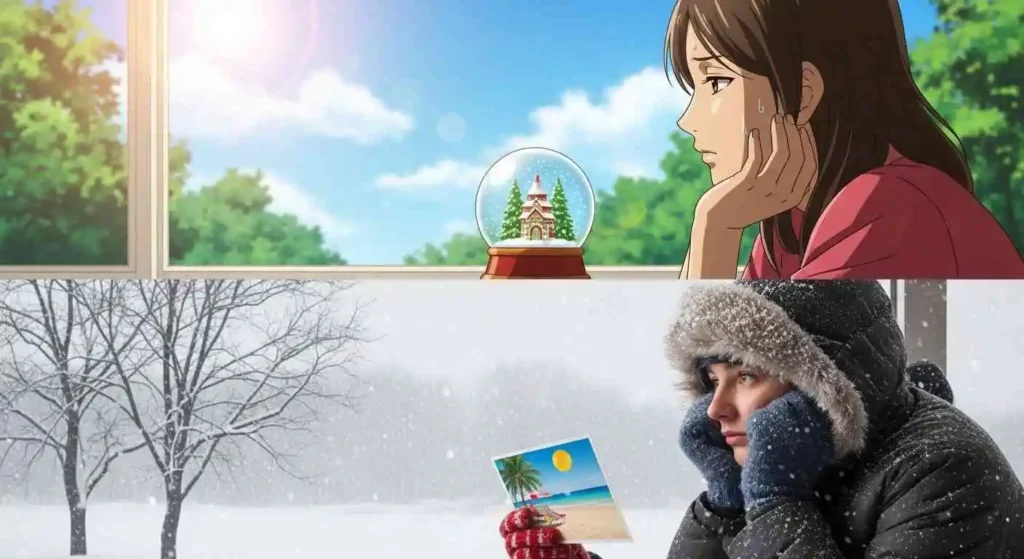
“The things from back then look wonderful now.”
How many people have resonated with this phrase and felt their hearts tighten?
I am one of them. Looking back at my student days, thinking if only I had done this, if only I hadn’t said that… the more time passes, the more those regrets are somehow wrapped in a veil called “beautiful memories.”
But this song doesn’t end there.
There is a visible will to seal away the past as “something that must never be touched with these hands again.” It carries the “determination” of a young person standing at the threshold of adulthood, reaching slightly beyond their years, rather than just soaking in sentimentality.
The “Transparent Membrane” created by the sound
From a musical perspective, “Natsu no Owari” is also extremely meticulously constructed.
In the late 1970s, Off Course was in a transitional period, moving from the simplicity of folk to a more sophisticated AOR (Adult Oriented Rock) approach.

What dominates the sound of this song is silence itself.
It excludes excessive decoration, with each note placed so that it permeates the space. In particular, the use of restrained strings and choruses to suppress the emotions that build toward the latter half is truly the work of a master craftsman.
Kazumasa Oda’s vocals also sound as if he is俯瞰ing (looking down on) the story from a step back, rather than baring his emotions. That “sense of distance” is exactly what stimulates the listener’s imagination and creates the space to project one’s own personal memories.
Even amidst the bustle of daily life, when I am enveloped by this “transparent sound” while gripping the steering wheel, it is mysterious how my own worries seem like trivial events in the long flow of time.
The cruel past tense: “The Kind Lover”
The highlight of this song is undoubtedly the scene in the middle where he calls out to his “former lover.”
What is striking here is that he refers to the person as a “kind lover” in the past tense. A person he must have cherished and shared so much time with is already defined as a “being of the past.” Here lies a certain cold truth: the purity of youth and the fact that once something is broken, it can never be restored.
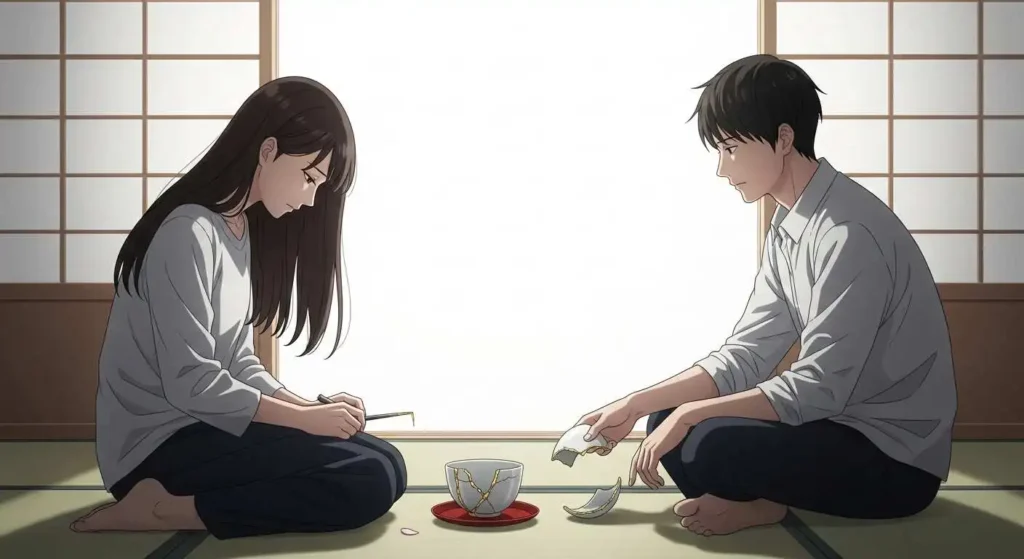
The world Kazumasa Oda depicts can sometimes harbor a surprisingly detached coldness. This is never out of malice, but rather the flip side of a sincerity that tries to look reality in the eye.
While asking, “What were you about to say back then?” he ultimately chooses to leave without ever hearing the answer. This “unfinished dialogue” is what sublimates this song into a deep human drama, rather than just a simple breakup song.
Whether in work or human relationships, if only I had conveyed that one word back then… or what did that silence mean… those “uncollected emotions” quietly but vividly take shape within the vessel of “Natsu no Owari.”
Where do the “Unspoken Words” go?
The description “as if my words block yours.”
This sounds like remorse for one’s immature self, who had lost even the capacity to accept the other person’s feelings. A moment where, by prioritizing one’s own correctness or pain, one cut off something precious the other person was trying to weave.

The reason this song continues to grip our hearts decades after its release is perhaps because it gently touches the old wound of “one’s own inadequacy at that time” that everyone carries.
The racing “End of Summer” and the stationary “Me”
In the latter half of the song, the tempo of the story accelerates with the phrase “The end of summer that races away.”
However, in contrast to that sense of speed, the protagonist’s heart merely watches “your scent as it fades.” Neither chasing nor holding back, he simply surrenders to the flow of time.
The contrast between this “motion” and “stillness” is truly brilliant.
The world changes moment by moment, and the seasons turn relentlessly. Regardless of our will, summer departs, autumn arrives, and we head toward winter. Within that irresistible great rhythm lies the solitude of an individual left behind.
Not the obsession of “I love you, so I want you to be by my side,” but the choice of “Because I loved you, I will watch over you from afar and never touch you again.” It is a form of love that accompanies pain, yet is noble above all else.
Why is “Natsu no Owari” #7? — The axis of the series
Now, I must also mention why this song is placed at Rank #7, a significant “turning point” of sorts in this “Personal Best 15.”
In this countdown that started from Rank #15, I have so far placed songs that show the relatively pop side or the breadth of Off Course’s musicality. However, from this Rank #7 onward, the ranking approaches the “core of Off Course” more deeply.
“Natsu no Owari” is, so to speak, a beautiful missing link that connects “Off Course as a folk group” and “Off Course as a stadium rock band.”
The delicate strokes of the acoustic guitar, the sophisticated synthesizer sounds, and the exquisite chorus work with Yasu-san (Yasuhiro Suzuki). All these elements coexist in perfect balance.

I am convinced that it was because of this song that the style of “racing while carrying sadness,” which led to later hits like “Sayonara” and “Ai wo Tomenaide,” was established.
A lyrical poem as a prelude to “Sayonara”
The more you listen to this song, the more the shadows of the masterpieces that follow come into view. For example, the premonition of a breakup. Or feelings that cannot be put into words.
The sense of awe toward “things that must not be touched” depicted in “Natsu no Owari” leads to the more profound solitude of “Sayonara,” which later swept across Japan. However, there is still “salvation” in “Natsu no Owari.”
That is the ray of hope toward music or expression, symbolized by the phrase “Don’t give up, at least on singing.” Even if everything is lost, even if words are lost, the act of singing alone cannot be taken away. That strength flows beneath the surface of this song.
Time flows smoothly, and we live in the now

“Ah, time is flowing smoothly.” These words are refrained at the end of the song. In the choice of the onomatopoeia “sarasara” (smoothly/softly), Kazumasa Oda’s sharp linguistic sense shines.
It is like the sand falling in an hourglass, or the murmuring of a brook—a flow that is light, yet mercilessly unstoppable.
“Longing for winter in summer, wanting to go back to summer in winter.” While harboring such contradictions, my self from back then, who believed in tomorrow and kept walking, stands right there.

音楽ファン同士の交流・リクエストはこちら / Connect & Request Songs Here