
- 🎧 Listen to This Article
- No.3: “Sotsugyou Shashin (Graduation Photograph)”
- First, Please Listen to the Official Audio
- “Graduation Photograph” as a Reckoning with Youth
- The Sacredness of “Those Days” and Our Distance from Them
- The Position of “Graduation Photograph” Within the Series
- Conclusion: An Unfading “Mirror of the Heart”
🎧 Listen to This Article
🎵 English Narration
Press play to listen to the full narration of this article in English.
🎶 Japanese Narration
You can also listen to the Japanese narration of this article.
Listening to the narration before reading may help you gain a deeper and more nuanced understanding of the song’s background and the perspective explored in this article.
No.3: “Sotsugyou Shashin (Graduation Photograph)”
A song so sacred that it would not be an exaggeration to say it is etched into the DNA of the Japanese people. That is the 1975 release “Sotsugyou Shashin (Graduation Photograph),” which I have selected as No.3 this time. As a standard graduation-season anthem—or as a symbol of nostalgic first love—we tend to assume we already “know” this song all too well.
Yet when I reexamine it from my present perspective, what emerges is not merely sentimental longing for the past, but a far more ruthless—and at the same time deeply redemptive—story of self-confrontation. Why does this song continue to tighten our hearts across generations? Today, overlapping it with memories of my former self walking the streets of Setagaya, I would like to unravel the song’s “true profile.”
First, Please Listen to the Official Audio
Credits (Japanese)
Song: Sotsugyou Shashin (Graduation Photograph)
Artist: Yumi Arai (Yumi Matsutoya)
Album: 40th Anniversary Best Album “Nihon no Koi to, Yuming to.”
Lyrics & Composition: Yumi Arai
℗1975 EMI Records Japan (UNIVERSAL MUSIC LLC)
Provided on YouTube by: Universal Music Group
Two-Line Overview
A masterpiece released in 1975, delicately portraying parting and remembrance at the milestone of graduation.
A timeless standard in Japanese pop history, covered by numerous artists across generations.
“Graduation Photograph” as a Reckoning with Youth
Turning the Page as a Question to Oneself
At the beginning of the song, the protagonist opens an old album “when something sad happens.” What matters here, I believe, is that she is not seeking shared memories—she is seeking restoration of the self.
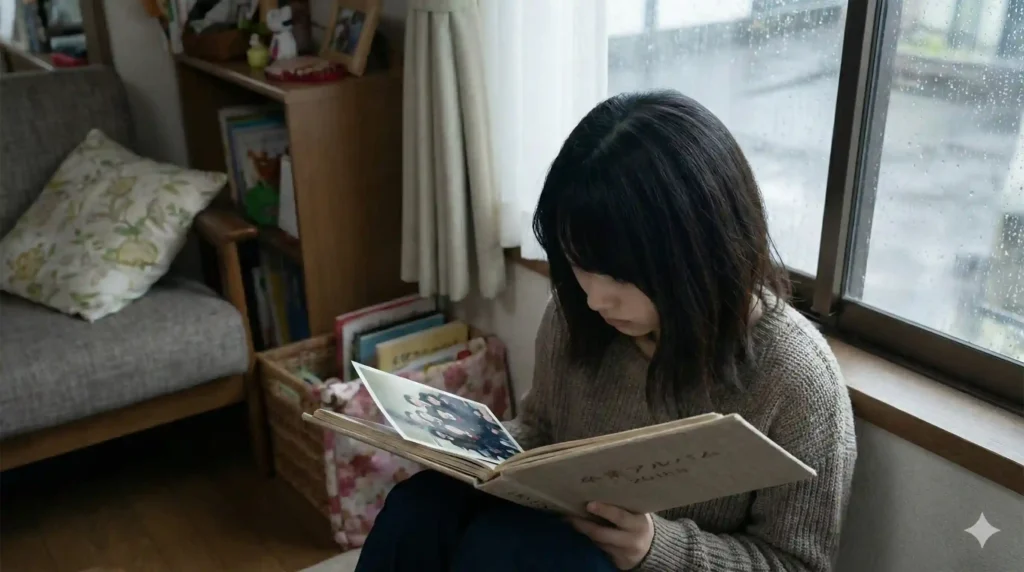
In the course of daily life, whether we wish it or not, we are tossed about by society’s currents. Our edges are worn down. Sometimes, without even noticing, we transform into someone hardly resembling who we once were.
In fleeting moments, we feel a subtle discomfort toward ourselves. To repair that fracture, she turns the leather-bound cover. The gentle eyes of “that person” in the photograph serve not only as the image of a first love, but as a mirror reflecting her former, untainted self.
Layered Over the Scenery of Setagaya
I picture the Tokyo streets where I once spent my student days—the townscape, the bustling shopping arcades, the willows that seemed to stand everywhere. Even without naming specific places, Yuming’s imagery possesses a power that evokes “that road from those days” in our collective memory.

Take the line, “beneath the willows swaying as if speaking.” This is no mere landscape description. The willows, moving in the wind, feel like living presences gently admonishing the protagonist in her confusion. Yet now she can only see that road “from the train.” This physical distance is a poignant testament to having become an adult.
The Sacredness of “Those Days” and Our Distance from Them
To My Former Self Who Breathed the Air of Setagaya
The Setagaya streets where I once lived as a student. Getting off at Meidaimae Station and casually walking those roads. Back then, I could not imagine what path I would take, what responsibilities I would carry. Yet I know I faced the “present moment” with all I had—sometimes awkwardly, but earnestly.
Each time I hear “Graduation Photograph,” the damp air and the glow of streetlights at dusk return vividly. The “swaying willows” Yuming depicts are, for me, the path I once walked to school. There stands the version of myself who was still no one—filled with pure curiosity.
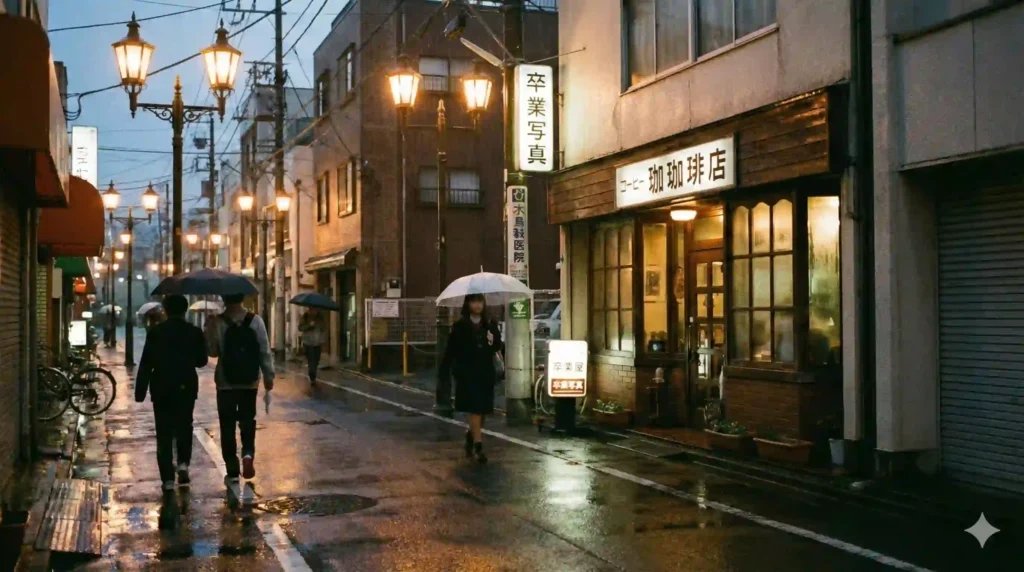
But what about the present me? The lyric “carried along by the crowd” has surely weighed heavily on all of us at some point. Our roles within organizations, our social responsibilities, the things we must protect… In gaining these, perhaps we have gradually shaved away that transparent something we once possessed.
The Structure of Prayer in “Please Scold Me from Afar”
The climactic line: “Please scold me from afar from time to time.” Within it lies the condensed loneliness of adulthood.
The older we become, the fewer people remain who will truly “scold” us. We may be corrected, but rarely does anyone question the very core of our being—asking whether we are living as we should. That is why the protagonist entrusts this role to “that person” in the graduation photograph.
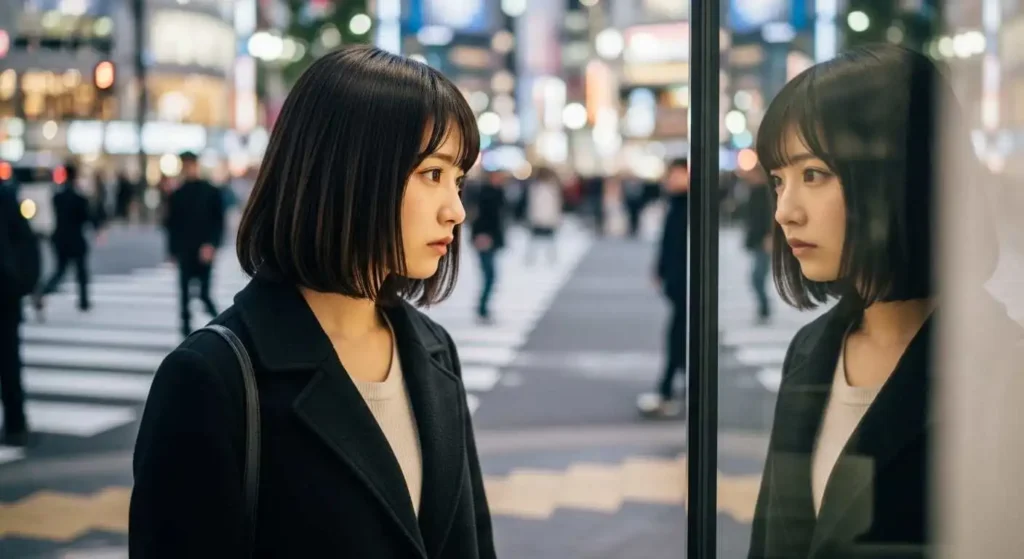
“Please don’t forget the way you lived back then.”
This line is both a wish directed outward and a final ultimatum to oneself. As long as you remain unchanged, I can avoid completely losing my true self. Within this brief sentence resides a clinging yet dignified resolve.
The Position of “Graduation Photograph” Within the Series
Why No.3?
There is a reason I placed this song at No.3 in my “Yuming Best 15.” It is not that I am attached to the ranking itself. Rather, without this song, the urban brilliance Yuming portrays might risk becoming mere surface glamour.
It is precisely because of this song’s introspective depth and its stern gaze toward the self that we can sense authenticity even in her most dazzling worlds.
In that sense, this No.3 position represents a place to return to. Not flashy, but a milestone we revisit at life’s turning points to confirm where we stand.
Conclusion: An Unfading “Mirror of the Heart”
“Graduation Photograph” is not merely a nostalgic song. It is a song of renewal—quietly yet sternly urging forward those of us who are still wandering, struggling, and striving to live.
When something sad happens, or when you feel you are losing sight of yourself, put on your headphones and listen. There, you will find the version of yourself with the same gentle eyes as before—watching over who you are now.

音楽ファン同士の交流・リクエストはこちら / Connect & Request Songs Here