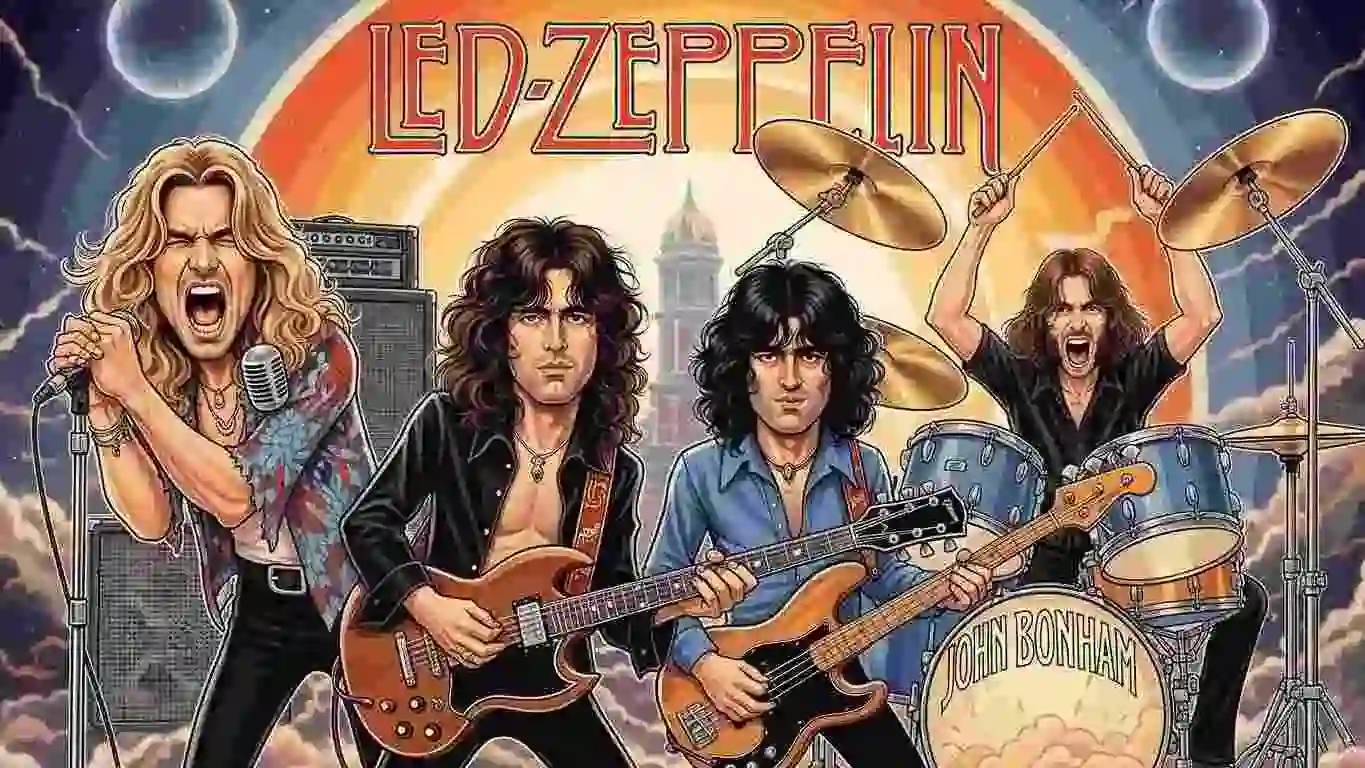
■For more in-depth info on 【Led Zeppelin】, click here・・・・➡ 🎈(Zeppelin)
🎧 Listen to the narration
This article is also available as an approximately three-minute audio narration.
Following the flow of the text, it traces the slow, undulating rhythm and vast sense of space that define “Kashmir,” ranked at No.3.
Feel free to enjoy it before reading, or after you’ve finished.
🎸【Led Zeppelin Edition】No.3 is・・・・
At last, the Zeppelin Best 25 has reached the final three songs.
And the track I’ve (selfishly) chosen as No.3 is “Kashmir”.
In their entire career, there is no other song to which the word “most epic” fits so perfectly.
The first time I heard this song in my apartment, pouring out of the stereo, what I felt was something close to awe—like the “borderline” of what we call rock music dissolving beyond a haze of sand and dust.

In good times and bad, what sustained my blog updates over the past year and three months was a pure conviction I had back in college: “If there’s music, you can go anywhere.” If No.5 Good Times Bad Times was a youthful declaration of war, and No.4 Achilles Last Stand was a headlong rush in a limit situation, then this No.3 “Kashmir” transcends even the notions of time and space—luring us into a labyrinth called eternity.
【Ultra-Short: Eternity Beyond the Dust】
A single road cutting through the desert. Rising heat, and endless repetition.
The ever-ascending melody detaches the listener’s consciousness from the everyday,
transforming physical “sound” into spiritual “prayer” in an epic sweep.
This is the most noble, most mysterious horizon that rock has ever reached.
🎥 First, as always, please watch the official YouTube video.
🎬 Official video credit (official audio)
Title: Kashmir
Artist: Led Zeppelin
Album: Physical Graffiti (1975)
Written by: Jimmy Page / Robert Plant / John Bonham
Audio: Remastered (official audio)
Two-line note
An 8½-minute monument that shines brightly in rock history. The massive riff built on a Middle Eastern-flavored scale, combined with sweeping orchestration, reveals the bottomless depth of ZEP as a band.
🎬 Official video credit (official audio)
“Kashmir”
Performed by: Led Zeppelin
Concert: Celebration Day (2007 Ahmet Ertegun tribute / London O2 Arena)
© Led Zeppelin / Swan Song Records
Footage released on the official YouTube channel
Two-line note
Official live footage of “Kashmir” from the one-night-only reunion show in 2007.
A towering performance where the heavy riff and orchestration merge, capturing the force of a seasoned band at full power.
💡 A small tip
What makes this 2007 stage especially moving is the presence of the drummer behind them, pounding out an earthquake-like beat. He is Jason Bonham, the son of John Bonham, who passed away suddenly in 1980.
“Kashmir” is, in a sense, John Bonham’s signature piece—where he carved out what may be the heaviest and most original rhythm of his career. Watching the son sit in that enormous chair and unleash a tank-like groove inherited from his father, you can feel an explosive energy called “bloodline”—something beyond mere technical reproduction.
The drummer anchoring that rising, sandstorm-like riff had to be someone with Bonham’s blood—so convincing is the authority that supports this long, fiery performance.
And Robert Plant, nearly 60 at the time, shows no real decline in vocal character. As expected—legendary.
The “Trance State” Created by Ultimate Repetition
The moment we start listening to “Kashmir,” what dominates our ears is that relentlessly repeated, ascending riff.

A joyful collision of 3/4 and 4/4
If we were to dissect this song’s “otherness” musically, the first thing to note is the brilliance of its polyrhythm.
Jimmy Page’s guitar riff is built on a triple feel, climbing upward again and again like stepping up a staircase one step at a time. In contrast, John Bonham’s drums refuse to yield, hammering a grounded four-beat pulse without wavering. This “3” and “4” interlock, slip, and yet meet at a single point—creating a strange sense of “buoyancy” and a hypnotic effect inside the listener’s mind.
In my room, watching cigarette smoke drift while sinking into this track, I found myself dozing in that pleasant “misalignment.” It went beyond simply riding a rhythm—closer to a trance state, as if syncing with the pulse of the universe. (Okay, I’m exaggerating!)

A “visual” sound: an endlessly rising staircase
This riff has no end. Just when you think you’ve reached the top, the next step appears beneath your feet. This “eternal ascent” is exactly why “Kashmir” feels like a colossal, motionless structure.
While many rock songs release energy toward a chorus, this one keeps compressing energy inward. It doesn’t explode—it simply remains there, with tremendous mass. That overwhelming “presence” is ZEP’s greatest weapon, carried into the sacred territory of the Top 3.

A “Spiritual Escape” Carried by Desert Wind
The fact that this song, titled “Kashmir,” was inspired not by the Kashmir region of India but by an endless drive across the Moroccan desert speaks volumes about its essence.

Robert Plant: a traveler’s monologue
Plant’s voice here carries a mystical, almost transcendent resonance—unlike anything in their other songs.
The line “Oh, let the sun beat down upon my face”. It’s both a record of a physical journey and an inner thirst—a hunger for “truth.”
A vocal that paints “colorless passion”
Plant never lets emotion burst outward. Instead, he surrenders to the repetition of that unshakable riff, sounding with quiet—but certain—weight, like sand flowing on the wind. This “restrained passion” gives “Kashmir” a kind of sacred grandeur not found in other rock numbers.

A Monument of Sound: The Functional Beauty of Strings and Brass
What makes this song into a “grand epic” is its meticulously calculated orchestration.
A “happy complicity” between rock and orchestra
When many rock bands bring in strings, they often remain a decorative touch—added to make a song more dramatic. But in “Kashmir,” the strings and brass are the very framework of the song.
At the moment that descending brass phrase crosses the ascending guitar riff, a gigantic cathedral-like space appears. With this track, Jimmy Page succeeded not in letting sound flow along a timeline, but in “placing” it inside a space.

John Bonham: the giant’s footsteps that shake the ground
And the foundation stone supporting that massive architecture is John Bonham’s drumming.
His playing here is astonishingly simple—and therefore overwhelming. Stripping away all ornament, he delivers nothing but heavy blows. The sound goes beyond “drums,” becoming a heartbeat: the thud of a gigantic living creature stamping on the earth.
Why This Song Is No.3
On this reflective journey that began at No.25, the No.3 spot symbolizes the “completed beauty” that ZEP reached.
The summit of perfect balance
As we’ve seen throughout this ranking, they absorbed and evolved a wide range of elements—blues, folk, hard rock, and more. On the vast land called “Kashmir,” those elements blend in an unprecedented form, quietly rewriting the existing frame of rock. It also becomes an exceptionally solid foothold for the band to climb even higher.
When we listen to this song, we forget they are a British rock band. What remains is something that transcends nationality and era: pure “will” in sound.

Closing: Toward the Two Remaining “Truths”
No.3, “Kashmir.” Now that we’ve passed through this colossal labyrinth of sound, only two answers remain before us.
Too much explanation may only blur its outline. From here on, the very “core” they carved into rock as an expression will reveal itself.
Next: No.2. An immortal masterpiece where beauty and madness coexist with impossible precision. It contains everything we can’t stop seeking in rock—both “salvation” and “despair.”
(End of No.3 “Kashmir”)

音楽ファン同士の交流・リクエストはこちら / Connect & Request Songs Here