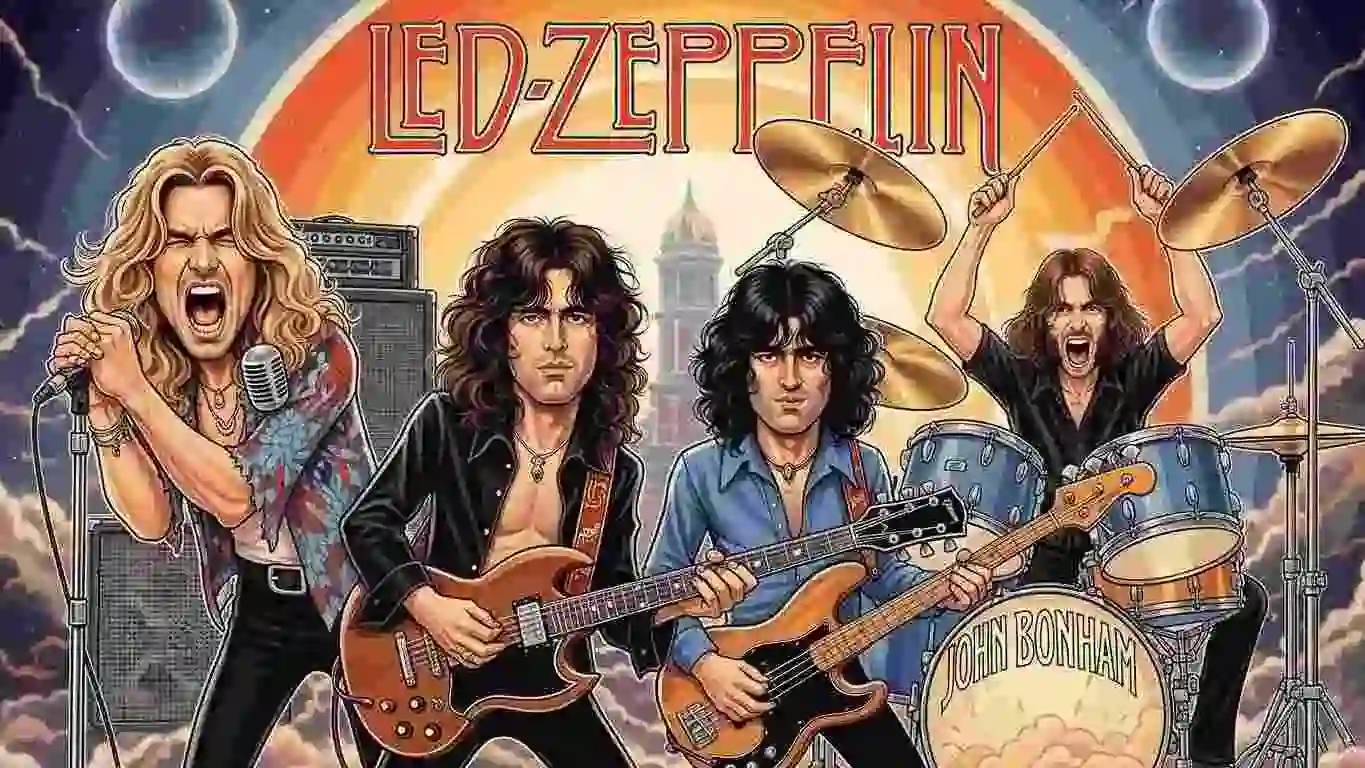
■Learn more about Led Zeppelin here・・・・➡ 🎈 (Zeppelin)
🎧 Listen to the Article
This article is also available as a short audio narration of about three minutes.
Structured around the flow of the written piece,
the narration traces the immediacy and physical responsiveness of “Rock and Roll,” ranked No.22.
Before reading, or after finishing the article, feel free to experience it through sound as well.
🇺🇸 English narration
🇯🇵 Japanese narration
🎸 Led Zeppelin Edition – No.22
No.22 is “Rock and Roll.”
This is a song that reacts before you have time to prepare.
The moment you press play, your weight shifts forward and your breathing tightens.
Before understanding or evaluation can catch up, your feet are already grounded.
For me, that’s how “Rock and Roll” begins.
Before fixing its meaning or settling on an evaluation, I want to look at the state that rises while this song is playing.
I follow, as directly as possible, what happens before words intervene.
In Short
The narrator tries to return to a place they once drifted away from.
What they seek is not the past itself, but the impulse that once moved their body—the tactile sense of beginning.
Time hasn’t weakened that impulse; it has given it clearer shape as something worth reclaiming.
🎥 First, as usual, take a look at the official YouTube video.
🎬 Official Video Credit (Official Audio)
Song: Going to California
Artist: Led Zeppelin
Album: Led Zeppelin IV
Release Year: 1971
Format: Official Audio
Source: Led Zeppelin Official YouTube Channel
🎼 Two-line Commentary
Built around acoustic guitar and mandolin, this track quietly depicts movement and emotional uncertainty.
By resisting grandeur, the performance captures the feeling of being mid-search directly in sound.
🎬 Official Video Credit (Live Footage)
Song: Rock and Roll
Artist: Led Zeppelin
Event: Live at Knebworth
Year: 1979
Original Album: Led Zeppelin IV (1971)
Format: Official Live Video
Source: Led Zeppelin Official YouTube Channel
🎵 Two-line Commentary
A late-career performance that preserves the song’s drive while commanding a massive outdoor space.
Not a burst of youth, but the sustained force of rock and roll shaped by accumulated time.
Basic Information
About the Track
- Artist: Led Zeppelin
- Song: Rock and Roll
- Album: Led Zeppelin IV
- Release Year: 1971
How It Feels Within the Album
This album includes songs that open outward into landscapes, and others that sink inward.
When “Rock and Roll” enters that flow, the atmosphere isn’t explained—your posture changes.
Before your gaze shifts, your body rises.
That transition gives the album a tangible sense of reality.

What This Song Depicts Is Not Emotion, but a State
The Protagonist Doesn’t Stop to Think
There are no long recollections or carefully sorted emotions here.
Regret and reflection never take center stage.
What remains is the sense that time has passed, and yet the voice emerges and the body moves anyway.

Here, understanding does not lead action.
Action happens first, and only afterward does the situation come into view.
That order becomes the song’s driving force.
Time Is Not Treated as Weight
The phrase “a long time” appears, but it isn’t used as a reason for regret or stagnation.
Time is not something to overcome; it’s left as empty space.
The music moves forward while carrying that space, and that is where the song’s lightness comes from.
What the Sound Creates Is Not Momentum, but Immediacy
The Drums Provide Ground, Not Speed
What stands out at the beginning isn’t speed, but how easy it is to respond.
When the drums hit, you don’t feel thrown by the tempo.
Because the footing is clear, you can step forward.
Rather than accelerating, the rhythm functions as solid ground.

Because the Sound Doesn’t Push Too Hard, the Body Can Move
The guitar and bass avoid complicated paths.
They hold only what needs to be played, without excess explanation.
As a result, the listener doesn’t chase the music—their own movement naturally aligns with the sound.
This immediacy feels like the core of “Rock and Roll.”
Where This Song Sits on My Personal Timeline
When I Was Younger, It Was a Sound I Could Use Without Thinking
From here on, this is not a general statement, but my own experience.
When I first listened to this song repeatedly, I thought of “Rock and Roll” as a sound I didn’t need to think about.
When my head felt heavy or I wanted to reset the atmosphere, I could play it without searching for a reason.
That kind of immediacy was enough.

At the time, I was affirming the physical response—the body moving the instant the sound appeared—rather than analyzing what state the song described.
That made it memorable, but not something I stopped to examine.
What Remained Over Time Was the Way It Returns
After some time passed, listening again changed the song’s role.
When starting something new, without knowing whether old methods will still work, the body moves first anyway.
“Rock and Roll” feels very close to that posture.
There’s no guarantee it will work.
No confirmation that you’ve truly returned.
And still, the sound comes out. The voice follows.
That unguarded movement now resonates not as lightness, but as a realistic kind of strength.

What Remains Beneath the Lyrics
Emotion Is Given No Destination
This song doesn’t guide emotions toward a conclusion.
Excitement, reassurance, or resolve are never clearly stated.
Still, something remains.
What stays is the fact that movement happened, and a stance that accepts that fact without denial.
I hear here the way life often moves forward before feelings are sorted, the sensation of taking a step without being able to explain why.
The song feels realistic because it allows time to pass without assigning emotion a destination, letting that structure sound as it is.

Why Strength Is Never Flaunted
“Rock and Roll” is a powerful song.
But that power is never used as proof or assertion.
The sound keeps moving forward, yet it never declares, “I’ve returned,” or “I haven’t changed.”
That’s why the song remains not as a conquered place, but as a passage.
For me, that quality of being a passage is deeply trustworthy.

Why It’s Ranked No.22
Not Comparison, but Distance
This ranking isn’t the result of comparing completeness or influence.
For me, it reflects the distance at which this song has existed in my life.
“Rock and Roll” always triggers a physical response.
But I rarely stay there long.
Once I’m standing, it sends me forward.
Rather than something I face at the center, it has remained a presence I reach for naturally when needed.
Considering that distance, this position feels right.
Why This Placement Matters
By appearing early in the Best 25, this song pulls the flow—until now focused on describing states—back toward the body.
Movement before words.
Response before understanding.
Placing that shift here slightly changes how the songs that follow are heard.
That’s how I see it.

In Closing
“Rock and Roll” doesn’t explain anything.
Rather than pushing you forward, it finds your feet already moving.
That sensation existed when I was younger, and it still remains.
That’s why I place this song here—not because it’s iconic, but as a sound that brings me back to the present again and again.
The sound is unmistakable.
And still, when it’s needed, it works—a position I can trust.

音楽ファン同士の交流・リクエストはこちら / Connect & Request Songs Here