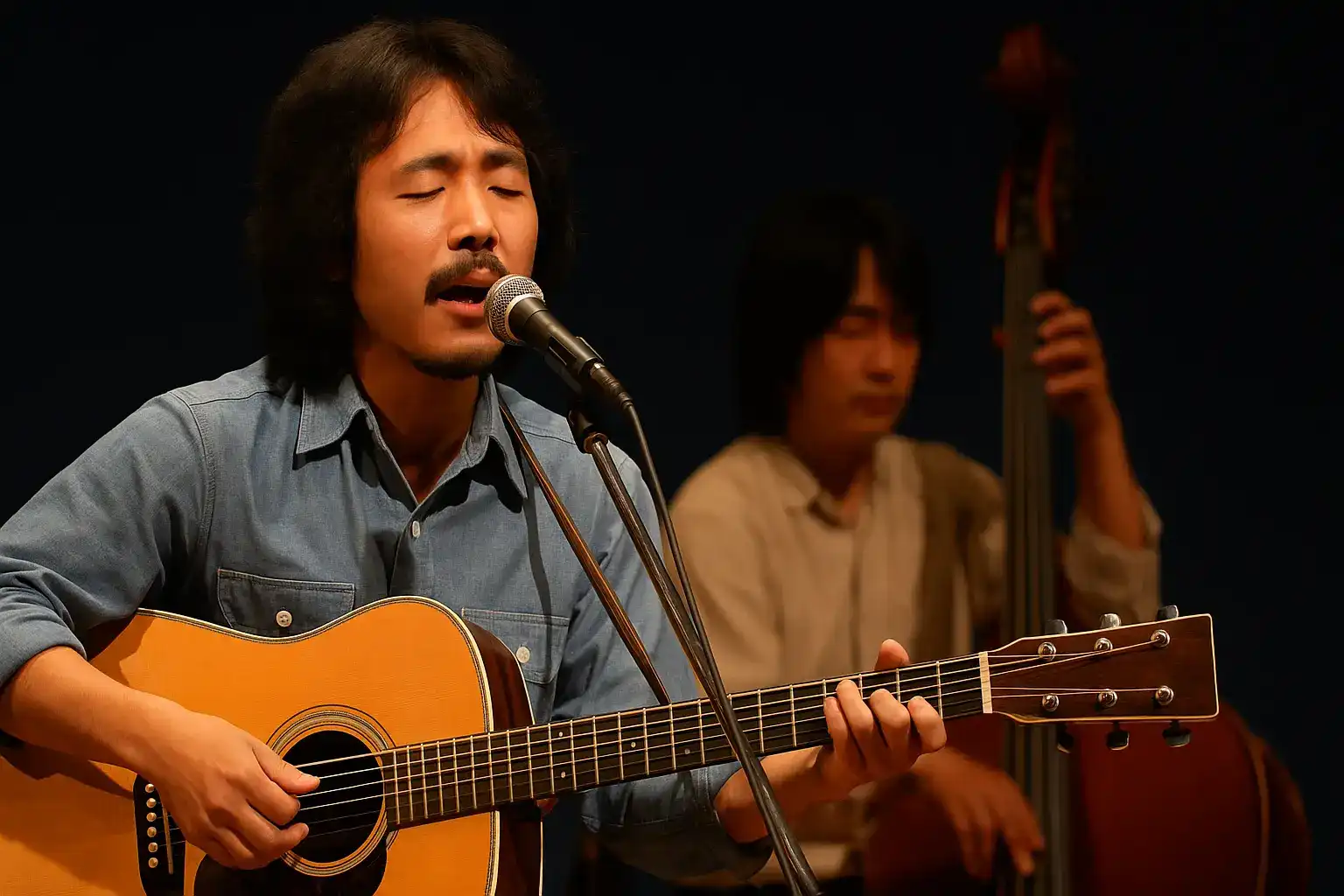
- 🎧 Enjoy “Farewell at Twenty-Two” in Audio (Listen to this article)
- 🎸【Kaze】No.4 — “22-sai no Wakare (Farewell at 22)”
- Basic song information
- Themes and worldview
- How the work expands beyond the song
- The core of the lyrics and interpretation
- From Kaguyahime to Kaze — the song’s lineage
- The Film “22-sai no Wakare” and the Memory of Place
- Why I Ranked It No.4 in My Best 15
🎧 Enjoy “Farewell at Twenty-Two” in Audio (Listen to this article)
🎶 English narration
Press play to listen to this article in English narration.
🎵 Japanese narration
Press play to listen to this article in Japanese narration.
※ Listening to the audio first and then continuing with the text allows you to experience the world of “Farewell at Twenty-Two” in a more three-dimensional way.
🎸【Kaze】No.4 — “22-sai no Wakare (Farewell at 22)”
Ranked No.4 is “22-sai no Wakare.”
The moment the first note of the acoustic guitar rings out, the air seems to tighten. This song doesn’t carry the listener into a flashy plot; instead, it guides us into a quiet room. The light beyond the window, the small things close at hand, and the image of oneself. “22-sai no Wakare” brings a turning point in life into view through the accumulation of such everyday scenes.
Even though it deals with the end of youth and the closing of a romance, it never pushes emotion to the front. That restrained touch is, I feel, exactly why the song remains unfaded with time.
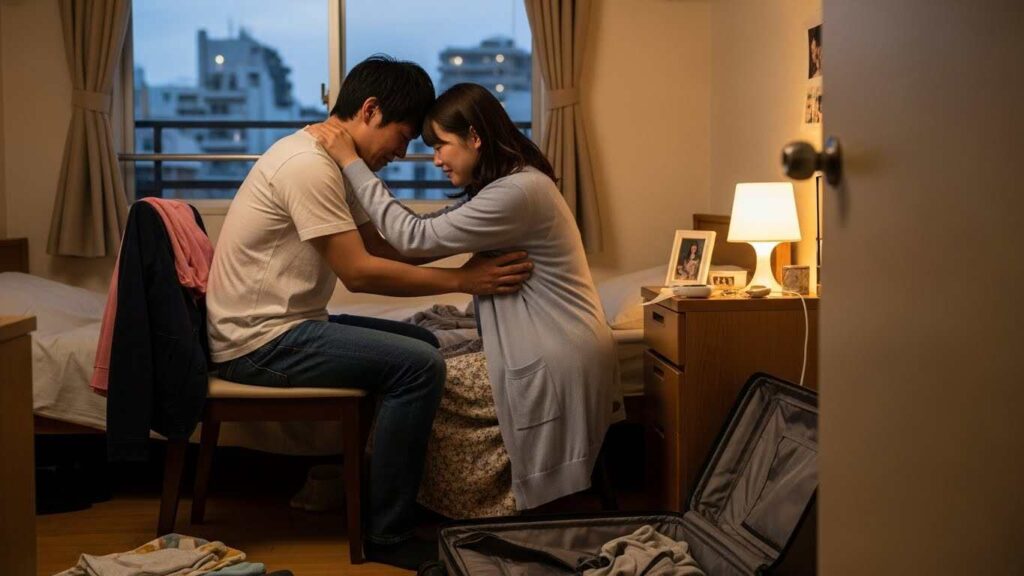
Ultra-short summary
This is a story of two people who have lived through the same time, coming to understand that they must walk toward different futures. Though the protagonist hesitates, they know that nothing will change unless a decision is made now. A farewell chosen within limited time—and the quiet resolve behind it—is描かれています。
First, please watch the official video.
✅ Official video credit
“22-sai no Wakare” — Kaze
Lyrics / Music: Shozo Ise
Album: KAZE SINGLE COLLECTION
※ The official audio is published via the PANAM channel.
📝 Two-line note
A signature song released in 1975 by the folk duo Kaze, written and composed by Shozo Ise. With its bittersweet lyrics about parting at the age of 22 and its memorable guitar intro, it has been highly regarded as a Japanese folk classic.
Basic song information
Release date and background
“22-sai no Wakare” was released as a single on February 5, 1975. Lyrics and music were written by Shozo Ise. It is a 대표曲 that helped bring the folk duo Kaze nationwide recognition.
While many folk songs at the time carried strong social messages, this work focuses on the individual’s inner world. In that sense, it carved out a distinctive place within the mid-1970s scene.
Album inclusion and the reach of the recordings
Originally released as a single, it has since been included repeatedly in compilation and best-of albums. One representative example is “KAZE SINGLE COLLECTION,” and it can still be heard today via streaming and official audio releases.
The fact that it has been recompiled and rediscovered across eras speaks to the song’s universality.
Chart performance and contemporary reception
At the time of its release, “22-sai no Wakare” ranked highly on the Oricon singles chart and became a long-selling record.
As the period of rapid economic growth settled and young people began confronting more realistic choices, the song earned strong support as “a song that feels personal.”

Themes and worldview
A decision placed inside everyday life
The setting of this song is not some special place. If anything, it is a living space familiar to anyone.
For example, the word “goodbye” appears naturally in the lyrics, not as something spoken to hurl emotions, but as a word uttered as if time itself were nudging the speaker forward. That sense of distance creates a texture close to real-life parting.
A storytelling style that follows scenery
In “22-sai no Wakare,” emotions themselves are rarely stated directly. Instead, we are shown small episodes—such as a figure reflected in a mirror—that symbolize the time that has accumulated.
As you follow these pieces one by one, the protagonist’s inner wavering naturally rises to the surface. Avoiding word-for-word explanation and letting the story move by tracing scenery is one of the song’s defining features.

How the work expands beyond the song
The symbolism of the age “22”
The specific number “22” in the title gives the song a strong sense of reality. But it is not a story limited to that particular age.
It functions as a symbol of the time when many people begin to feel, “I can’t go back anymore,” allowing listeners to overlap the song with turning points in their own lives.

A narrative that goes beyond music
In later years, director Nobuhiko Obayashi adapted the song into the film “22-sai no Wakare: Lycoris — Leaves Unseen, Flowers Unseen.” The fact that the world of the piece expanded beyond music suggests that “22-sai no Wakare” has long been received not merely as a hit song, but as a story.
The core of the lyrics and interpretation
Words that rise up as scenery
What is striking about the lyrics of “22-sai no Wakare” is the abundance of expressions that capture scenes rather than words that explain feelings directly. Even the “goodbye” placed near the beginning appears not as a burst of emotion or a firm declaration, but as a realistic word that draws a line in time.
Objects in the room, the figure of oneself, and symbols of accumulated time are arranged in sequence. They may seem fragmentary at first, but when the listener connects them, a single landscape emerges.

The subtle shift of the protagonist’s mind
As the story moves forward, the protagonist’s heart does not swing wildly. If anything, you sense an effort to keep it from wavering.
The reason for choosing separation is never stated clearly—only the feeling remains that “it has to be now.” This restrained psychological描写 gives the listener a strong sense of realism. The song teaches that a decision is not always dramatic; it can be the accumulation of quiet resolve.
From Kaguyahime to Kaze — the song’s lineage
An original form born during the Kaguyahime era
“22-sai no Wakare” was originally written when Shozo Ise was active as a member of Kaguyahime. For that reason, the song is included on Kaguyahime albums as well, and strictly speaking, it was not a song that came into existence only after Kaze was formed.
In the Kaguyahime-era version, a more distinctly folk-like simplicity comes to the foreground, and the song stands out as a record of personal emotion.
Re-presented as the duo “Kaze”
Later, Shozo Ise formed the duo Kaze, and the song was released to the world with a new arrangement and interpretation.
In the Kaze version of “22-sai no Wakare,” the sound is more refined, and the scenery comes across with greater clarity. Though it is the same song, there is a clear difference between the introspective face it had in the Kaguyahime era and the universality it gained when presented as Kaze. This act of re-presentation is one of the reasons the song was elevated into a classic that transcends generations.
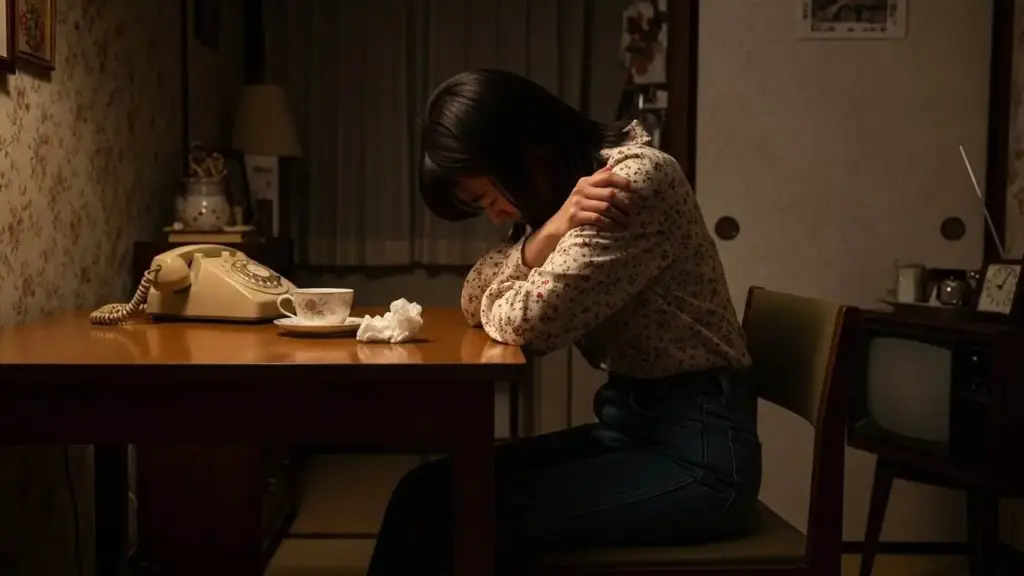
The Film “22-sai no Wakare” and the Memory of Place
A Cinematic Adaptation by Director Nobuhiko Obayashi
In 1996, director Nobuhiko Obayashi created the film “22-sai no Wakare: Lycoris — Hamizu Hanamizu Monogatari”. This work does not simply trace the song itself; rather, it takes the theme of “farewell at 22” as a point of origin and explores the relationship between time and memory, and between people and the places they inhabit.
Within Obayashi’s characteristically lyrical visual style, the song’s quiet sense of decision is expanded into a different form.
The Filming Location and Shozo Ise’s Birthplace
The film’s locations are closely connected to Tsukumi City in Oita Prefecture, the birthplace of Shozo Ise. The sea and townscapes of Tsukumi appear as essential scenery in the film, functioning as a place where personal memory and the memory of the land overlap.
By making both the song’s background and the creator’s roots visible on screen, “22-sai no Wakare” came to be received as more than a single song—as a story grounded in place.

Why I Ranked It No.4 in My Best 15
The Song’s “History” Is Part of Its Power
What makes “22-sai no Wakare” special is not only the quality of the song itself, but also the path it has taken. Not many works are born in the Kaguyahime era, re-presented as Kaze, and then expanded even further through film.
The way this song gains meaning over time gives it a weight that feels fitting for a No.4 ranking.
A Song You Can Always Return To
Depending on where you stand in life, the contours of this song shift little by little.
In younger years, it reaches you as a song that presses you toward a choice; later, it rises as a quiet way of looking back on days that have passed.
“22-sai no Wakare” is that kind of song—a place you can return to again and again, somewhere along your life’s path.

音楽ファン同士の交流・リクエストはこちら / Connect & Request Songs Here