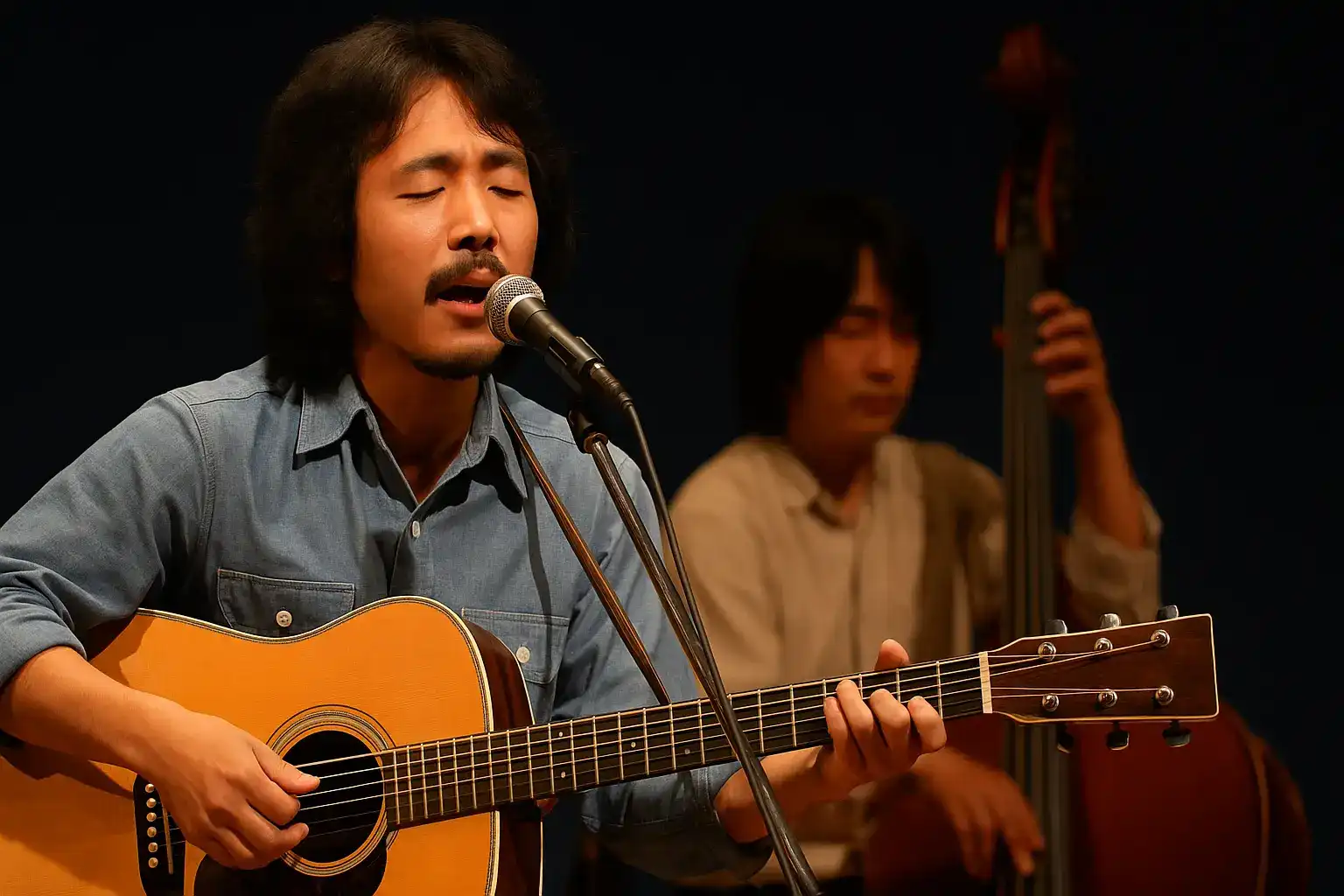
🎧 Listen to “Hoozue o Tsuku Onna” (Audio narration)
🎵 Japanese narration
Press play to listen to the Japanese narration of this article.
🎶 English narration
Press play to listen to the English narration of this article.
※ Listening first can help clarify the background and evaluation points before reading the full article.
🎸 Kaze — My Personal Best15: No.5 “Hoozue o Tsuku Onna”
No.5 is “Hoozue o Tsuku Onna” (“The Woman Resting Her Cheek on Her Hand”).
“Hoozue o Tsuku Onna” isn’t the first title most people name when they list Kaze’s signature hits. But that’s exactly why it matters here. This song sits at a point where Kaze begin to step beyond the familiar frame of “lyrical folk,” and start fixing something more concrete into music: the texture of daily life, and the way time keeps moving even when a person does not.
It’s a love song, yes—but the story doesn’t lean on big declarations or emotional climax. Instead, it pays attention to actions and time. The core of the song isn’t whether love succeeded or failed, but how a life behaves afterward: where the body stays, where the mind points, and how the hours get spent.
Quick Summary
This song follows a woman after a breakup as she moves back and forth between two kinds of time: time that stays parked in the past, and time that begins to step into a new routine. The center of the story is not romance itself, but the shift of everyday life—hesitation, restart, and the quiet change of how she uses her day. The song shows that process through concrete, ordinary details rather than emotional explanation.
Start with the Official Audio
✅ Official Video Credit
Song: Hoozue o Tsuku Onna
Artist: Kaze
Label: PANAM (Nippon Crown Co., Ltd.)
Lyrics & Music: Shōzō Ise
Source: 2021 Remaster (Official Audio)
© NIPPON CROWN CO., LTD.
YouTube info: Label official audio / Auto-generated by YouTube
📝 Two-line Note
A defining Kaze track from the 1970s, capturing Shōzō Ise’s lyrical sensibility in a restrained, everyday scene.
The 2021 remaster keeps the original atmosphere while sharpening the outlines of the voice and acoustic instruments.
Basic Information
Release Details
“Hoozue o Tsuku Onna” was released on December 5, 1976 as Kaze’s fourth single. The A-side is “Hoozue o Tsuku Onna,” and the B-side is “Tabi no Gogo” (“Afternoon of a Journey”). Both songs were written and composed by Shōzō Ise, and together they present a clear snapshot of Kaze’s style at the time.
The song was also included on the album WINDLESS BLUE. Appearing in both single and album form suggests the track was seen as broadly usable—something with enough completeness to stand alone, yet strong enough to anchor a longer listening experience.

Chart Performance & How It Was Received
The single reached No.40 on Oricon. It wasn’t a breakout hit, but within Kaze’s catalog it represents a solid result—evidence that the song consistently found listeners, even without the kind of immediate punch that drives top-chart momentum.
In the mid-1970s folk / new music scene, songs with clear messages or easily readable emotion tended to get attention quickly. This track makes a different choice. It avoids obvious “statements” and dramatic turns, and instead focuses on stagnation inside ordinary life. That choice may explain the modest chart result, but it also explains why the song stays in the memory of listeners who absorb albums as full narratives rather than single moments.
Theme & World of the Song
She Isn’t “Stopped”—She’s “Fixed in Place”
At first glance, the protagonist looks like someone who isn’t changing at all. But the crucial point is not “no change.” It’s that she remains inside time—days keep passing, hours keep being spent—yet the direction of that time is aimed entirely at the past.

What’s depicted here isn’t emotional “sadness” as a headline. It’s behavioral fixation: the same place, the same posture, the same looping thoughts. That repetition creates a condition where time is consumed but never updates its direction. The song lays out this structure with a calm, almost documentary clarity—moving, yet not progressing.
Not a Romance Plot—A Story About the Direction of Daily Life
If you read “Hoozue o Tsuku Onna” as a standard breakup song, you might focus on the reason for the separation or the intensity of feelings. But the real focus is what remains afterward: the direction of the life that is left behind. Who you spend time with, where you place yourself, how you use your day—those small choices accumulate into a visible state.
The first half shows a life that is completely past-facing. By drawing that structure carefully, the song prepares the listener for the shift that appears later—not through a dramatic announcement, but through a change in movement.
Lyrics: The Core Idea & Interpretation
How the Turning Point Is Built
In this song, the protagonist’s change is never explained in emotional language. Instead, short phrases that describe posture and action are placed like markers—points where the direction of time quietly flips.
The first half is symbolized by the posture named in the title: resting her cheek on her hand. It suggests a gaze turned inward and a closed contact with the outside world. Time keeps being spent, but its destination is fixed to the past.

Later, the song introduces a brief expression that implies going outside. There is no speech about “closure,” no declaration of decision. The lyric simply presents a fact: her action changed.
This contrast isn’t about feelings. It’s about the direction of life. From posture to movement, from inside to outside. She doesn’t “defeat” the past—she changes how she spends time. That modest switch is what makes the story believable.
Change Appears in Action, Not in Explanation
The change described in the second half is not psychological resolution. The protagonist doesn’t voice strong will, nor does she announce a clean break from what happened. What we’re shown is only a shift in where she places herself and where she moves next.
Even when emotions remain unsorted, life can still move. The song proves that point not by telling us, but by building a structure: action changes first, and as a result the direction of time updates. The order never collapses—and that’s where the realism lives.
Sound & Vocal Approach
An Urban Soundscape That Makes Daily Life Feel Real
The sound of “Hoozue o Tsuku Onna” doesn’t lean on folk sentimentality. Instead, it carries a thin layer of urban air—subtle, but persistent. There aren’t many notes, yet the placement is efficient: like background music inside a room, it quietly draws the outline of a life.

Even with an acoustic-centered arrangement, the sound doesn’t point toward fields or nature. It stays closer to indoor space, paved streets, and the late-afternoon city. Because this urban distance is maintained, the story is received less as emotional drama and more as a piece of everyday reality.
In my mind, she’s standing by a window. Not crying. Not frozen in a theatrical pose. She simply can’t decide the next appointment yet—while the noise of the city slips into the room.
A Vocal That “Pins” an Urban Figure in Place
The vocal here is not designed to display emotion. The voice is placed like a line drawing—enough to show the contour of one person in the city, without decoration or emphasis. It functions as a sketch of an urban scene rather than a performance that demands attention.
That’s why the song has never been primarily evaluated by “how well it was sung.” Because the vocal doesn’t insist, the listener can imagine her freely: after work, or on a quiet weekend evening. That openness supports the urban realism at the center of the track.

On the 2021 remaster, this design becomes even clearer. As the sound is cleaned and organized, what rises is not a bigger emotional statement, but a sharper sense of position: where she is, what kind of room this is, what kind of daily environment surrounds her. The song doesn’t “argue” anything—it simply fixes a figure quietly standing inside the city.
Why I Chose This as Best15 No.5
A Rare Focus on “Life Structure” Within Kaze’s Catalog
Kaze has many songs that carefully draw scenery and emotion. But “Hoozue o Tsuku Onna” puts the spotlight elsewhere: not on feelings, but on the structure of daily life. It’s a love story that refuses to judge the relationship itself, and instead examines how time is handled after the relationship ends.
A Song That Changes Meaning as the Listener’s Life Changes
This song can sound like a track about stagnation at one point in your life, and like a track about renewal at another. The shift doesn’t come from the song changing. It comes from the listener’s daily life changing—and the song meeting that new reality.
It isn’t exhausted in one listen. That quality is exactly why it belongs at No.5 in my Best15.

—

音楽ファン同士の交流・リクエストはこちら / Connect & Request Songs Here