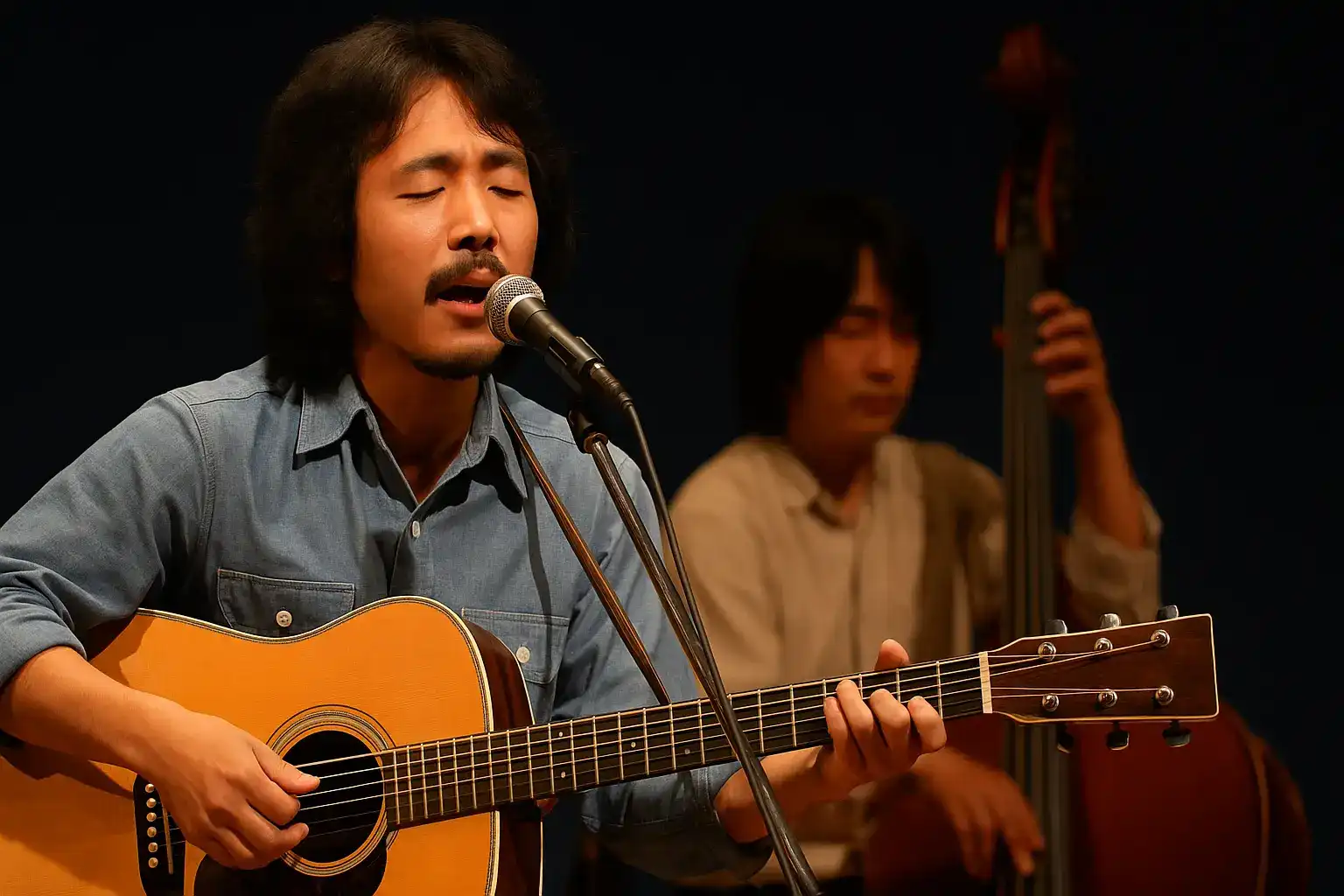
🎧 Listen to this article (Audio narration)
🎶 English narration
Press play to listen to the English narration of this article.
🎵 Japanese narration
Press play to listen to the Japanese narration of this article.
*Listening first helps clarify the perspective and themes of “Otoko wa Ashita Haku Tame Dake no Kutsu o Migaku.”
🎸 Kaze Best15 — No.6: “A Man Polishes His Shoes Only for Tomorrow”
No.6 is “A Man Polishes His Shoes Only for Tomorrow.”
This song does not portray an extraordinary life.
Still, the man at its center carries a quiet, unshakable kind of cool—something that doesn’t rely on showing off or making noise.
In a corner of the city, he stays out of the spotlight, never performs his emotions, and simply keeps preparing for tomorrow. That steady posture is the core of this track.
Ultra-Summary
The protagonist is a man living alone in the city. He neither clings to the past nor overinvests in the future; he chooses only the actions that keep daily life moving.
Within an ordinary routine, he avoids explaining his emotions and instead reveals his way of living through attitude and behavior. The song portrays a person who stands his ground while blending into the city—quiet strength without bravado.
First, watch the official audio on YouTube.
✅ Official Audio Credit
Song: A Man Polishes His Shoes Only for Tomorrow
Artist: Kaze
Lyrics & Music: Shōzō Ise
Label: PANAM (Nippon Crown)
Audio: 2021 Remaster Official Audio
YouTube: Official label upload (PANAM channel)
📝 Two-line note
This is the 2021 remaster reconstructed from the original master tapes for the track included on Kaze’s 1975 debut album.
The restrained, no-frills sound makes the protagonist’s steady, city-bred attitude feel even more sharply defined.
Basic Information
Release / Album
“A Man Polishes His Shoes Only for Tomorrow” appears on Kaze’s debut album Kaze First Album, released on June 5, 1975.
Although it is the band’s starting point, the album already leans more toward a grounded, everyday perspective than youthful momentum. Shōzō Ise’s writing is also evident here: instead of stating emotions directly, he lets them rise out of actions and situations.
Charts and Cultural Context
In the mid-1970s, Japanese folk was gradually stepping away from overt social messaging and collective heat, moving toward more personal sensibilities.
This song hardly uses language designed to “speak for an era.” As a result, it isn’t trapped by a specific decade—it holds up as a long-lasting portrait of urban life.

Theme and Worldview
Where the Protagonist Stands
The protagonist is not presented as someone whose “loneliness” is the point.
The lyrics include the line:
“Living alone—just call it easy.”
But there’s no emotional explanation attached to it.
It is neither a proud declaration nor a defensive excuse—more like a condition he has already accepted.
He doesn’t try to be understood, and he doesn’t rewrite his own meaning.
That refusal to “explain himself” is what makes his outline so clear.
How the Story Opens—and How Time Is Treated
At the beginning, we simply follow the flow: evening streets, a slope down, then back to his room.
There is no symbolic event, and almost no visible emotional swing.

“He doesn’t recall the past.
He doesn’t know what comes next.”
This is not a refusal to think.
It’s a state in which he has already stopped using the past or the future as material for self-narration.
He focuses only on how to process “today.”
What “Polishing Shoes” Really Means
The center of the song is this line:
“A man polishes his shoes only for tomorrow.”
This action is not preparation for hope or success.
He isn’t imagining tomorrow as a special day.
He is simply doing what is necessary so he can walk again the next day—quietly, without ceremony.
There is no grand ideal in that gesture.
But it is not resignation either.
Choosing only what keeps life moving—without drama—forms the backbone of this character.
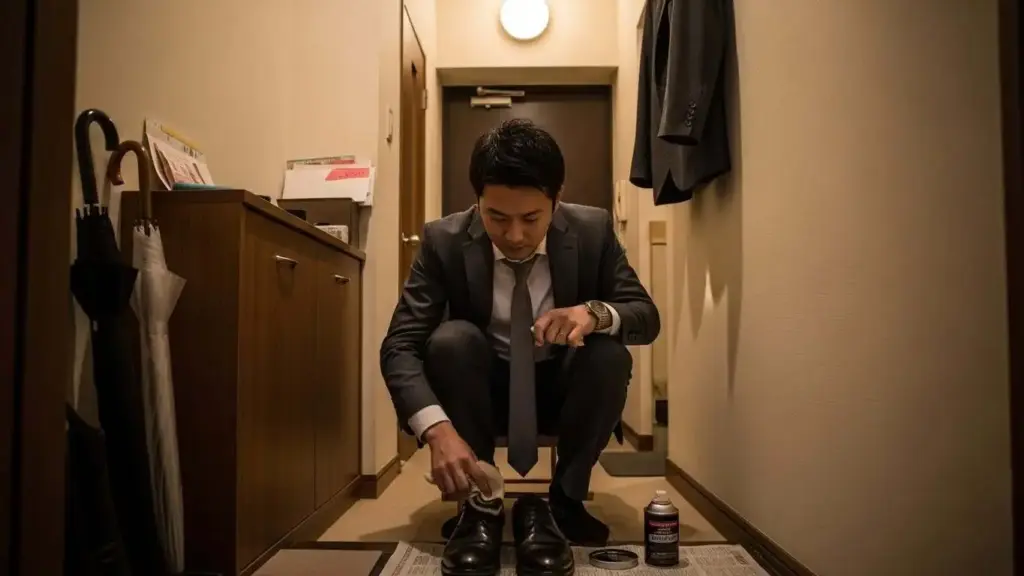
In this first half, the song avoids speaking in feelings and avoids rushing into judgment.
By following what he does, we start to grasp what kind of posture he keeps toward everyday life.
The Core of the Lyrics — Interpretation
A Woman Left as a Vague Memory
In the middle of the song, the “kind woman” does not function as a character who pushes the story forward.
She appears more like a trace—something that passes through the mind without becoming a decision.
“I feel like there was a gentle woman somewhere.”
This is less a clear flashback than a blurred afterimage.
No relationship is defined, no timeline is pinned down, and the protagonist does not try to verify what it “really was.”
That restraint matters: the song refuses to turn memory into drama.

“Even if I can’t give an answer to that feeling…”
Here again, the protagonist is not “working through” emotion as a project.
He does not unpack the memory to find a moral or a lesson; he leaves it where it is—like something placed on a shelf and never labeled.
That distance is one of the song’s signatures.
“Just let the burning memories quietly fade away.”
This line is not a loud declaration of closure.
It suggests a practical stance: feelings are not defeated; they simply lose oxygen inside the flow of daily life.
The song treats that as neither victory nor tragedy—just a way a person survives in the city.
Where His Mind Turns: “Dreams” Without Dependence
Later, the song introduces “dreams,” but not in the usual sense of life-changing ambition.
It sounds more like a small internal mechanism that keeps a person from collapsing—something you can swap out when it stops working.
“A man can overturn at least one dream,
and when he wakes from it, he can dream a new dream again.”
Notice what this does not say.
It does not claim that dreams will save him, or that dreams must be realized for life to matter.
Instead, dreams are treated as replaceable—kept within a scale that doesn’t smash the structure of living.

That is why this track feels “cool” in the strict sense: it does not bargain with life by promising future reward.
It stays with what a person can do today, in the room he returns to, in the city that barely notices him.
The song’s strength comes from that self-contained stability.
“I want to find such a small way of living.”
What he seeks here is not social recognition.
It is not “a big life” validated by others.
If a way of living holds inside one room, inside one day, inside one person—then it counts. That is the landing point.

How the Sound and Vocal Shape the Character
A “City-Night” Groove That Doesn’t Overstate Anything
The performance does not try to steer the listener’s emotions.
Rather than “painting” scenes, the instruments behave like the air in the room—steady, functional, and quietly present.
That restraint is what allows the character to stand on his own.

The tempo neither rushes nor drags.
It moves at something close to a walking pace, so the song feels less like “a story with twists” and more like time continuing as-is.
Instead of chasing a climax, the arrangement protects consistency—the same kind of consistency the protagonist seems to live by.
A Vocal That Refuses to Explain
Shōzō Ise’s vocal also avoids explaining the character’s feelings.
He does not lean on emphatic endings or obvious crescendos to “tell you” what to feel.
The voice stays contained, which fits a person who doesn’t ask to be understood.

As a result, the protagonist doesn’t become “a narrator of his own emotions.”
He becomes a person defined by what he does—returning home, turning on the light, polishing shoes for tomorrow.
The song lets those actions carry the meaning.
What Lingers After the Song Ends
This combination is not built to manufacture tears or grand uplift.
What remains is simpler and harder: the sense that this kind of life can stand, can continue, can hold its shape.
That is exactly why the track feels sharp and stylish without chasing “style.”

Why I Chose It as Best15 No.6
How It Stands Apart Within Kaze
Kaze has many songs that carefully sketch relationships and inner movement.
What makes this one distinct is that it shows feeling while refusing to explain it.
The protagonist doesn’t declare anything, and the music doesn’t hype anything—yet his way of living becomes unmistakable.
That structure is rare even within folk: a portrait built from posture, not confession.
For me, that is where the “coolness” lives—quiet, unsentimental, but solid.
A Final Note
The appeal of this track is not a loud message or a catchy slogan.
It is the discipline of continuing: not showing off, not begging the future for meaning, and still preparing for tomorrow.
That is why it lands as refined. It gives a clear shape to the dignity of an ordinary person living in the city.


音楽ファン同士の交流・リクエストはこちら / Connect & Request Songs Here