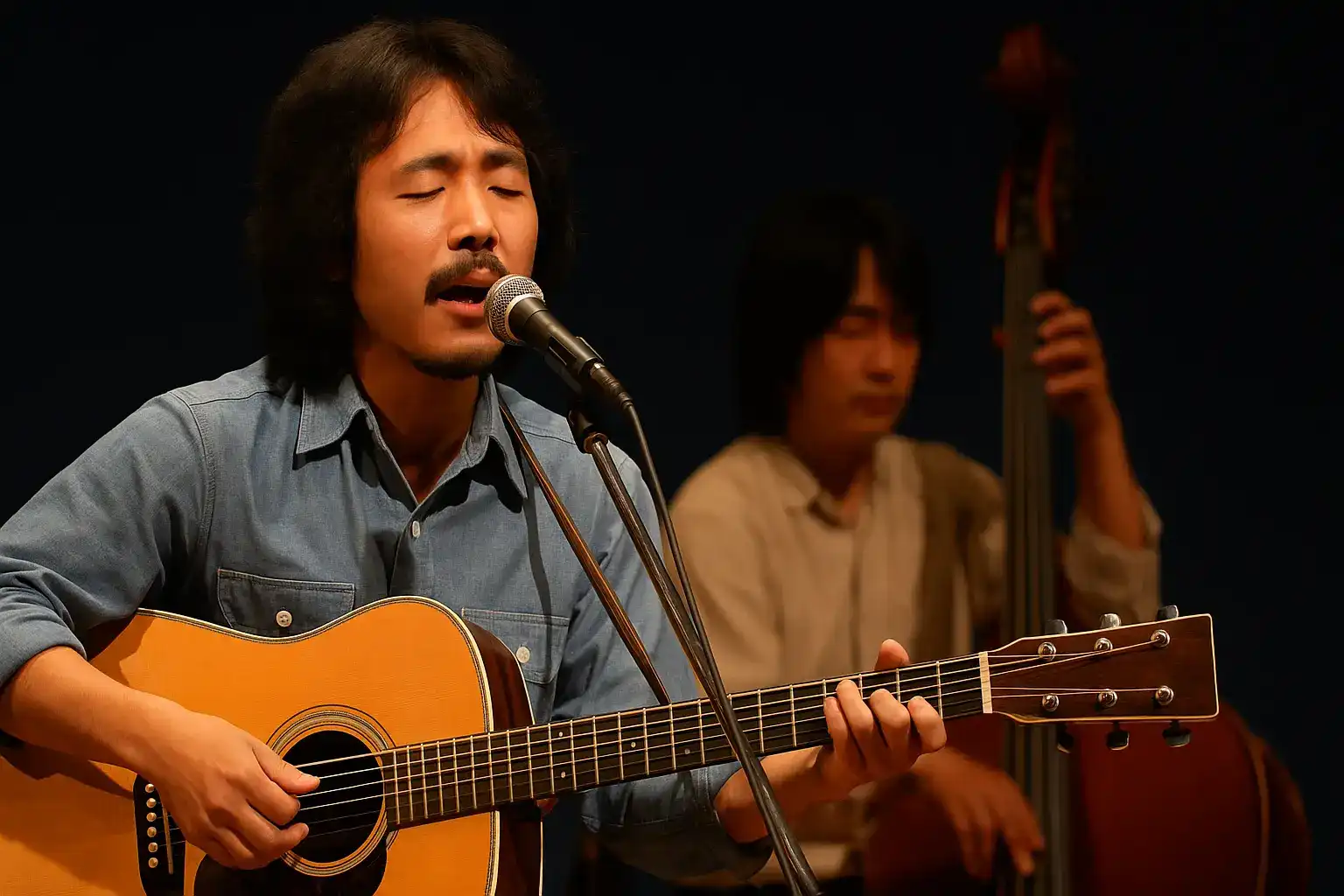
🎧 Enjoy the audio version of “Omae Dake ga” (Listen to this article)
🎶 English Narration
Press play to listen to the English narration of this article.
🎵 Japanese Narration
Press play to listen to the Japanese narration of this article.
Listening first will help you enjoy the depth and atmosphere of “Omae Dake ga” as you read the article.
🎸 Kaze Best 15 – No.7 “Omae Dake ga”
No.7 is “Omae Dake ga.”or “Only You”
Released on the 1975 debut “Kaze First Album”, this song looks in a different direction from many folk songs of the same era that gazed out at society. Instead of themes like travel, loneliness, or farewell, it quietly描き出す intimacy rooted in everyday life. That perspective gives Kaze’s early sound a fresh and distinctive outline.
Super-digest
The protagonist is convinced that no matter how many attractive people appear around him, the person he truly wants to cherish will never change.
He imagines a future with this partner and feels joy in how naturally their time together seems to extend.
Scenes that evoke a family home are scattered throughout, and the central value is continuity of everyday life rather than intense, dramatic romance.
Watch the official video first.
✅ Official Video Credit
Song: Omae Dake ga
Artist: Kaze
Lyrics & Music: Shōzō Ise
Label: PANAM (CROWN group)
Source: 2021 Remaster Official Audio
YouTube: Published on the official PANAM channel (authorized upload)
📝 2-line summary
Originally included on Kaze’s 1975 debut album, this track is one of their key songs that portray a “down-to-earth view of love.”
The 2021 remaster lets us hear the simple, early-days sound of Kaze with even greater clarity.
Basic information about the song
Release / album
“Omae Dake ga” is included on “Kaze First Album,” released on June 5, 1975.
Elec Records’ recording policy was to minimize reverb and studio effects and preserve the feeling of musicians playing right in front of you.
Because of that, the vocal and guitar here are not artificially separated; the air of the studio is captured together with the performance.

This sound is often dismissed with the single word “simple,” but in fact it reflects a recording philosophy that searches for the point where the voice feels most natural and dense. Choosing this approach for their very first album set the tone for Kaze’s entire body of work.
Charts and historical background
There are no single-chart records because it was an album track, but the folk scene of 1975 was going through a major transition. The focus was beginning to move away from strongly messaged songs toward an interest in individual life and relationships.
In that context, “Omae Dake ga” is a song that:
- does not comment on society,
- does not set off on a journey,
- does not sink into loneliness, but instead presents the quietly radical theme of “extending everyday life into the future.”
Within Kaze’s debut album, it occupies a unique position as a song that squarely depicts a private relationship.

Themes and worldview
The protagonist’s point of view
Early in the song there is a short line that goes:
“Even if the most beautiful person in the world told me they loved me.”

This single line symbolizes the gap between external evaluation and the protagonist’s own value standard. He is not guided by how attractive someone appears to others, but by his own inner certainty.
This way of thinking contrasts sharply with the “view of society” often found in folk songs of the time. Rather than looking outward, the song focuses on where the relationship between these two people is headed.
Introduction of the story – the reach of daily life
The “future family” image that appears in the middle of the lyrics is not a flamboyant fantasy. It is描かれている more as a straightforward idea that “the present relationship will simply continue into the future.”
In other words, this song has a structure where the future is not dreamed of as something distant, but is accepted as a “natural extension” of what exists now.
That viewpoint is what gives the song a homely, lived-in warmth even though it is technically a love song. The protagonist does not get swept away by emotion; he is portrayed as someone who quietly chooses and keeps choosing this relationship.
Because of that, the whole piece feels less like the heat of a young romance and more like the steady conviction of two people nurturing a life together.

Core lyrics and interpretation
A hint of the future rising from everyday scenes
One of the most striking aspects of the latter half is that the lyrics move forward as if the future simply starts to appear on its own, rather than being loudly proclaimed.
There is a short but memorable line:
“Morning light is already streaming in.”
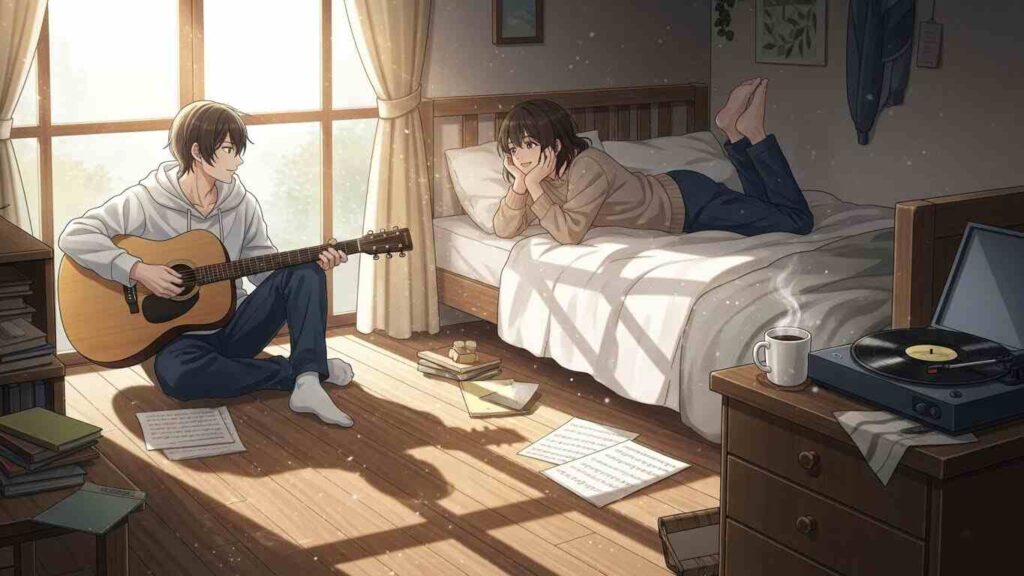
From this single line, we can picture the way light slowly spreads across the room. Nothing dramatic happens, yet the everyday sunlight quietly suggests that their relationship will keep moving forward. For the protagonist, this tiny moment becomes a turning point where feelings begin to lean toward the future.
In another scene, a picture of a future family is mentioned. Instead of grand declarations of hope, the protagonist imagines future life through something as ordinary as a photograph. Warm light entering the room, the photo in their hands, the sound of laughter— through these small images, the conviction grows that “this relationship will continue.”
So the story structure here is not one of dramatic romantic escalation, but of a future seeping out from fragments of everyday life.
Deepening of the protagonist’s feelings
Near the end, the protagonist speaks of:
“The night feels far too short.”
This is more than a simple comment about time. It expresses the feeling that hours spent together always finish sooner than he expects.
Night ends and morning comes. Each time that happens, there is a small shift inside him—a slightly stronger desire than yesterday to protect this relationship.
The most remarkable thing about the psychological描写 in this song is that, even though love is never overstated in words, we sense it growing through the scenes themselves.

By avoiding emotional overstatement and simply placing fragments of daily life in front of us, the song lets listeners imagine how the protagonist’s choice gradually hardens into certainty. This technique—building a story by what is not explicitly stated—is relatively rare even among Ise’s early works and hints at a very mature songwriting sense.
Sound / vocals and how they support the scenes
The “room atmosphere” created by close-miked sound
In the first half we looked at the recording philosophy; now let’s see how it shapes the story itself.
The recording of “Omae Dake ga” has the intimacy of someone speaking in the middle of a small room.
The guitar strokes are even, with hardly any ornamentation, and you can almost hear the air moving in the room.

This closeness of voice and guitar makes the lyrical images— morning light, photographs, nights that end too soon— feel more tangible.
The arrangement itself is restrained, yet the placement of sounds works to increase the density of the story. For a debut album track, this is a surprisingly sophisticated structure.
The “unsaid” power of Shōzō Ise’s voice
Ise’s singing does not rely on big vibrato or powerful belting. Instead, he lets phrases fall gently at the end, leaving a small space where listeners can imagine the emotions behind the words.
This approach fits perfectly with a song full of scene descriptions, allowing us to slip naturally into moments such as:
- the softness of the morning light,
- the quietness of conversation while looking at photographs,
- the lingering feeling when the night ends too soon.

Rather than “acting out” the emotions, he sings as if simply placing the story in front of us. That distance keeps the overall worldview of the song intact and, if anything, makes it deeper.
Why it ranks No.7
A unique position within Kaze’s catalog
The main reason I place “Omae Dake ga” at No.7 is that its portrayal of love is extremely rooted in daily life, and the story rises out of the accumulation of time.
Kaze has many famous songs:
- the dense recollection of “Aitsu,”
- the broad landscapes of “Kitaguni Ressha,”
- the emotional swings of “22-sai no Wakare.”
Amid such strongly dramatic pieces, “Omae Dake ga” stands out as a rare song that avoids exaggerated emotion and carefully描く the theme of “two people simply continuing their everyday life together.”

One perspective that makes you want to listen again
If you are coming back to this song after a while, try listening with the idea that “whenever the future is mentioned, there is always a trace of everyday life in the scene.”
Because the song never exaggerates romance, the moments where the future is evoked feel all the more real. Through this, you can sense the essence of Kaze as a duo— their commitment to placing music inside ordinary daily life.


音楽ファン同士の交流・リクエストはこちら / Connect & Request Songs Here